Saying goodbye to a legendary airport
A great transatlantic fuel stop while it lasted
After years of debate, Greenland’s Narsarsuaq International Airport is set to close in April.

In 2018, Greenland authorities made the decision to close the airport (International Civil Aviation Organization code BGBW) to all but helicopter operations and expand the Qaqortoq heliport 37 nautical miles to the south, to accept airplanes. Work began on a runway and other facilities in 2011. The new airport reportedly will open by early April, ushering in a new chapter in Greenland’s aviation history.
There were other concerns. Since the 1930s, Germany had been interested in seizing a cryolite mine in southern Greenland, the largest in the world at the time. Cryolite, essential in making aluminum, was (and remains) central to aircraft manufacturing. Knowing this helped further boost the United States’ willingness to forge a bond with Britain as well as Denmark.
All this meant that an American air base would be built in southern Greenland. It was a daunting task, what with many narrow, towering fjords and little land between them suitable for runways. Reconnaissance flights discovered one candidate with a comparatively long and wide patch of land at the head of a navigable fjord—near a tiny town called Narsarssuaq. Construction began in July 1941, and it took a year to build a 5,000-foot-long, pierced-steel mat runway; barracks for the troops; a radar station on top of a mountain; and a nondirectional radio beacon on an island (Simiutaq) at the mouth of the correct fjord to guide airplanes to the new air base. A half-sunken freighter mid-fjord was originally another checkpoint, but a few years ago it sank completely. More recently, power lines were strung across the fjord. In any event, once the pilot entered the fjord, he was essentially committed: The fjord’s narrow channel and mountainous walls made a 180-degree turn practically impossible.
The new airport was named Bluie West One, or BW-1. “Bluie” was code for Greenland, “west” indicated it was on the western shore, and “one” meant it was the most southern of the airports and harbors. By October 1941, Bluie West Eight was built some 250 nm north. Later, BW-8 was renamed Sondre Stromfjord Air Base, then Sondrestrom Air Base, and eventually today’s Kangerlussuaq Airport.
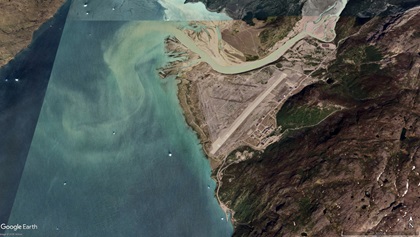
BW-1 was busy during World War II. Some 4,000 troops were stationed there, and Boeing B–17 and B–25 bombers, Lockheed P–38s, Consolidated PBY Catalinas, and many other military airplanes operated out of the airport. In 1943 an Army hospital was built. Estimates are that 10,000 or so airplanes flew the North Atlantic using BW-1 as a fuel stop. Some bombers, like B–17s and B–24s, could make a nonstop crossing only with strong tailwinds. Most of the bombers wound up becoming the 97th Bombardment Group (Heavy) based at the Prestwick Airport in Scotland.
BW-1 has lived on as a civilian airport after the war under the BGBW identifier, and has a new spelling of its name—Narsarsuaq instead of the former Narsarssuaq (not that it makes any difference when it comes to pronunciation). A new, paved 6,000-foot runway, 6/24, replaced the Army’s shorter, north-south runway that hugged the coastline.
It continued to serve as a commercial airport for Air Greenland—and as a fuel stop for general aviation airplanes making North Atlantic crossings. Its location—about midway between the Reykjavik and Goose Bay, Newfoundland, airports—makes it ideal for piston singles and twins with ferry tanks and comfortable endurances in the four- to seven-hour time frame.
Through the years Narsarsuaq earned a reputation for being a risky place—especially if the weather was bad. Which was often the case. Low ceilings, high terrain, 1,800-foot minimums, high winds, a final approach fix 9 nm from the runway, a missed approach point 3 nm from the threshold, and a missed approach procedure with tight turns near mountains made pilots think twice about landing there. And that’s not all. The airport’s closed at night and on holidays, you’re fined if you land on a Sunday, landing fees are $53, handling fees are $172, METARs are only issued when the tower is operating, and for a long time there were no terminal aerodrome forecasts. As for alternates there’s Kangerlussuaq (BGSF) because the weather’s usually better, and it has a 9,000-foot-long runway flanked by friendlier terrain. But it can be stressful to fly that 250-nm leg if you’re low on fuel.
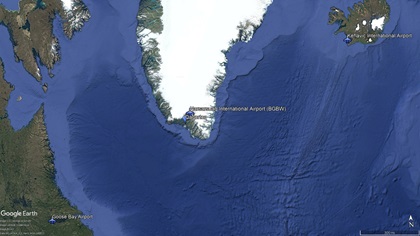
Knowing all this, in 2018 Greenland announced a decision to close Narsarsuaqto airplanes, turn it into a heliport, and open operations at the Qaqortoq Airport—BGJH—about 37 nm to the south. (In another tongue-twister, it’s pronounced Ka-Kor-Tawk). It will have a 4,900-foot-long runway—Runway 11/29—which is some 1,000 feet shorter than BGBW’s. GPS approaches to both runways should come first, followed by ILS approaches to both. High terrain surrounds the airport, but nothing like the 3,000-footers wrapping around BGBW. Even so, Runway 29 will have a steeper glideslope angle to avoid ground proximity alerts.
The advertised April opening may well slip into May, but either way an era will end. Those who’ve flown in and out of BGBW will have yarns aplenty. They’ll enrich an already storied past as yet another steppingstone to Allied victory, and a rite of passage for many a ferry pilot.
Find out more about Narsarsuaq and read a story about a trans-Atlantic crossing by the author.