Next stop, Hawaii
Intrepid pilots and their trimotor in an unlikely journey

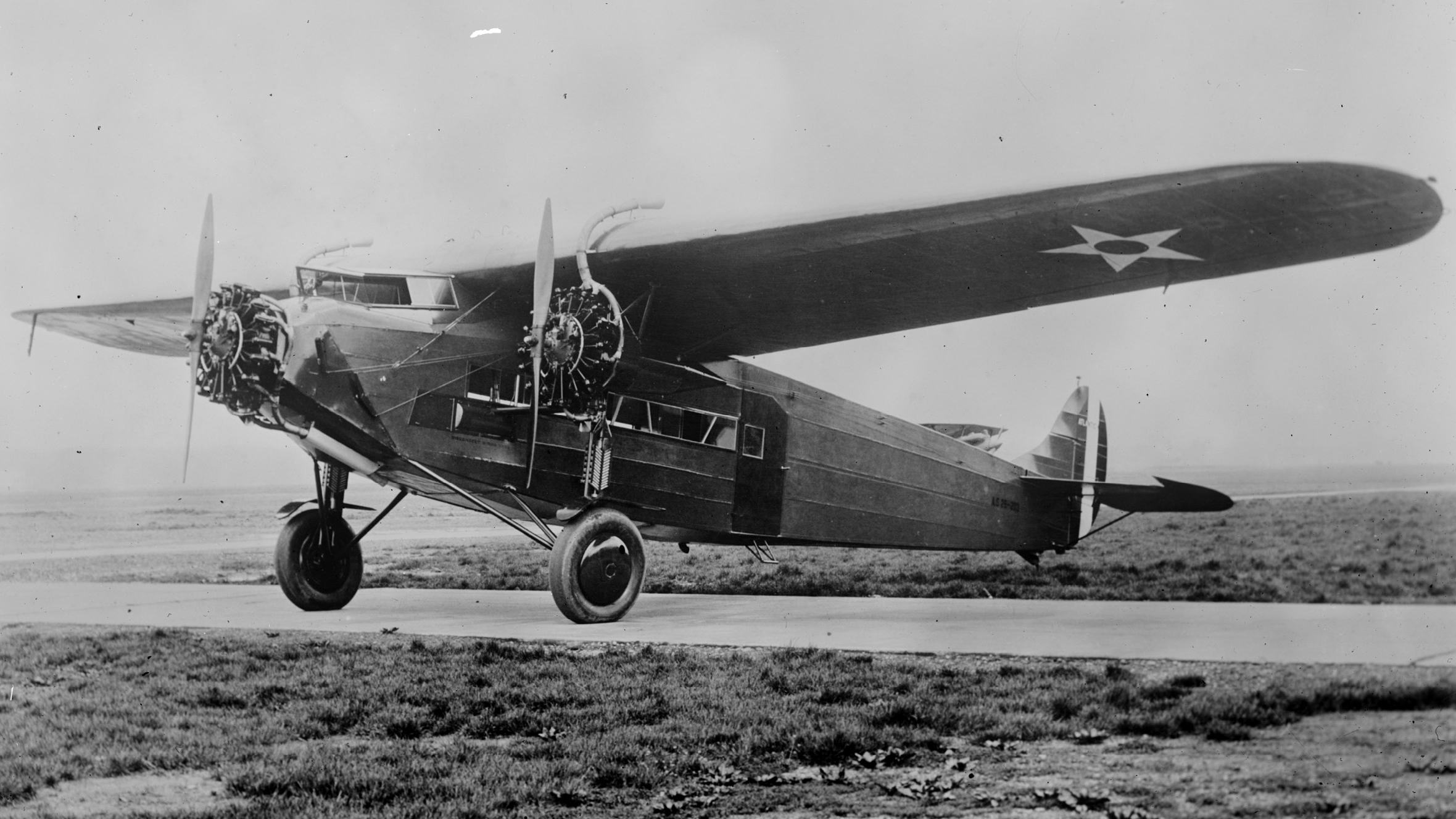
That’s what it took to achieve the first nonstop flight between California and Hawaii. The flight had been in the works for years by the U.S. Army Air Corps, but on June 28, 1927, 1st Lt. Lester J. Maitland and 1st Lt. Albert F. Hegenberger hopped in the trimotor Bird of Paradise to attempt a journey none had made before.
Both were distinguished aviators. Maitland, a Milwaukee, Wisconsin, native, earned his wings at the age of 19 and had set a short-lived world speed record in a Curtis R–6—the record was disqualified for failing to maintain level flight. Hegenberger of Boston, Massachusetts, was studying civil engineering at the Massachusetts Institute of Technology before entering military service in the Aviation Section during World War I.
The flight was one of the longest open water crossings of its time and a testament to the navigational advancements of the era. The first Atlantic crossings surely required fine navigational aptitude, but Hawaii was a needle in a haystack relative to the large European landmass. That is why the flight was taken from California to Hawaii; a flight in the opposite direction would not have proven navigational aptitude in the same manner.
The aircraft was loaded up with minimal food and water, saving as much room for fuel as possible. The heavily modded C–2 was loaded up with a whopping 1,134 gallons of fuel, bringing the airplane’s takeoff weight to around 14,000 pounds. The trimotor departed the California mainland in the early morning of June 28, with a purported ground roll of 4,600 feet.

The two pilots would later be quoted as saying the only mishap of their flight was misplacing the coffee thermos, although that doesn’t quite give credit to the incredible challenges they faced.
The aircraft was equipped with a radio compass and a directional radio receiver. The compass failed shortly after takeoff, and the two pilots relied primarily on dead reckoning, using a sextant and solar and celestial observations to pick their way through the Pacific. When they climbed above 10,000 feet to get over the clouds for navigation, one of the airplane’s three engines sputtered and failed. Maitland correctly identified the problem as carburetor icing (some things never change), descended to 4,000 feet to get warmer air to melt the ice, and, windmilling in the slipstream, the engine started again.
The aviators spotted the Kauai lighthouse on time, around 3 a.m. on June 29. Not wanting to land in the dark, the airplane circled for three hours before finally touching down at 6:29 a.m. on the grass at Wheeler Army Airfield (HHI) which is still around today. The men were greeted by a crowd of people. Two infantry battalions were posted around the base to control the crowds, and the duo enjoyed lush Hawaiian banquets and celebrations during their time on the island.
Both aviators received the Distinguished Flying Cross from the Air Corps and the Mackay Trophy—awarded for the “most meritorious flight of the year” by a member of the Air Force. The pair then underwent a nationwide tour in a C–2 sister ship of the Bird of Paradise, receiving commendations, celebrations, and awards. Hegenberger was welcomed back by tens of thousands of people in front of his South Boston home, according to The New York Times.
Milwaukee also welcomed back Maitland with a celebration so large that The New York Times reported at the time that “never in the history of the city has there been such a tremendous demonstration,” and estimated the crowd at the Wisconsin Avenue parade at 200,000 people.
The Bird of Paradise would never make a powered return journey to the mainland. It was stationed in Hawaii, continuing to fly for the Army Air Corps. In the late 1930s, it was shipped to Wright Field in Ohio (now the Wright-Patterson Air Force Base). Despite initial plans for its display, the aircraft was scrapped during World War II. Some artifacts of the aircraft remain in the National Museum of the United States Air Force’s collection today. 

Related Articles


