The Skylark's moment has arrived
A blank canvas for modifications
Flight schools didn’t want 175s because 172s were less expensive to buy and operate. Individual owners were wary of 175s because they were heavier, less fuel efficient, and didn’t hold their value.
Way back in 1972, Flying magazine pointed out that GO-300 engines on 175s were known for warped valves, broken rings, scored cylinders, cracked pistons, and the six-cylinder engines seldom reached the already low bar of 1,000 flight hours before overhaul. Much of the fault was attributed to operator error, but the reputational damage was done—and that black mark has endured.
In the post-COVID years, skyrocketing demand for 172s and 182s has caused their values to surge, and the rising popularity of adventure flying has dramatically increased the popularity and prices of 170s, 180s, and 185s. Yet the 175 remains largely overlooked.
But these underappreciated airplanes may finally get their big moment.
Several firms have developed supplemental type certificates (STCs) to replace unwanted and increasingly rare GO-300 engines with Lycoming O-360s, IO-360s, and IO-390s, as well as Continental IO-370s and O-470s. Tailwheel conversions are also available via STC, as are constant-speed propellers, STOL kits, extended baggage compartments, and shock absorbers for rough fields.
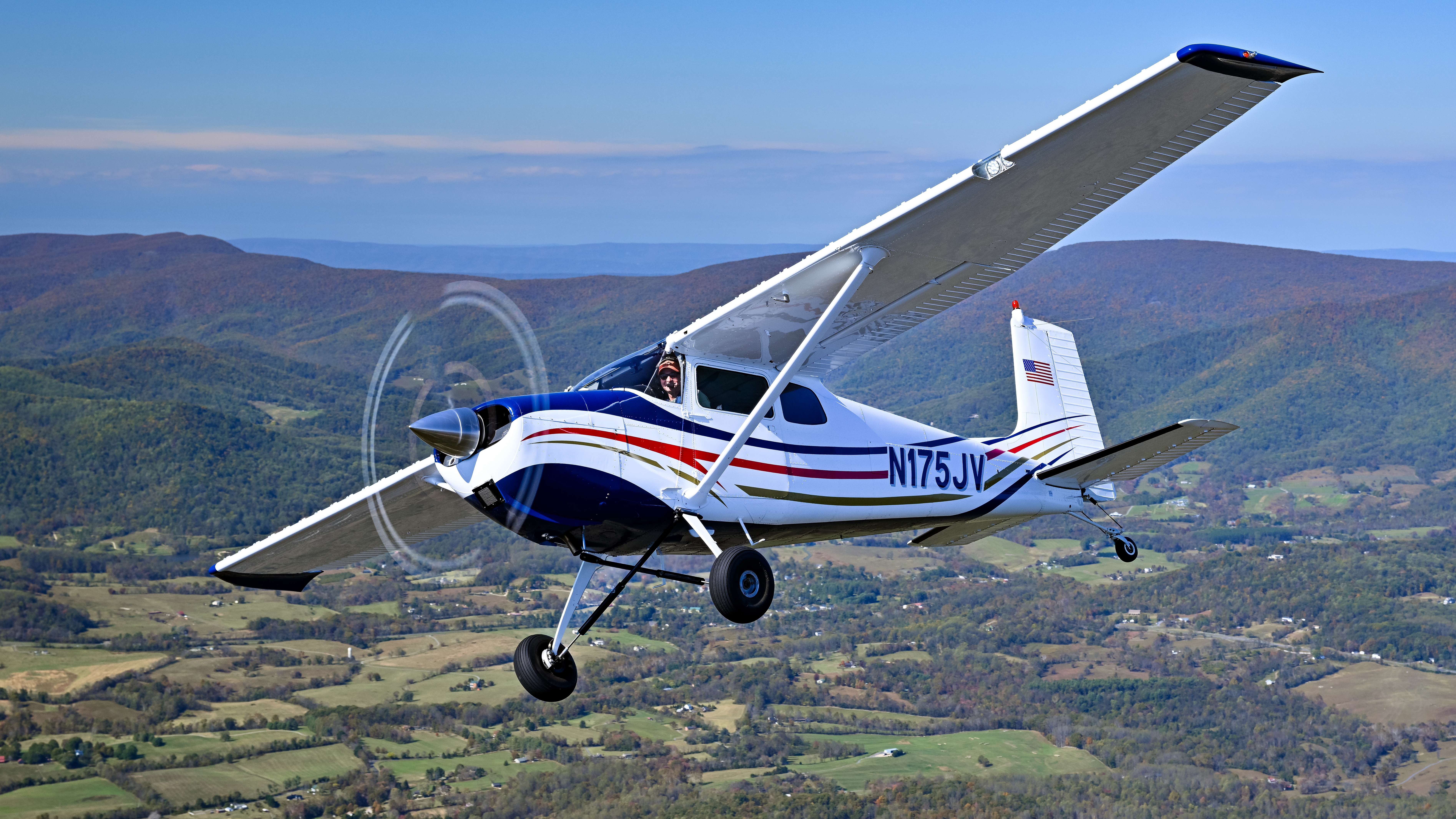
Dean “Demo” Castillo, a resident of the Berryvale flying community near Culpeper, about 50 miles southwest of Washington, D.C., recently acquired a highly modified 1959 model with a long list of modifications, including Stoots IO-390 engine and tailwheel conversions, STOL wing cuffs, and Cessna 180 gear legs.


Castillo—the Virginia liaison for the Recreational Aviation Foundation (RAF), a former U.S. Navy fighter pilot, and current airline pilot—wanted to make his airplane the “ultimate backcountry 175” to advance the volunteer organization’s mission to preserve, improve, and expand mostly turf airstrips around the country. He added a Hartzell Trailblazer prop, ACME Aero shock absorbers, Atlee Dodge jump seats, and bigger tires.
Castillo said he was wary, however, because the airplane had twice been damaged in landing mishaps.
“I’d never flown a 175 before,” he said. “All these mods and the airplane’s recent history made me wonder whether something was fundamentally wrong with it.”
Castillo checked its weight and balance and rigging, measured the control surface deflection, read the logbooks, inspected the repairs, and then went flying.
“The airplane’s an absolute joy,” he said. “It’s got great energy thanks to its engine/prop combination, and its ground handling feels pretty standard for a tailwheel, really.”
The 210-horsepower Lycoming IO-390 engine is heavier and more powerful than the original, but the lighter EarthX battery and composite Trailblazer prop partially offset the weight difference.
Standard 175s hold 52 gallons of fuel, and this one has an optional 18-gallon auxiliary tank in the rear fuselage for a total of 70 gallons.
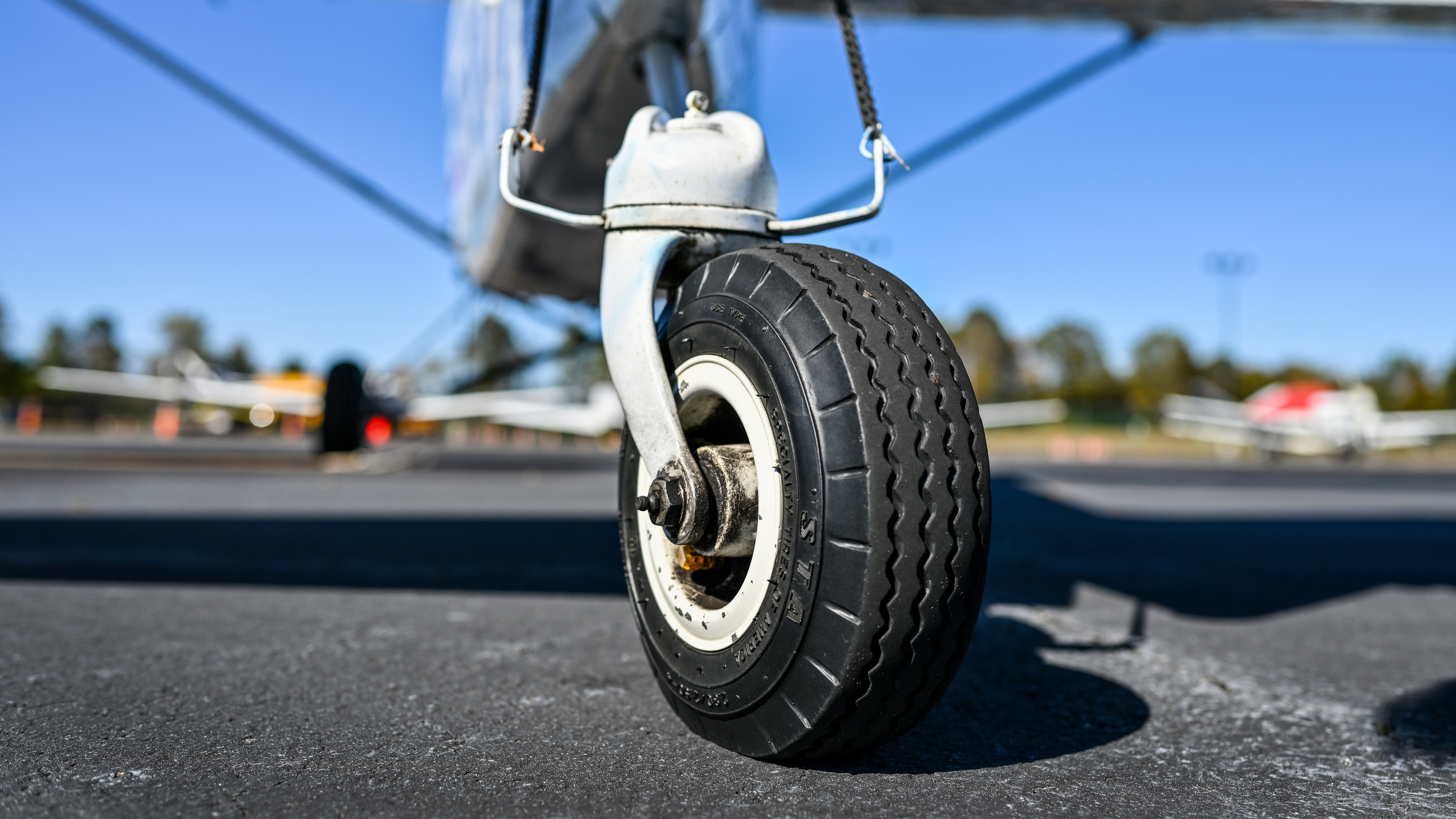
For rough fields, Castillo has a bolt-on Acme Aero Cessna Damper that braces the main landing gear and makes them less springy. Those braces are draggy, however, and reduce the airplane’s 130-knot cruise speed to the low 120s, so Castillo removes them for long trips. But he leaves them on just about all the time when the airplane is at home.
“They just eat up any bounce,” he said. “I really enjoy them.”

Sweaty palms
The tree-lined, 2,300-foot, turf runway at Berryvale Airport (VA30) is an ideal location for a demonstration flight, and conditions are CAVU with a gusty 10-knot crosswind.
The sight picture from the left seat is standard Cessna single, and anyone who’s flown a 172, 182, 180, or 185 would feel right at home in the 175. The knobs and switches are right where a Cessna pilot expects to find them, and the engine start sequence is standard for a fuel-injected engine.
With two adults in the front seats, 40 gallons of fuel in the wing tanks, and 20 pounds of ballast in the rear, the tailwheel seems unusually light and highly responsive as I make broad S-turns while taxiing to the departure end of the 100-foot-wide grass Runway 20.
With the runup and pretakeoff checklist complete, I add two notches of flaps, align the airplane with the runway, and apply full power.
“Keep the elevator neutral and the tail will come up on its own,” Castillo says. “As soon as the tailwheel comes off the ground, the airplane is ready to fly, and you can apply back-pressure.”
The 175 doesn’t have rudder trim, and I’m expecting a strong left-turning tendency as the oversized engine and prop reach their full crescendo. But unlike a Cessna 180 or 185 which can require a massive and sustained right rudder during the takeoff roll, the 175 only needs modest right rudder pressure as it accelerates briskly and tracks straight ahead.
We’re off the ground and climbing after an eight-second ground roll, and I raise the manual flaps once we’re clear of the tree line. I ask Castillo whether the right crosswind has counteracted the airplane’s left-turning tendencies.
“There’s really not a whole lot there to counter,” he says. “The airplane is generally very well behaved on the takeoff roll. It just accelerates straight ahead.”
With flaps up, we climb at a 15-degree pitch attitude and an 80-knot indicated airspeed, and the vertical speed indicator shows a 1,200-foot-per-minute climb. In cruise, the most notable feature is the buttery smooth engine/prop combination. In high cruise at 2,500 rpm or low cruise at 2,200 rpm, the composite, Hartzell Trailblazer prop, and IO-390 are silky.
Slow flight holds a few surprises. The airplane is easy to control with flaps up or down, and the ailerons are effective even at low airspeeds and high angles of attack. Precise airspeed control at low speed is complicated by the fact that the airspeed indicator tends to read zero at high angles of attack.
He appreciates the model's ability to shapeshift. It’s a blank canvas.
Castillo credits vortex generators for the airplane’s authoritative slow-speed roll control and stubborn refusal to stall in a wings-level attitude at idle power.
We configure the airplane for landing, and Castillo notes the airplane’s one “gotcha” characteristic. At a normal approach speed of 60 knots, flaps at 30 degrees, and a low power setting of 12 inches of manifold pressure, the airplane descends at a very manageable rate of 500 feet per minute. The instant the pilot pulls the power to idle, however, the nose drops about 5 degrees while the rate of descent increases dramatically.
“This is why I recommend carrying a small amount of power all the way to touchdown,” he said. “It needs that little bit of extra airflow over the elevator in the flare.”
During several visual approaches and landings at various flap settings, the 175 was lighter on the controls and more responsive than a 180, 182, or 185.
“Flying a Cessna 180 or 185 on a crosswindy day like this would be challenging,” Castillo said. “That would give me some sweaty palms. But there’s just no drama in the 175. The airplane just does what you ask it to do.”


Quizzical looks
The unprecedented surge in aircraft values during the last six years leaves very few bargains among the legacy aircraft fleet—especially big Cessna singles.
Cessna 180s, 182s, and 185s have been leading that rapid rise while the 175 has remained something of a sleeper. But now, that appears to be changing.
A stock 175—especially a neglected one—is sure to require a great deal of specialized work to get up to code. A new engine and prop, a tailwheel conversion, and perhaps a new interior, panel, and paint could all be part of the upgrade package.
Castillo said he appreciates the model’s ability to shapeshift.
“It’s a blank canvas,” he said. “With all the STCs out there, you can make a 175 into the airplane you want it to be.”
The retail price for a full menu of Cessna 175 upgrades is likely to go deep into six figures. But even then, a 175 is likely to offer similar performance at a far lower price than its more popular brethren.
Even among veteran pilots, Castillo says his 175 is frequently misidentified.
“It gets lots of quizzical looks on the ramp,” he says.
That’s understandable because this particular airplane has undergone so many modifications. But more 175s are sure to follow its path because the economics are so compelling.
“I didn’t think it was possible to find a backcountry airplane that does all the things I want to do and still be a good value,” Castillo said. “That’s why I’m secretly glad the 175 has been forgotten for so long.” 

Related Articles


