Glass at last
Upgrading a vintage Skyhawk
By BJ Spratt
After flying for more than 20,000 hours over the past 35 years, I finally found myself in a position to pursue my dream of owning an aircraft. After months of searching and two failed prebuys, I purchased a low-time 1973 Cessna 172M Skyhawk with outdated avionics. My priority was to make the aircraft as safe as possible. To that end, I immediately set out to install a glass cockpit.
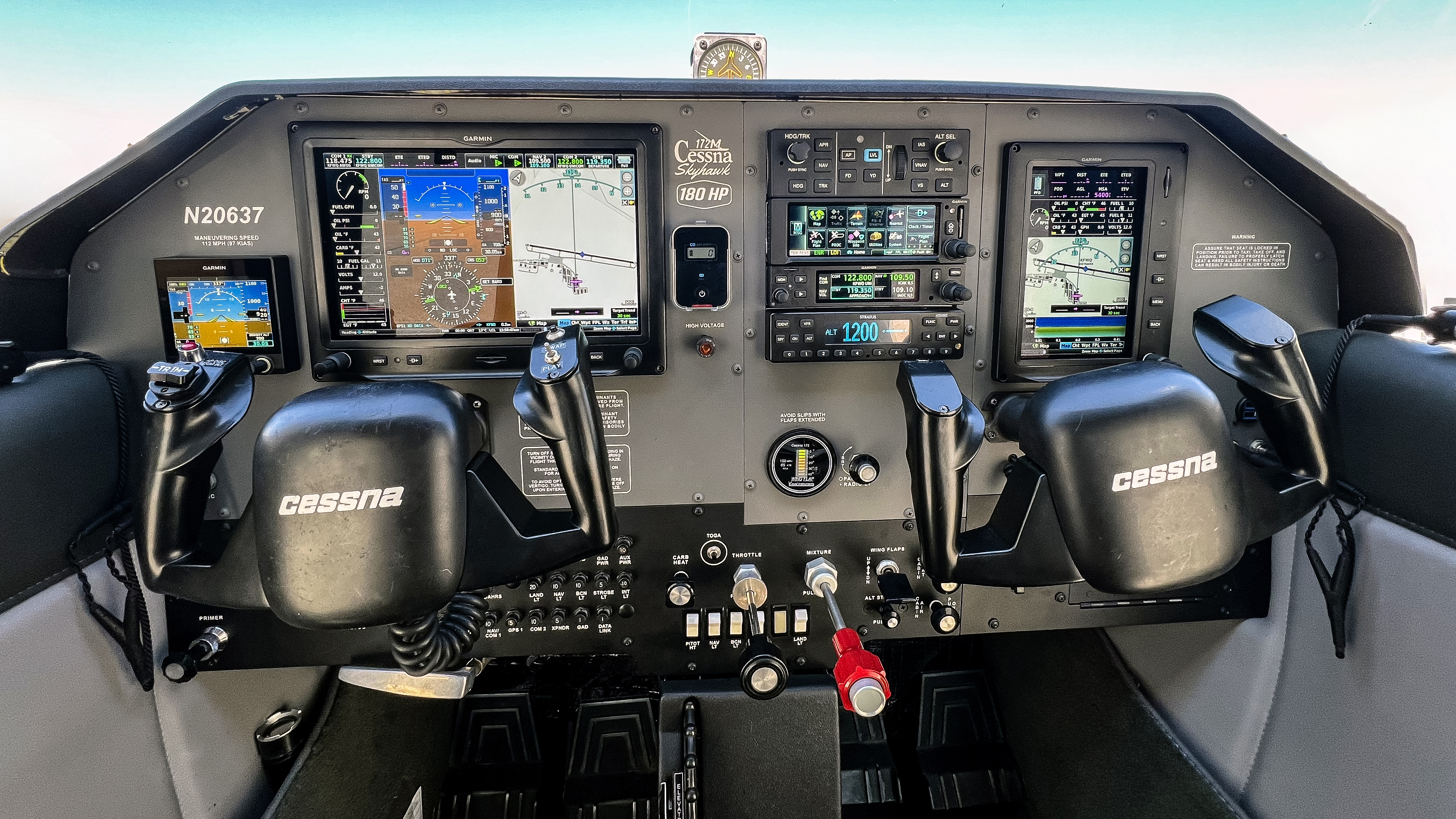
After extensive research, I narrowed my choices to the Dynon SkyView HDX and the Garmin G3X Touch. Both offer advanced features not found in most current transport category aircraft. Individual retrofit glass instruments, like the capable Garmin G5, are a viable option and a clear upgrade to any original GA panel. However, the large-screen systems provide the element that I find most essential: enhanced situational awareness.
The three main considerations in any large-scale glass upgrade are choice of installer, brand, and total cost. The decision can quickly become complex. For example, a local shop may charge significantly more, cannot begin the work for eight months, or may be only certified for one brand. I reached out to every Garmin and Dynon shop within a four-hour flying radius and ultimately chose a local Garmin-certified installer. The estimate was $5,000 higher than those from other shops. However, I wanted to watch the progress firsthand and knew I would have to bring the aircraft back for adjustments after delivery. In fact, I have flown my aircraft back (a 15-minute flight) for corrections twice, and the installer has traveled to my hangar for service. This would have been quite a burden if the shop was three hours away.
The Garmin equipment is costlier. The 10.6-inch G3X Touch display I chose as the centerpiece for my installation was $11,895, compared to $5,624 for the 12-inch Dynon SV-HDX1100. However, it is important to consider long-term valuation. My finance company explained that 85 percent of the Garmin equipment cost and only 50 percent of the Dynon costs would be added to my aircraft valuation. In my upgrade, the Garmin equipment cost about $10,000 more. The net result was $8,500 more in aircraft valuation, narrowing the cost gap. A large-screen glass upgrade will exceed $50,000 including a GPS and autopilot. Therefore, it is imperative to evaluate and balance brand, location, installation date, and price. I was advised by experienced owners, and I am now certain, that the most important factor is choosing the correct installer. Cautionary tales have been related to me by numerous individuals who have experienced serious airworthiness issues following inept installations. It is prudent to speak with current and prior customers of any avionics shop in consideration.
Confident in my choice of installer, we met to discuss my dream panel. This is the point when the owner realizes the project is going to cost more than a luxury car. With two touch panels, autopilot, nav/com, WAAS GPS, audio panel, and engine monitoring, my quote was $60,000. Once the sticker shock faded, I convinced myself that the safety benefits outweighed the price. After all, I am teaching my youngest son to fly this aircraft, and my wife and other children will be frequent passengers.
Deposit paid, the modern panel was taking shape. However, in the early stages of the installation, the project became sidetracked, leading to months of frustration. To the dismay of myself and the avionics shop, we learned that I was facing the same dilemma as thousands of other Cessna owners. Unbeknownst to most owners and many experienced avionics shops, nearly 15,000 pre-1976 Skyhawk models were equipped with the dreaded “stationary panel.” In basic terms, the limited space between the yoke and the top of the panel does not provide sufficient real estate for these modern displays. In late 1975, beginning with serial number 17265685, Cessna lowered the yoke 1.5 inches. In these models, modern 10-inch glass displays can be displayed without modifying the structural stationary panel. For the thousands of Skyhawks produced before the modification, a modern panel upgrade provides a substantial challenge.
The experienced installer I selected began with several creative design attempts. After 15 CAD diagram revisions and two failed acrylic templates, it became obvious the install could not proceed without cutting into the panel. Unfortunately for owners and installers, the panel is a structural component of the aircraft; it’s attached to the forward fuselage bulkhead and the engine mount stringers. Beyond the primary purpose of keeping the avionics firmly in place, the stationary panel also provides lateral structural and forward landing load support. To proceed, a designated engineering representative (DER) must provide a detailed report. Extensive in-house fabrication is also required, along with an airframe-specific supplemental type certificate. The FAA designates this process as a major repair or alteration, further complicating the installation. The installation suddenly became more complex and costlier.
After months of anguish, the installer finally found a solution. However, the time, labor costs, skill level required, and the extensive approval process proved to be a considerable barrier. In addition, I was not excited about being a test pilot by choosing this one-off solution. During an internet search, I finally stumbled upon a resolution to the dilemma. Six Pack Aero, based in Bellingham, Washington, has developed an innovative STC panel to address this increasingly common predicament. Their product replaces the original panel with an FAA-approved, redesigned stationary panel. Structural integrity is maintained by using the original mounting points. The new design provides additional space to comfortably accommodate the larger displays of the Dynon SkyView HDX, Garmin G3X Touch, and a host of other glass options.
I reached out to Six Pack Aero and found that owner Lyle Jansma was familiar with my plight. Jansma began developing the panel in 2018, after continually encountering owners with the same dilemma I was facing. He was concerned that many of these owners were unknowingly making detrimental changes to their aircraft’s structure to accommodate the larger panels. By making non-approved modifications to the panel, many of these owners had forfeited their aircraft’s airworthiness. The Six Pack Aero STC panel is unique in that it is approved by the FAA, accommodates the glass upgrades, and actually increases structural integrity.
Jansma took an inventory of my equipment and produced a custom design for my review the following day. One week later, my laser-engraved custom panel was delivered to the avionics shop. The shop had been apprehensive when I suggested the Six Pack Aero panel. Their concerns were alleviated when Jansma sent an incredibly detailed installation guide, complete with diagrams and pictures thoroughly describing each step. My installer described the installation as simple and straightforward. The shop only made one brief call to Jansma throughout the entire installation. No special tools or training are required. The STC panel added $3,000 to my project, although the current cost of the panel has since risen to nearly $8,000. Even at a higher price, the cost is potentially offset by the panel’s modular design. Future panel upgrades will not require a new costly single-piece overlay panel. Only the specific panel will need to be modified. In addition, the Six Pack Aero panel has become so well respected that the aircraft valuation service Vref gives the owner dollar-for-dollar credit for the panel cost and installation. In addition, the reaction to the panel has been amazing. Everyone who has seen the panel agrees that it looks as good or better than any brand-new GA panel.
With the stationary panel dragon now slayed, the project proceeded rapidly. Once I began to fly the aircraft, I was certain that I had made the correct choice. I could have created a very capable IFR aircraft and saved $20,000 by adding two Garmin G5s or an Aspen display. Ultimately, though, the additional safety features and resale value justified the additional cost.
In a perfect world, I would have purchased an aircraft with my desired avionics. During my six months of daily prepurchase searching, I found only one aircraft comparable to my current aircraft. It had a full two-screen Dynon system, with a firm price of $254,000. I flew 1,000 miles to conduct a prebuy, but it was derailed by mechanical concerns. There are countless other factors to valuation. However, I now have a far more capable aircraft for $50,000 less.
Considering the premium being paid for late-model Skyhawks, more individuals and flight schools are choosing to purchase vintage airframes with the intention of replacing the antiquated steam gauges. While there are challenges and limitations, I can attest that viable options remain. 
BJ Spratt is a Boeing 767 captain for a major U.S. airline. He has multiple type ratings, including for the McDonnell Douglas DC–9, MD–11, and Airbus A320.


