Whale masters
Flying marine mammal surveys in a Cessna 337
After what can be hours of anticipation for pilots Donn Heikkila and Alice Paul, few feelings beat the moment of spotting a whale.
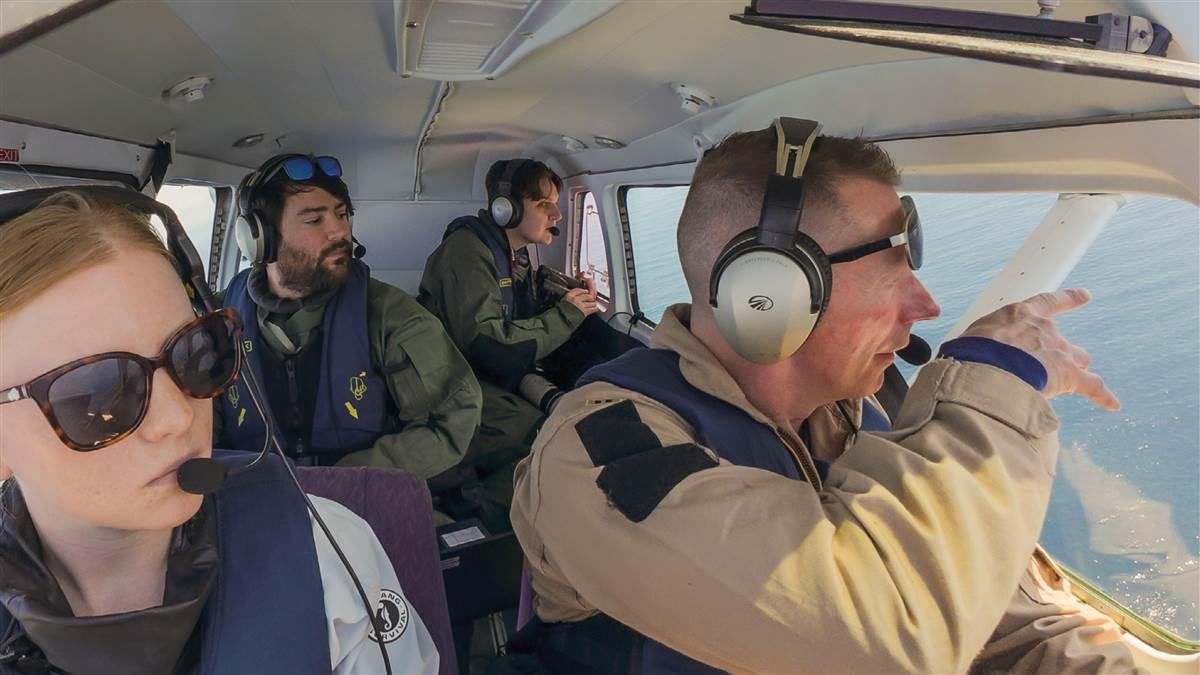
A team of pilots and researchers is embodying the meaning of guardian angels. For as long as there is right whale activity to note, a two-pilot team loads two observers into the back of a Cessna 337 Skymaster and heads out over the open Atlantic Ocean with a single goal: being whales’ protective eye in the sky.
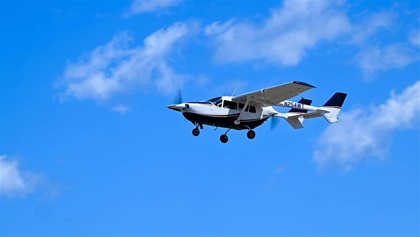
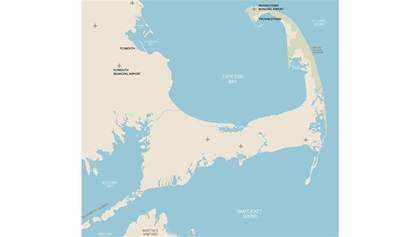
Specifically, the team of observers from the Center for Coastal Studies (CCC) set out to document the amount, activity, and other details of the North Atlantic right whale population—a critically endangered whale species with total population numbers in the hundreds. Survey flights happen when the whales make their home in Cape Cod Bay and the surrounding waters—from early winter till around mid-May. The Skymaster departs Plymouth Municipal Airport (PYM) to pick up their two observers at Provincetown Municipal Airport (PVC), then heads out over open waters.
It’s not just a short flight over water to see if there are whales and return home. It’s long hours of constant scanning of the water for any kind of disturbance or sign of activity.
“The missions range from, the shortest one we have is probably a little under four hours, but depending on what we see, it could be anywhere up to, and we typically don’t like to exceed, 10 hours,” said Donn Heikkila, a pilot for Nimbus Aerial Solutions, which operates the Skymaster aerial surveys.

With the Skymaster leaned out to a meager 15 gallons per hour for both engines to maintain the 100 knots required by observers for the survey, that usually means a day consists of up to two five-hour legs, with time for a much-needed break in between. Any faster than 100 knots risks missing critical details on the ocean surface. Combining the long duty days with the constant need to be scanning and spotting, two pilots crew the Skymaster for the missions.
Heikkila and fellow pilot Alice Paul operated the missions while AOPA visited and collectively have several seasons of whale survey flying under their belts. In the back of the airplane were CCC researchers and observers Jess McCoppin and Ryan Schosberg. With the amount of time the crew spends together in and out of the Skymaster, they build a sense of camaraderie.
“The people in the back aren’t just strange faces, it’s friends,” said Paul.
The pilots, who knew little about whales before flying the mission, learn a lot more about marine life, and the animal’s unique behaviors. The observers, mostly inexperienced in small GA aircraft, learn a lot more about flying and operating an aircraft. Both the scientists and pilots said they continue to learn about their counterparts’ jobs every week.
“It was a steep learning curve for me…. I heard some terminology…that I never obviously knew,” said Heikkila. “Now I’m conversational in whale talk.”
“They’re always happy to teach us some of the basics of aviation,” said Schosberg. “What they’re working with on their side.”
Suddenly showtime
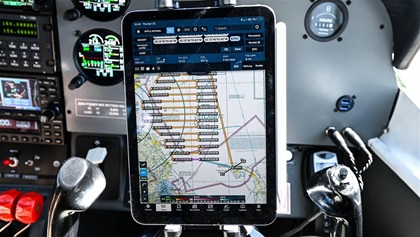
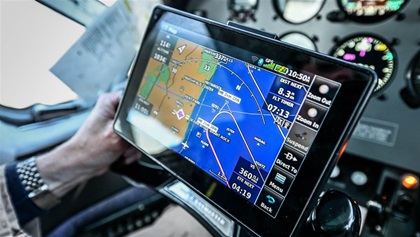
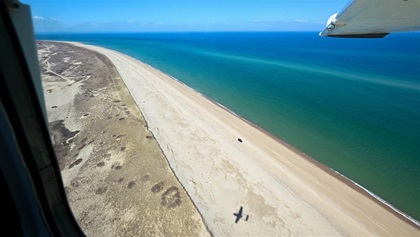
The pilots’ jobs appear relatively simple. After picking up their observers, they’ll embark on mutually agreed track lines over the Atlantic Ocean. The Skymaster is equipped with an autopilot, and it’ll follow the track lines diligently at 1,000 feet, giving observers a good observation range while not being too high to lose observability straight below, with the biggest requirement of the pilots being to keep speeds around 100 knots. Sometimes “hours of nothing,” said Paul. Until finally, it’s time for action.
“Sometimes you’re like, ‘I see a little bit of funny water,…can we just go investigate that?’” said Schosberg. “And then it’s actually like 20 whales feeding…that you wouldn’t have even known.”
“Any time a scientist sees a water disturbance…we’ll break from our track line, and we’ll start making circles around whatever disturbance it is,” said Paul. “Any time we’re circling a whale, I’m manually holding those controls and making the plane do that maneuver.”
Meanwhile in the back, the observers will kick into gear. One, in the far left back seat, will pop open the window and begin photographing the marine life. The other observer, a couple feet more forward in the back right seat, operates a computer and logs the animal, its behavior, and will identify it, if possible. That sudden excitement after sometimes hours of straight track-lines provides a rewarding feeling to the crew that keeps them coming back.
“You could just be staring off in the distance, and then this little steam of air and sea gets blown up, and it’s a massive creature,” said Paul. “The most massive creatures on the planet, just existing.”
All marine activity is logged, from potential whale food sources to humpback whales or other species they observe from the aircraft, and that data is shared with other researchers and organizations who use that data to their benefit. It could be a couple of orbits for a non-whale or other marine activity, but if it’s a right whale, the observers take a particular interest.
And it’s no simple task. Hand-flying steep turns for extended periods of time is demanding, both pilots said. It’s not unusual to orbit for tens of minutes around particular areas of interest, and it takes a lot of stick and rudder skills to execute the maneuvers with the precision required.
A whale of a task
Right whales are not tagged. Instead, the whales have unique “callosities”—calloused skin that rises up on their heads—that are inhabited by white whale lice. The contrast between the white and black creates a unique pattern, almost like a fingerprint, that the researchers can use to identify whales. Sometimes, the whales’ identities are even obvious from 1,000 feet. Other marks, like scars from being struck by boat propellers or fishing gear, also help identify the whales. Although the scientists will record any other kind of whale they come across, right whales are of particular interest because of the species’ conservation status.
“North Atlantic right whales are one of the most critically endangered marine mammals,” said McCoppin. “By surveying them we can have the best data to make the best decisions.”
With the unique patterns, all the whales get assigned not only identification numbers, but also names.
“With a population under 400 you really get to know each and every whale you see pretty intimately,” said McCoppin.
And of course, there are favorites. This season, at least, McCoppin’s favorite right whale is called Padiddle after a scar on its front-left side, named after the night-driving car game where players compete to spot vehicles with a burned-out headlight. Schosberg’s favorite is Cupcake, named for a cupcake-shaped callosity on the whale.
Sometimes, the team will come across whales in distress or in need of assistance, that means a whale caught up in fishing nets or debris. In those instances, the team can hail a boat team out of Provincetown, Massachusetts, to the site of the whale. The aerial team will continue to orbit the whale—for as long as it takes—until the crew of the boat can take over the rescue of the whale. Other times, the team will come across a situation where the whale is in the path of a boat or fishing operation. The Skymaster’s panel is specially equipped with a marine radio, which the pilots can use to call down to a boat and help them navigate in a way that doesn’t interfere with whale activity.
Many pilots think of survey flying as a way to build time, a steppingstone to bigger and better missions. But the crew spoke differently of their duties flying whale surveys. Every flight they take impacts the local community’s efforts to protect the right whales that inhabit the surrounding area and knowing they play a part in that with every hour, every orbit, makes it easy for them to come back and fly the next day. Giving the big whale watching, fishing, and boating industries in the area, the results of the surveys have a real, immediate impact on the community.
“Just seeing those really quiet, subtle things out in the ocean,…knowing that that’s just a pure gift that I’m even physically able to be seeing that…is my favorite part about any job I’ve ever had,” said Paul. “There’s a certain peace when you’re out in the ocean…just hearing the engines and seeing the ocean sparkle.”
Ian Wilder is a former editor for AOPA.
Why the Skymaster?

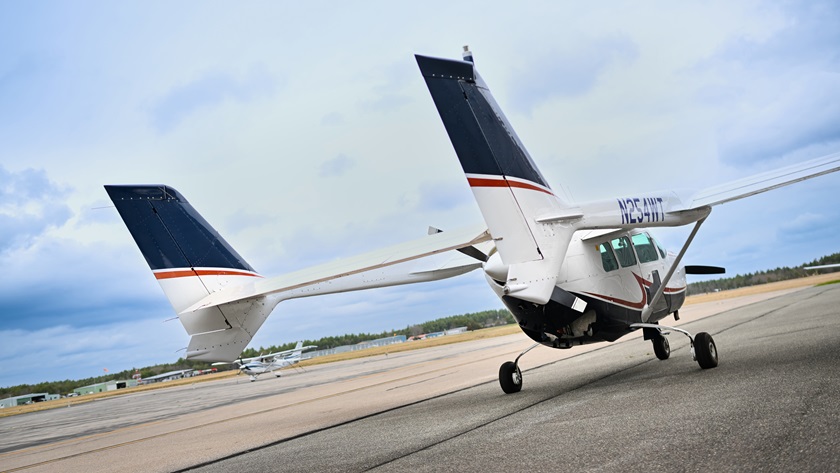
“It’s the ugliest, prettiest airplane that you’ll ever fly,” says pilot Donn Heikkila. The Cessna 337 has certainly garnered some love and criticism for its unusual pull-push high-wing setup, with two six-cylinder Continental IO-360s in-line. But for marine mammal surveys, it’s the perfect platform.
The high wings and lack of propellers on the wings (like you’d see with your average twin) make downward visibility, which is crucial to the mission, second-to-none. A window opening and (relatively) good amounts of space for the four-person crew further solidify it for this mission. So why not a Cessna 182? The requirement for the flights to be conducted at 1,000 feet over open water means a second engine is a critical safety feature for the operation. Retractable gear also improves the likelihood of a successful ditching in an absolute worst-case scenario.
It’s great to see such a peculiar airplane find its mission. Centerline thrust twin-engine aircraft elicit many opinions, but it’s certainly peculiar to see what very much looks like a Cessna with unique design features. The booms on either wing cause the iconic barn-door flaps to be split on either side. A two-blade tractor propeller pulls and weirdly the same Cessna-looking propeller pushes from the back. But for what they need for whale surveys, it’s perfect.—IW