From dream to disaster
One pilot’s abbreviated adventure

In mid-2020, one California-based non-instrument rated private pilot decided to go on an epic cross-country adventure. The global COVID-19 pandemic had disrupted life and shuttered many popular locations, so he developed a plan: to land in every one of the lower 48 states.
The 35-year-old pilot had gotten his certificate just a few months earlier. He was an active athlete; his public Facebook profile featured images and videos of adventures on motorcycles and bicycles, as well as acroyoga, a physical practice that combines yoga and acrobatics. We also learn from his profile that he was fond of snow sports and firearms, reflecting a pattern of high-energy, risk-tolerant pursuits.
He shared his idea in a social media post on June 25:
“For those that know me, this crazy adventure should be of no surprise to you.
“This summer, I will be taking off on a cross-country flying trip and trying to land at as many airports and states as possible. I’m sure I will be posting many photos along the way. Since all the family weddings and acro festivals have been cancelled, what better way to see all my friends and family than to fly.
“If you want to be my copilot for the day…or just meet up for lunch or dinner, let me know.”
When he left his home in San Luis Obispo during the last week of July, he likely had no more than 100 hours of total flight time. He told a friend that his blue-and white Piper PA–20-135 Pacer, which carried the registration N7323K, had just gotten a “new motor, new prop, new tires, new wings.” Records show that the aircraft had passed its annual inspection on July 3, and the airframe had just over 1,800 hours.
“Time to put her in the air where she belongs,” the pilot added.
His tour initially took him across the northern states before looping down into the Midwest. He loved landing his taildragger at grass strips and often stopped to visit friends and family. He scheduled one stop in Sturgis, South Dakota, to coincide with the eightieth annual Sturgis Motorcycle Rally, which took place with minimal pandemic-related restrictions. He landed at Wittman Regional Airport (OSH) in Oshkosh, Wisconsin, and Dayton/Wright Brothers Airport (MGY) in Ohio. He made a pilgrimage to the birthplace of his airplane, Lock Haven, Pennsylvania (LHV). The pilot’s photos also show that he frequently skirted late-summer afternoon thunderstorms and weaved his way around cloud banks.
After threading through New England, he flew down the Hudson River Valley to the mid-Atlantic. On day 36 of his journey, he landed at Maryland Airport (2W5) in Indian Head, Maryland, about 15 nautical miles south of Washington, D.C. At that point, he’d logged somewhere around 115 flight hours on his trip.
The photos accompanying an August 31 post showed a sunny summer afternoon visit to the National Mall, and another photo of his tent, pitched in the grass behind his Piper’s left wing.
According to a Maryland Airport employee, N7323K took no fuel during the “day or two” the aircraft was parked there. He said the pilot told him that he was headed to Martinsburg, West Virginia (MRB), about 65 nautical miles to the northwest, to check off another state on his list. It would bring his total so far to 30 states—almost two-thirds through his journey. After that, the pilot intended to visit a friend in Raleigh, North Carolina.
The airport employee and other local pilots advised the Piper pilot not to depart that day, due to a forecasted line of storms. Throughout the afternoon, he monitored the weather on his iPad. His primary concern was likely the low cloud ceiling coupled with the rising terrain of the Appalachian Mountain ridges to the west. The forecast did not change.
Radar and satellite imagery from that day show that there was an extensive area of low-and mid-level cloud cover through 20,000 feet, with precipitation. Visibility was less than 10 miles. At one point in the late afternoon, Martinsburg reported IFR conditions, with moderate rain, mist, and visibility reducted to below two miles, combined with scattered clouds at 700 and overcast clouds at 1,600 feet. An airmet Sierra—advising widespread mountain obscuration—was issued for the route the pilot intended to fly. For a non-instrument rated pilot flying a VFR-only aircraft, these conditions left little room for error.
N7323K had still not taken off from Indian Head when the FBO employee left the field at 6 p.m. But shortly thereafter, the pilot decided he was ready to go.
It was 6:19 p.m., and he had about an hour of daylight left.

Maryland Airport lies in the D.C. Special Flight Rules Area (SFRA)—a band of closely controlled airspace that surrounds the nation’s capital—and the pilot was obligated to contact Potomac Terminal Radar Approach Control before departing, so that he could be assigned a transponder code to exit the area.
Communications between the pilot and controllers were routine, and ATC handed N7323K off frequency after he left the airspace. He asked if a restricted area southwest of the city was active and was told it was not. His aircraft was running smoothly—nothing indicated that this flight would end any differently than the dozens of flights he’d logged since leaving his home in California five weeks earlier.
He continued westward, shifting his destination from Martinsburg to Grant County Airport (W99) in Petersburg, West Virginia, in his EFB when it was clear that Martinsburg’s inclement weather was staying put. Grant County reported VFR conditions, but he would have to cross a stretch of instrument meteorological conditions to get there.
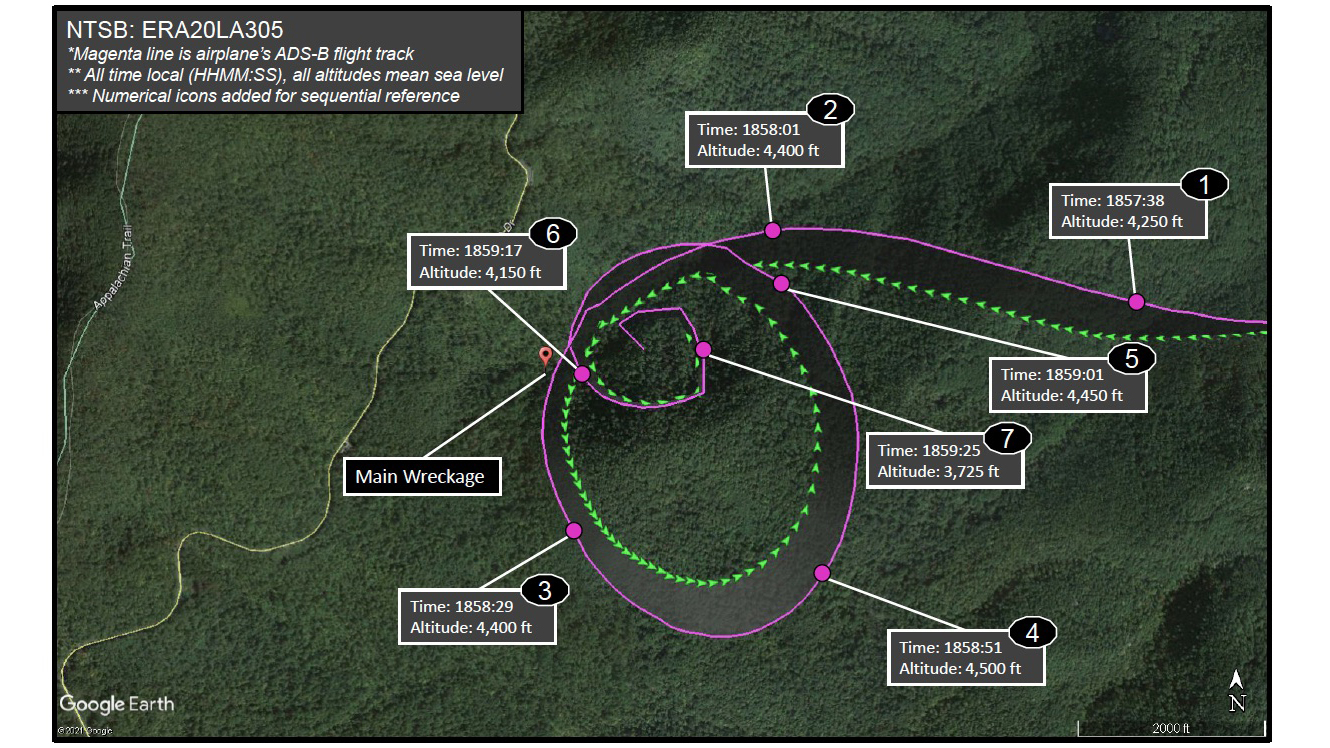
Just before 7 p.m., the aircraft entered a level left turn at about 4,500 feet msl over the Blue Ridge Mountains of Shenandoah National Park. At that location, the terrain rises to 3,500 feet msl. After one full 360-degree revolution, N7323K continued circling, much tighter this time. The turn developed into a rapidly descending spiral, consistent with spatial disorientation.
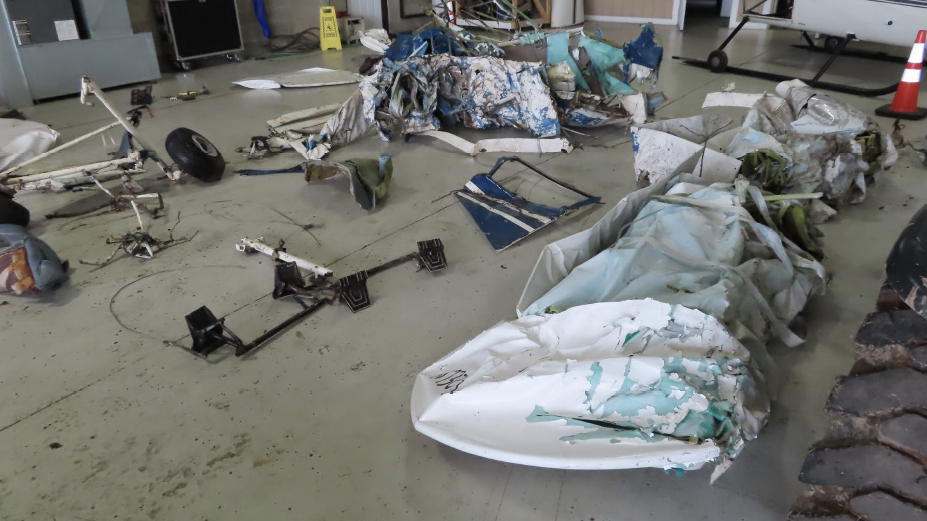
The Pacer crashed into a dense forest, not far from Skyline Drive, a popular scenic road that winds along the crest of the range. Hikers on Buck Hollow Trail found the wreckage and the deceased pilot, still strapped into his seat, two days later. There was no indication that an emergency locator transmitter signal was ever received from the aircraft.
Analysis
The NTSB said in its final report that the accident was caused by the “non-instrument-rated pilot’s continued visual flight into instrument meteorological conditions, which resulted in spatial disorientation, a loss of control, and collision with terrain.”
The weather was poor that Monday afternoon, with storms crossing the pilot’s anticipated line of flight. Conditions were either IFR or MVFR at several airports in the vicinity. The pilot did not file a flight plan, he was not using flight following, and he did not request an official weather briefing. Local pilots advised him to wait out the weather.He likely fell victim to the sinister pressure to follow through on what he promised, at any cost.
But he was eager to get going; he was already behind schedule because of maintenance stops along his journey. His initial plan had called for him to be in Raleigh “around” August 30 and in Texas in the first few days of September.
Four days before the accident, while in Rhode Island, the pilot posted on social media: “plane broken.” His alternator’s positive terminal tab was faulty, and a replacement part was being shipped to his location for repair. A broken terminal tab is an unairworthy condition that needs professional attention. About a week before that, he noted in a post that the aircraft was getting unspecified “airplane maintenance” in Stanton, Minnesota.
The NTSB said that the Pacer was not equipped with an attitude indicator or any panel-mounted navigation system. Neither is required for day VFR flight according to FAR 91.205(b), but it’s always wise to have one on board—especially when embarking on an ambitious multi-week journey of this nature. (And it’s required equipment for IFR flight, as per 91.205(d).)
He appears to have used his EFB’s attitude indicator/synthetic vision feature instead. But the ForeFlight pilot guide states that the feature is “for informational purposes only. Do not use the ForeFlight AI/SV display as a primary instrument in any phase of flight.”
The fragmentation of the aircraft wreckage in the forest indicated that it experienced an uncontrolled descent and impacted terrain at high speed. There was no indication of a fire, and the NTSB’s examination of the airframe and engine “did not reveal any anomalies that would have precluded normal operation.”
Final thoughts
The pilot of N7327K was fulfilling an aviation dream while documenting it extensively on social media. His followers let him know that they were waiting for his daily reports. He likely fell victim to the sinister and inescapable pressure to follow through on what he promised, at any cost.
Adding to the allure was the fact that he was welcomed by friends or family at many stops, and he evidently relished the role of “being tour guide and Uber air” for them.
When one asked him how long it took him to get his pilot certificate, he answered: “Two years of FAA bullshit and two months of actual flying.” Another asked, “How long are you planning for your trip?” The answer: “Till I decide to come home and make more money to buy a faster plane.”
These answers, while possibly tongue-in-cheek, indicate a dismissive attitude and overconfidence that could also have slipped into his aeronautical decision making. In his social media posts, at least three of the FAA’s five hazardous attitudes were on display: macho, invulnerability, and impulsivity.
Like many of us, the pilot of N7323K loved to fly, invested a great deal of time, energy, and money into his passion, and was excited to share that love with anyone who listened. His flight was a journey of a lifetime, and he was eager to get to the next place. So, we can assume that “get-there-itis” also played a role in the decision to launch into more-than-questionable weather conditions.
In hindsight, the venture was questionable at best: An extremely low-time, non-instrument rated pilot attempts a larger-than-life voyage across the lower 48 states. On the eastern seaboard, far away from home and looking forward to seeing a familiar face, he encounters unpredictable late summer storms that demand piloting skills far beyond his experience level. Those who followed his journey online saw a man chasing something rare: freedom, adventure, and connection, through the miracle of flight. What they did not see, and what he may not have fully recognized himself, was how unforgiving and slim the margins can become when enthusiasm outruns experience and judgment.
Aviation does not judge our intentions. It only responds to our decisions and the willingness to stop when stopping feels hardest. 

Related Articles


