Flying the forgotten coast
GA pilots see the best of this beautiful spot
In Maine, they have an expression: You can’t get there from here. Way to the south in Apalachicola, Florida, the same would apply. You just can’t easily get here—unless you are a general aviation pilot.
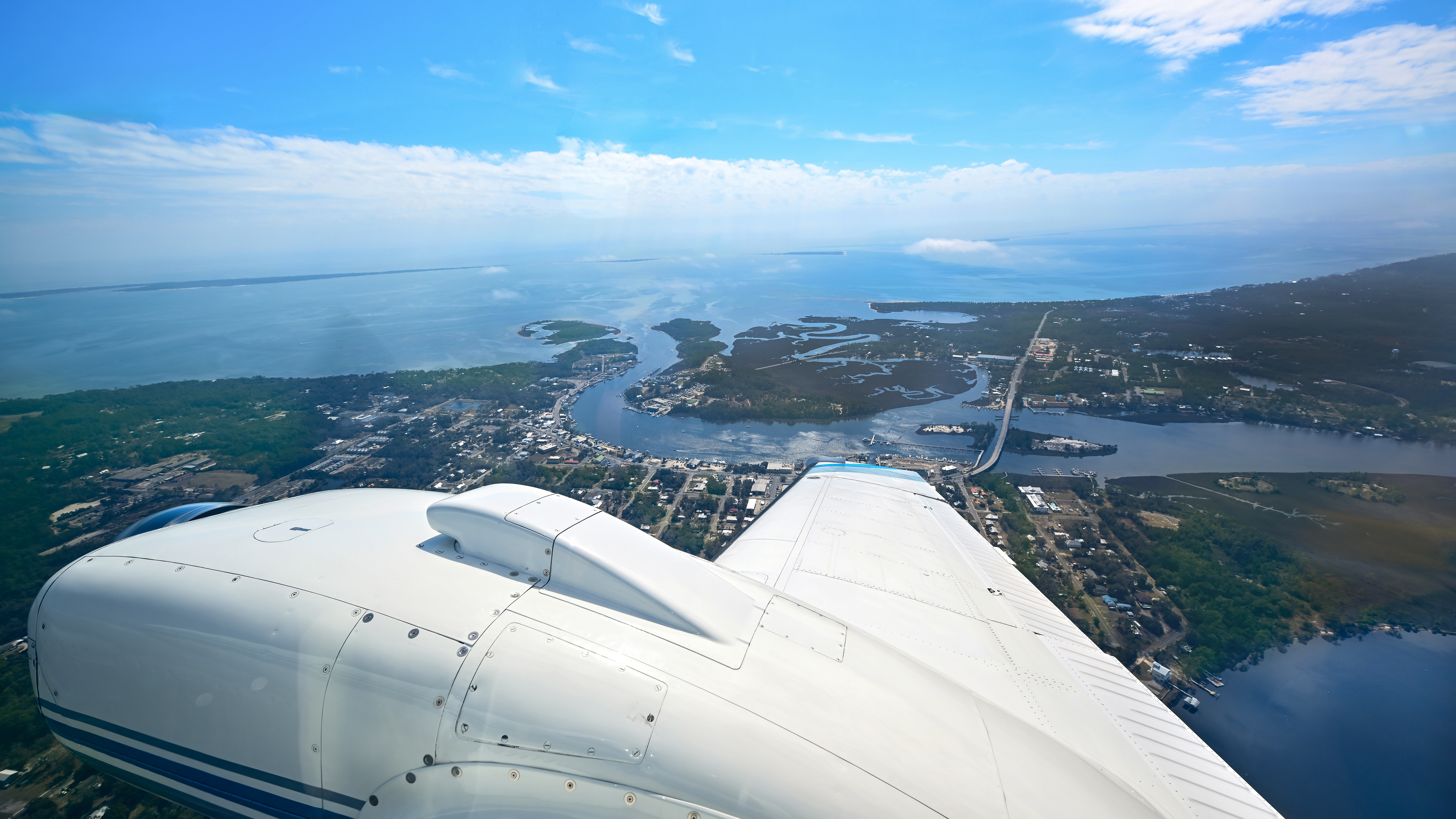
Apalachicola is on Florida’s “Forgotten Coast,” an area so unlike the rest of the state as to be an anomaly—no high rises, no golf courses, no glitzy hotels, no Mickey and Minnie, no Bentleys and Jags. It’s as if the developers were never shown this part of Florida, or someone saved it and kept it from their predatory eyes. Because Apalachicola and the rest of this coastal retreat on the Gulf of Mexico, cradled in the northwest bend of the state just south of Tallahassee, is simply striking, surrounded by the Apalachicola River and Bay, and water as far as the eye can see.
Someone also forgot to widen the roads and stick in an interstate and make getting there a not-so-straight shot from anywhere. Commercial air travelers will have to fly into hubs like Panama City, Pensacola, Tallahassee, or Gainesville and drive single-lane roads across tidal marshes and seagrass beds. But just two miles from the historic and bucolic seaside town is Apalachicola Regional Airport (AAF), and it is a GA pilot’s dream—three paved runways, each more than 5,000 feet long.
The airport is another desirable relic from America’s past—it’s an Army Air Corps airfield constructed in 1939 and expanded in 1942 as a subbase of Tyndall Field, now Tyndall Air Force Base (PAM). It became a civil airport in 1947. The airport is situated on 1,100 acres of wetlands and coastal plains. I don’t even want to think about the alligators and snakes living there. Good thing you can land long at any of the three runways!


Going to town
Centric Aviation, the welcoming FBO at AAF, offers on-site car rentals, and it’s a quick two-mile drive into town along roads lined with trees adorned with Spanish moss and phenomenal beach vistas. Little roadside stands and bars dot the drive. Once in town, you will find historic homes and shops dating from the nineteenth century. Ornate Victorian homes and sea captain antebellum houses are enjoyed on a walking tour of the small village. There are more than 900 historic buildings in town. Also known as the Oyster Capital of the World, Apalachicola was once the third-largest port on the Gulf of Mexico. Tin-roofed warehouses speak to the town’s maritime history, which includes not just oyster harvesting, fishing, and shrimping, but cotton and timber shipping. We discovered the John Gorrie Museum State Park on a side street; Gorrie was a doctor who invented a mechanical ice maker that led to the invention of modern air conditioning and refrigeration.
Worth the visit is the Gibson Inn, a classic Old Florida hotel with a wraparound porch, replete with white rocking chairs. Built in 1907 after a devastating fire in the town destroyed many buildings in 1900 and named for owners the Gibson sisters in 1923, the inn has 45 rooms that perch overtop the city and Apalachicola River, the bay, and the John Gorrie Memorial Bridge to Eastpoint and St. George Island. It was restored and refurbished in 2018 by current owners, the Etchen family. If you stay at the inn, you can rent a golf cart, which is the best way to get to the shops and restaurants. Of course, the inn is haunted; the legend of the sea captain and his mistress is just one of the delightful aspects of the inn. Drinks in the historic Parlor Bar in the Franklin Café offer the quintessential cocktail hour experience. Take your drink out on the porch for spectacular sunsets.


Seafood is synonymous with Florida coastal towns, but Apalachicola is world-renowned for oysters. Apalachicola oysters once made up 90 percent of Florida’s oyster harvest, and the remnants of a thriving fishing industry can be seen throughout the town. After hurricanes and oil spills, the Florida Fish and Wildlife Commission shut down the oyster harvest for the past five years to allow the industry to recover. But on January 1, 2026, the harvesting of wild oysters reopened. Apalachicola oysters (Eastern oyster) are briny with a buttery finish and are wild caught using traditional tonging methods.
In the heyday, mounds of football-size oyster shells were piled up on the streets, and longboats with oystermen plying their trade were thick on the water. Today, the combination of factors, including climate change, natural disasters, and less salinity in the water, has altered the once thriving industry. Most doubt it will ever come back. It’s rare to get a real Apalachicola oyster; most served in the restaurants are from the Texas coast. Aquaculture farming methods are now starting to be used, and there is hope that both wild harvesters and aquaculture farmers will coexist in the bay.
Two other highlights of the area are Florida natural sea sponges brought up by divers from the Gulf of Mexico waters—no two are alike—and Florida tupelo honey from the Ogeechee tupelo trees that are native to the Florida Panhandle along the Apalachicola River. The trees’ thick gray roots are like monster fingers clinging to the water’s edge.


Flying around
There’s more than one airport to greet GA pilots in the area. Although AAF and Carrabelle-Thompson (X13) are public, some of the others—Dog Island (FA43) and St. George Island Airport (F47)—are private. St. George Island is worth the visit. A barrier island, it has 22 miles of windswept beach and is only one mile wide, so you get both the Gulf of Mexico and the Apalachicola Bay breezes. If you drive over from Apalachicola, you’ll cross one of the longest bridges in Florida; a two-lane structure, St. George Island Bridge is more than four miles long. U.S. Route 98 connects Apalachicola to the island to the east and back to Panama City to the west.
The St. George Island Airport has a 3,300-foot-long paved runway, and taking off on Runway 32, you will have a glorious overwater escape. There are no lights and no fuel and no transportation, but a call ahead to the homeowner’s association should get you all the help you need (850-927-2362).
Two towns worth the flight are Carrabelle to the east, home of the world’s smallest police station (a phone booth), and Port St. Joe, which hosts a sea turtle festival each July. Both are served by GA airports. Carrabelle-Thompson Airport has a single 4,000-foot-long runway, and fuel is available. Costin Airport (A51) at Port. St. Joe has a 4,230-foot-longturf runway. 

Related Articles


