Seat belts, please
Cockpit safety starts with the basics
By Jeremy King
We’ve all heard it plenty of times. “To fasten your safety belt, insert the metal tip into the buckle. Lift up the buckle to release….” Riding in the back of an airliner, we all get schooled on how to operate our safety belts. Every. Single. Flight.
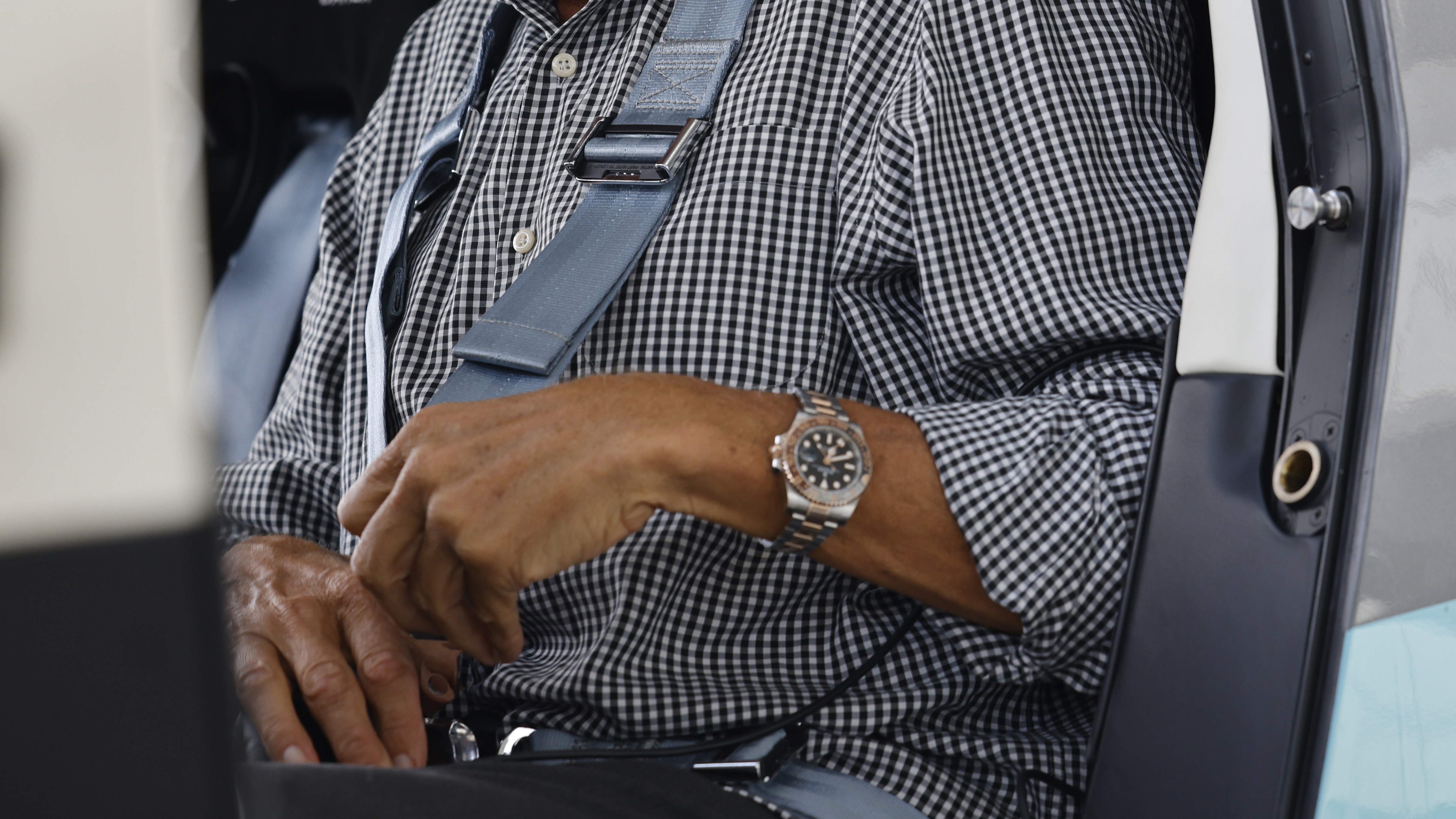
From time to time, in social media group posts, group chats, or over a happy hour beer on a layover, a pilot speaks up. The nature of their delivery varies widely based on the personality of the messenger. Sometimes it’s a sheepish admission: “I can’t believe that I made it 12 years in the business before figuring this out.” Sometimes it’s a profound discovery broadcast far and wide: “Did you know there’s a tab on the back of the seatbelt buckle that only releases the shoulder harness?” And in the case of at least one young professional aviator, he simply kept his mouth shut and filed the seatbelt-buckle revelation away among many other lessons that the university of hard knocks left out of its learn-as-you-go curriculum.
Whether flying under FAR 91, 135, or 121, we’re required to wear the whole shebang for takeoff and landing, so it’s no surprise that for many pilots a flow following the callouts of “positive rate/gear up” is immediately followed by the zzzzziiipppp of the inertial reels pulling the shoulder harnesses back out of the way (FAR 91.107(a)(3), 121.311, 135.171).
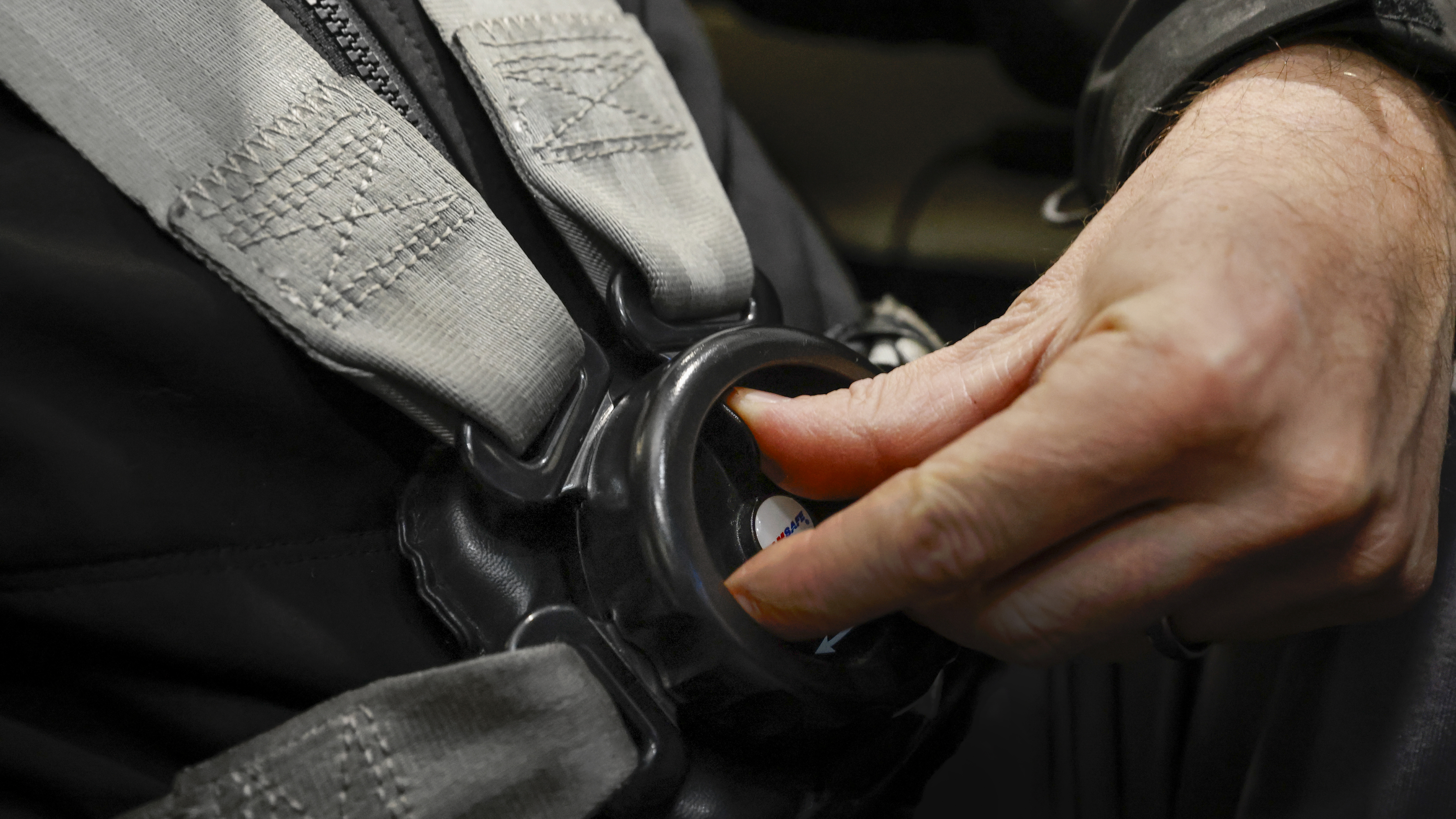
Most of us who have been using these harnesses for decades know there’s a little tab at 12 o’clock on the back of the buckle, which when pushed forward releases the shoulder harnesses, but some of our pilots consistently release the entire safety harness, just to pop the lap tabs back into the buckle.
Not every buckle works that way, but that’s how it is in every jet I’ve flown to date. I understand there are other configurations where a partial rotation of the release will unlatch just the shoulder harnesses. Others may lack that functionality altogether, leaving the users to the same motion as those who didn’t know about the release function.
Just as many of us operate the buckles without a second thought, we also take our seat belts’ physical presence for granted. They are bolted to the airplane, after all. But, nearing 13 years after an embarrassing day in the office, I buckle my lap belt as soon as I get into the seat. Let’s call it part of the preflight inspection—ensuring the inertial reels for the shoulder harnesses aren’t locked, and that the buckle works. Sometimes the other pilot casts a glance my way, even a snarky question from time to time. “Expecting turbulence before we depart?”
I could simply smile, but no. At some point in pilot training we all learned that yes/no answers are for checkrides; story-length answers are suitable in the real world. When I was flying regional jets, we had an airplane towed to the gate from the maintenance hangar, which had us behind schedule to begin with. We went through all our preflight preparation and with the door closed and the jet bridge pulled away the captain called for the checklist as he reached for his lap belts and grabbed nothing but handfuls of air, on either side of the seat.
He stammered and searched for words, utterly confused. “Where…is…my…seat…belt?” I handed him the flashlight I’d used for the preflight inspection, and sure enough there were no seat belts attached to his seat at all. The logbook told the tale, although it required a little creative interpretation to suss it out.
“Robbed seat belt from captain’s seat for other aircraft,” one entry in the maintenance log read. A few blocks later, “Installed captain’s lap belts” per the maintenance manual made it all seem fine on paper—until we realized the installer had signed off the install in the wrong logbook, and whoever reviewed the logbook hadn’t physically seen the seat belts. One entry documented removing the things, and another documented their installation, albeit in another aircraft at the hangar.“I can’t believe I made it 12 years in the business before figuring this out.”
 “We’ll grab a seat belt and head out your way,” the mechanic told us.
And then word filtered back: There were no seat belts for the pilot’s seat in stock—explaining why mechanics had to steal the ones off our airplane to begin with. Then, the problem solving got creative. “I’ll grab an entire seat out of the warehouse and we’ll pull the lap belts off it,” the mechanic said. His smile and confidence faded quickly, though, as he returned with more bad news. “There were two slits cut into the plastic wrap. Someone had already robbed the lap belts off the only seat we’ve got in stock,” he said.
So back to the hangar he went, to rob some belts off another aircraft. For all we know, they might have been the same belts stolen from our jet to begin with.
We wound up landing so late in Wichita that night that one controller was running all functions—the same voice, on the same frequency, vectored us for the approach, cleared us for the approach and the landing, then issued taxi instructions to the gate.
So, “seat belts, please.” It can be an abbreviated request to passengers—or to your mechanic, depending on how your day is going. 
Jeremy King began his aviation career as a mechanic’s apprentice in his early teens. After 31 years and more than 10,500 flight hours logged, he now works as an airline captain, holding type ratings in the CL–65, A–320, and DC–9, maintains an A&P certificate, and owns a 1965 Mooney M20C.
Related Articles


