North Carolina flights marked new chapter in EMS
First US paramedic responses in Pivotal eVTOL
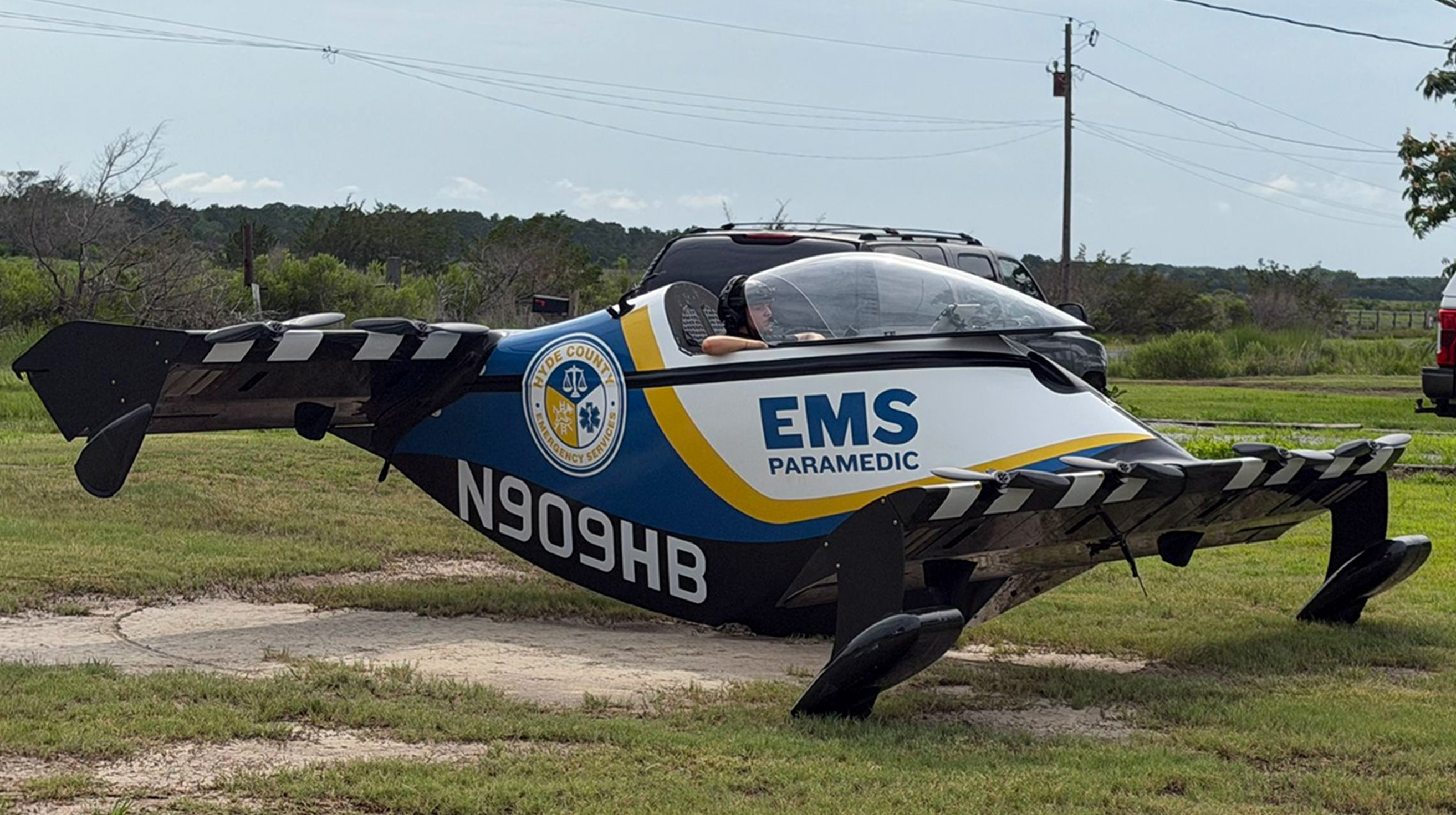
After months of preparation and training, North Carolina paramedic Quinn Reece was ready on June 27 when a 911 call summoned her to fly the first advanced life support (ALS) response in the United States using an electric vertical takeoff and landing aircraft.

The flight, and another Reece made days later, marked the operational realization of a new model of emergency medical services response, using small, personal eVTOL aircraft to get advanced care to patients faster than is possible with ground units. About 20 minutes faster, it turned out.
"There were so many calls that I could have made. I just couldn't put in enough man-hours to be physically down there. But the two calls that I did, I'm very satisfied in, because we did get there at least 20 minutes before an EMS crew," Reece said in a telephone interview August 11.
One of the first two calls she responded to was a cardiac emergency, a response where seconds shaved off the response time can matter, more so minutes. In one study on the topic (retrieved from the National Library of Medicine), researchers analyzed years of data on EMS responses to out-of-hospital cardiac arrest events in Taipei City, Taiwan, and quantified a rapid decline in survival probability when ALS care is delayed. "For every minute of delayed ALS response time, the likelihood of survival to hospital discharge would reduce by 7 [percent]," the paper reports. "Further, for every minute of delayed ALS response time, there was a reduction of 9 [percent] … chance of favorable neurologic outcome … at discharge."
While other, similar studies have failed to prove comparable fast-response advantages, the premise that ALS response time matters to a significant degree in certain types of emergencies—particularly cardiac events and trauma—has shaped paramedic training and practice for decades. It generally takes more than two years to qualify as an emergency medical technician—paramedic, including 1,800 hours or more of classroom and clinical rotations, in-service training on basic life support and ALS ambulances, and passing a series of exams. On a ground ambulance, a paramedic has most of the same tools used in a hospital emergency room at their disposal, but the strict payload limits of a multirotor electric aircraft prompted Reece to pare that down to the absolute essentials. The Philips Tempus ALS cardiac monitor and defibrillator is a lightweight version of the crucial device that trades off some diagnostic capability for size and weight, administers electric shocks via pads rather than paddles, and "fits perfectly in this aircraft." Reece also filled a primary care bag with all the tools needed to control bleeding and restore an airway, various medications, a suction device, and an oxygen bottle. "In all, I think my gear weighed around 30, 32 pounds."
Medical helicopter pilots rarely, if ever, get involved in patient care, but Reece had to learn to wear two hats, and develop an aeronautical skill set and knowledge base. She recalled learning when to think like a pilot and not like a paramedic.
"It was a real eye-opener. And one of the things that was told to me was, you know, when you're piloting this aircraft, you're not a paramedic. And I had to let that sink in… I had to make sure I broke that apart because on the way there, you know, I'm focusing on, okay, I'm flying. I'm making sure I can get down on the ground no matter what the call is… I had to make sure, okay, if I'm not going to be safe to land, it does me no good to land there and get hurt if …[I], you know, can't help them."
Quinn said aeronautical decision making did not turn out to be as unfamiliar as one might think to an EMS professional. Even in a ground ambulance, weather or mechanical issues can be a factor. "You've got to think about getting there first," Reece said. "That's no different than flying. There's just a lot more moving pieces when you're trying to fly and you're in the air."
Favorable weather made the go/no-go decision easier for the first two operational uses of Pivotal's eVTOL.
"I felt like a fish out of water for sure, but it was beautiful weather, beautiful winds. I had tailwinds both [flights]. I mean both of them just panned out perfectly."
Reece had plenty of help preparing for the first 911 responses. Tim Lum, a paramedic and one of the first private owners of Pivotal's BlackFly (a newer version has been renamed Helix), supports the program from the ground, and designed EMS training scenarios that built on the foundational flight and systems training Pivotal requires of all customers. Lum "really put me through, I won't say the wringer, but he really, you know, the places he had me train and land [were] always going to be harder than what I was going to be landing [on] at someone's house. So, I was very comfortable where I landed."
More than 300 training flights preceded the first operational response. Akute Networks, a 501(c)(3) nonprofit based in California, provided program management and assisted with securing FAA approval for Hyde County Emergency Services to conduct PAO flights. Code Blue Resources, a North Carolina company that offers emergency medical training and consulting, recruited volunteer paramedics and helped the county refine the medical side of the aeromedical project.
Reece, whose day job is in EMS management, said the applications for Pivotal's aircraft extend to other emergency services missions where time is of the essence, including search and rescue. Meanwhile, she is, for now, the only pilot-qualified paramedic who can respond under the PAO in Hyde County. "They did train four paramedics at the beginning of this program," Reece said. "I'll just say I was the last one left. You got me… you had to be a little ballsy to do this, so you got me."
Reece said the goal of the program and the new CONOPS is to add to the EMS arsenal, not to replace.
"I will say this again and again, this isn't to replace, you know, helicopters, personnel, ambulances. This isn't to replace anything. This is just to add more resources to our tools."
As for taking a place in aeromedical history, Reece said the opportunity to inspire other women and girls has been more meaningful than a superlative.
"I was able to bring my kids with me and my mother and to watch them smile when I flew, whether it was training, an actual mission, or, you know, doing these little things, traveling around, doing these little demonstrations for people, seeing the joy of people seeing something new, especially your kids and friends and family. And that was what took me first, because that was the first for me, just being able to bring life to people. I just thought that was really, really humbling to be able to be a part of that."