Unavoidable carb ice
When your carburetor heat fails you
By Matt Person
It was the summer of 1990.
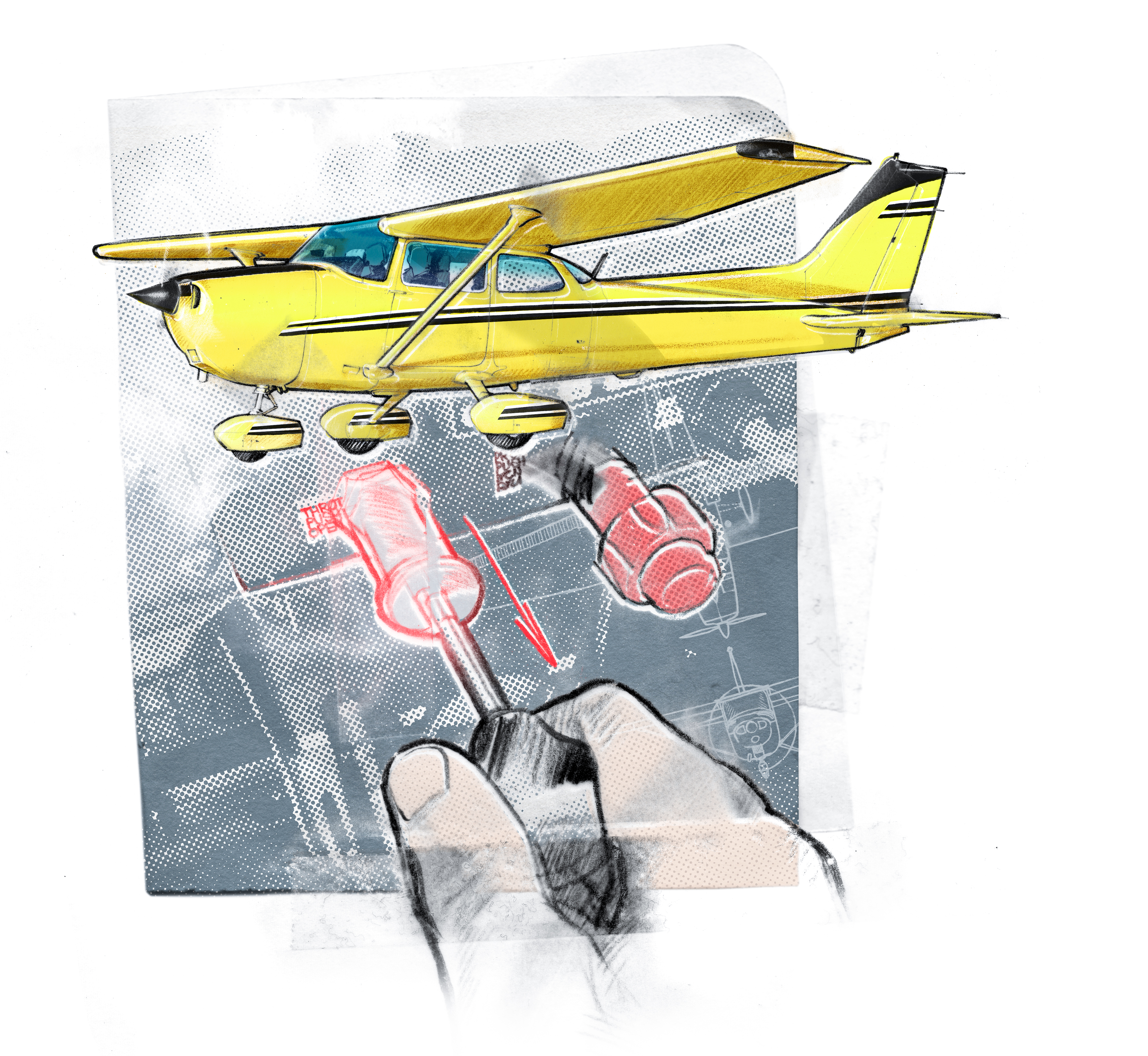
I was a Navy lieutenant stationed at what was then Naval Air Station Miramar. I owned a one-third share of an older, but reliable, 1960 Cessna P172. It was much like a regular Cessna 172, but instead of the Continental O-300 engine, this one had a GO-300 engine and constant-speed propeller, giving us an additional 30 horsepower, 100 pounds of gross weight, and several knots in cruise, and making it a better cross-country airplane than a typical 172.
We all had a Friday off for a long weekend, so the three of us decided to take the day to fly over the beautiful Southern California countryside and stop at some interesting places. With me in the front was Rick, a Coast Guard lieutenant who was instructing jet pilots at a training base in Texas but here for the long weekend, and in back sat Kyle, an A&P.
Our first stop was at Chino Airport (CNO) in the Los Angeles area, where we had lunch and visited some friends at Air Combat USA. We continued on to North Las Vegas Airport (VGT) but only as a fuel stop. We traveled south to see the Anza-Borrego Desert, then turned west to San Diego. We were about 6,000 feet in altitude and started our descent to remain clear of the Class B airspace on our way to our home base, Montgomery-Gibbs Executive Airport (MYF).
I reduced the manifold pressure a few inches, pulled the carburetor heat to full-on, and adjusted the mixture for the descent. A few minutes later, I noticed we were going through a thin scud layer, one that did not reduce visibility much but was noticeable. The engine went from about 2,200 rpm and making a healthy, six-cylinder growl to less than 2,000 rpm and a wimpy sort of hum.
I immediately started to beat through all of the controls: throttle full in, full out, full in; carb heat on, off, on; propeller maximum rpm, low rpm, max rpm; mags left, right, both; gas left, right, both.... While I was thus occupied, Rick had previously tuned the com one radio to approach control and then contacted them to report our rough-running engine and ask for directions to the nearest airfield. I heard San Diego Approach respond that Gillespie Field (SEE) was at our “one o’clock, 10 miles.” I turned in that direction but could not see the airport because of a few scattered clouds in the way. I beat through the controls again with no results, just as we were forced to pass through the lower part of a cumulus cloud. As we exited the cloud, the controller again called the field direction and distance. I saw Gillespie and knew it was way too far away.
When the engine issue arose, Kyle, as he told us after we were safely on the ground, checked his feet to make sure he did not accidentally kick a fuel valve, then sat back and thought as light of thoughts as possible. He said he also made the mistake of looking at the ground a few times, only to see windy, curvy roads and fields, 100 feet long with trees at both ends, so he knew if we did not make Gillespie, we were dead.
I beat through the controls a third time to find that when I rammed the throttle back and forth, I got a very slight surge of engine power. I did it again, and I got that same slight surge. I immediately began pumping the throttle for all I was worth, and our descent rate decreased a little. After what seemed to be an hour, but was probably 2 to 3 minutes, my right arm wore out, and I told Rick to start pumping the throttle. He had not noticed what I was doing and was somewhat skeptical at first, but once he saw the benefit, he pumped the throttle madly until his left arm wore out. I took over again and kept it up until we crossed the runway threshold at a few feet. Our tires squeaked on the runway, and the adrenaline rush hit us hard. We all three yelled, cheered, and high-fived each other. If you have never cheated death, you may not understand—but those of you who have most certainly do.
We rolled out, and the engine purred as if nothing had happened. We taxied to the fuel pump, not really knowing where else to go to deal with our problem. After getting out of the airplane, stretching our legs, and generally coming back to the present, we saw a ring hanging from the nose gear torque link. Not just any ring, but the kind of 1960’s hose clamp that holds the big, orange carb heat tube to the intake/carburetor box. We had a definitive answer to our problem: carburetor icing. There was extra moisture in the air at altitude in that scud layer, with no way to prevent it from freezing in the venturi.
When I told my airplane partner, Chuck, of my adventure, he immediately went out and bought us enough brand-new, screw-tightening hose clamps to replace all those forward of the firewall. We replaced them that weekend and flew the airplane to MYF.
The lessons that I learned from this incident are: If you are in the back, check what you can and be ready to help in any way possible. If you are in the right seat, be ready for any contingency, pre-tune radios, and be ready to assist the pilot in command, whatever he or she asks. If you are the PIC, do not stop trying to keep that airplane flying and engine running, and be cognizant of what it is telling you, even if its voice is not very loud. 
Matt Person is a multiengine land ATP, commercial single-engine land pilot, CFII, MEI, and commercial helicopter pilot with almost 5,000 hours logged. He has owned four airplanes and flown U.S. Navy jets and U.S. Army helicopters.
Related Articles


