Mustangs resume racing
National Championship Air Races pack Roswell, New Mexico, as Unlimited Class returns
Spectators rose to their feet, eyes turning toward five North American P–51 Mustangs as the vintage fighters opened their throttles over the New Mexico desert, unleashing horsepower by the thousand.

The crowd just a few feet below became a blur to the approaching pilots, among them Steven Coutches, competing in a particularly rare Mustang with a name that stood out from the other racers for its simplicity: 43. A P–51H, the last Mustang variant produced, 43 was a little more rare than the other P–51 Mustangs that had converged on Roswell, New Mexico, September 16 through 20, to find out who is fastest in a race like no other. The National Championship Air Races remain the only pylon race in the world where the fastest piston fighters of World War II compete today, eight decades hence.
Across the main grandstands, VIP tents, and Founders Club section the crowd was on its feet with anticipation and awe as the piston heavyweights returned to duke it out wing-to-wing.
Though he was flying the fastest production Mustang variant, a model built for speed, stripped down to the essentials to make it lighter and faster than the Mustangs that made the name a legend in combat, Coutches was the underdog. He was racing against a field that included Steve Hinton Jr., a perennial winner dating back to the Reno days, flying Wee Willy II in the Silver races. Hinton would go on to clock the fastest Unlimited Gold run, averaging 432.897 mph over six laps in Bardahl Special, a P–51D.
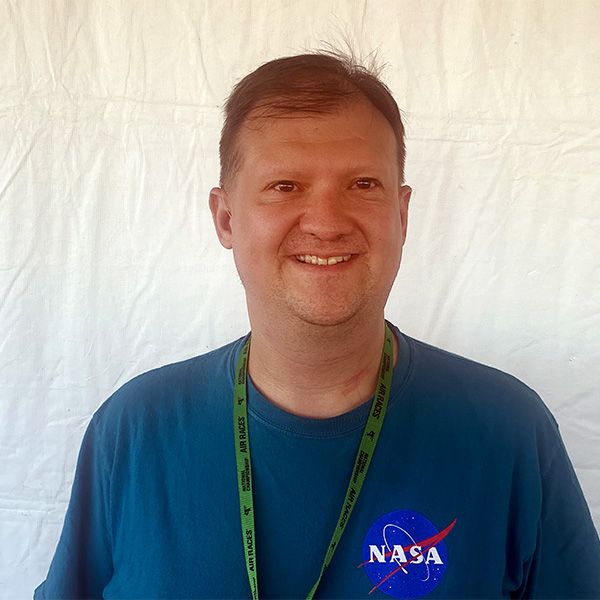
Coutches said he still has “dialing in” to do on his P–51H. He reckons he could bump to Gold and be at the back of the pack, or stick to Silver and maybe, just maybe, beat the winningest Unlimited Gold pilot in the long history of the event.
"I'd rather be at the top of the Silver Class than at the bottom of the Gold Class," said Coutches.
The Roswell race course is shaped like a triangle with rounded edges. This layout was chosen so that the fastest part of the course is the front straight, the airplanes passing the crowd at top speed. This is thrilling to watch, and has several benefits for the pilots, also.
'It's truly a close-knit family'
With the return of the Unlimited Class and the Sport Class, the 2026 event field returned—in terms of classes—to its previous size, albeit with fewer aircraft than in 2023 in Reno. Relaxing with his crew in an air-conditioned motor home at the end of a race day, Coutches explained why he and other Unlimited Class pilots, who must master maneuvering at high speed, pulling high Gs close to the ground, wingtips sometimes feet or even inches apart, had balked at the new venue the year before. Power lines intruded on the original layout, for one thing, the retired airline captain explained.
"The back of the course had no emergency landing strip. If we lose an engine the nine- to 11-foot prop acts as a sail; we don't have much time to pick a spot to land," Coutches said. "By the time you see a power line at 400 to 500 miles per hour it's too late."
Redesigning the course also reduced the G forces that the pilots must endure. Reno routinely pounded pilots with 6-G turns, and the pilots' fatigue builds cumulatively as the week goes on. Roswell's course caps acceleration at about 4 Gs, making race week a lot less tiring, and more enjoyable.
Steve Hinton Sr. won the races twice—in 1978 and 1985—and served as the pace pilot this year, leading his son and the other pilots around to the start line. Racing tends to run in families, and Coutches also followed his father's lead into the sport.
In 1957 Coutches' father, Michael "Mustang Mike" Coutches, attended a military surplus auction and bid $1,900 each on a buyer-takes-all lot of 26 P–51 Mustangs. It was quite the sum back in 1957, though a fraction of what a fully restored P–51 will fetch today. Many of those aircraft were sold and continue to fly with private owners. Coutches said 43, the P–51H, has a lot of sentimental value to him, as he and his dad spent many hours bonding while rebuilding the aircraft together. While many of the race airplanes are modified to squeeze a few more knots out of the production design, Coutches has no plans to re-engineer the airplane, much less repaint it in a bright racing color.
"No. I have memories restoring this with my dad over the course of seven years. Everything from the bearings, pulleys, hinges … had to come off. We repainted, and replaced everything… The aircraft was bare aluminum, and was in really good condition to be restored. It had been sitting outside five to seven years," Coutches said, smiling at the recollection.
The North American P–51H went into production too late to see combat in World War II, and only 555 of the "H" model were manufactured. While the P–51D, produced in much larger numbers, saw action in the Korean War, the P–51H models were relegated to reserve duty, or used for testing transonic wing designs that helped make jet propulsion practical, after World War II.
Coutches said the rebuild included restoring the "military paint job," no stripes, no eye-catching colors. Only five of the 555 P–51H models remain, and 43 is the only one still flying. They served as pilot trainers in the early days of the Jet Age, and were auctioned off in 1956 and 1957. The H model is a completely different airframe than the earlier "D" model that became famous for escorting heavy bombers over Europe. The H model shaved 600 pounds by removing unnecessary weight from different parts of the airframe. Another big improvement over the D model was reducing the belly scoop height, and lengthening the intake. This significantly cleaned up the aerodynamics, making the aircraft faster. The metal was thinner, and a lighter alloy to also help save weight. The propeller is even slightly different, and known as the H prop, as it had a more rounded edge compared to the D model.
Pylon racing in a field of aircraft is truly a unique experience, according to Coutches. It takes a lot of stamina, and concentration at the speeds the Unlimited Class races. Situational awareness must include everything from the wind speed to the direction of the prop wash, and wake vortex turbulence created by an aircraft ahead can affect the flying line. Pilots also pay close attention to geometry during racing, continuously visualizing their position relative to the ideal racing line, and the aircraft around them, in three dimensions, aware of who and what is ahead, to the side, above, and below their wing. Pilots can only pass another aircraft on the outside and on a higher line. Coutches managed to push 43 to a peak speed of 340.569 mph, and completed the final six laps of the Silver Class event with a time of 11 minutes, 4.213 seconds—about 6 seconds behind Hinton and Wee Willy II, nearly 45 seconds ahead of the third-place Mano'war, a P–51D flown by Ken Gottschall.
Crossing the start line is an achievement few pilots experience. To get certified to race at the Roswell Air Races, all new pilots, and any pilots absent from the races for three years or longer, must complete a required four-day Pylon Racing Seminar. This includes one day of classroom instruction, and three days of on-field instruction and practice. Day 2 covers call signs, protocol, and taxiing. The third and fourth days are all about flying the course, learning emergency procedures, and getting comfortable with flying at high speed in formation. Pilots learn quickly that leading the way has advantages beyond the obvious.
"Its' very beneficial to jump out in front of the field as you don't have wake turbulence, nor other aircraft to contend with," Coutches said.
Running a piston engine full throttle puts significant strain on the machine, and overhauling a 12-cylinder piston engine will set you back roughly $330,000. After every 400 hours of racing, the top end of the engine needs an overhaul. After 800 hours, a complete overhaul is required, though much depends on how hard the pilots push.
"Airplane speed is one thing but the experience on the course is over 75 percent of your speed," Coutches said.
Smooth, steady control inputs reduce energy waste and translate into race-winning speed.
While P–51 variants have not been the only warbirds that have raced in the Unlimited Class over the years, they have been dominant, and P–51 pilots had the Unlimited Class to themselves this year. The reasons include both design and parts availability. About 15,000 P–51s were built during World War II, and many still survive. The upgraded Rolls-Royce Packard-Merlin V-12 (the version built in the United States under license) vastly improved performance over earlier Allison V-12 powerplants, producing significantly more power at the higher altitudes required of long-range bomber escort missions. Compared to radial-engine fighters such as the Vought F4U Corsair, the V-12 configuration reduced the surface area of the front of the airplane, and the drag.
Wing design is also a significant reason for the Mustang's speed. It was the first operational aircraft with a laminar flow wing. This one change redefined aircraft wing shape for decades to come, and turbine aircraft continue to employ laminar flow wings for the same reason today. All of these factors explain why the P–51, with a smaller engine than some of its rivals, dominates pylon racing. Hawker Sea Furies (modified for racing) beat Mustangs in the early 2000s, but with fewer than 900 airframes manufactured, there are fewer airframes and parts available for competition, or pilots knowledgeable enough to fly that aircraft.
The race field has declined steadily since its 1997 peak, when 32 pilots flew Unlimited Class races. The cost of keeping 80-year-old airplanes in race trim is likely to continue shrinking the field; only 11 aircraft entered the Unlimited Class this year; at least 16 would be needed to bring back the Bronze races.
Still, the crowds continued to build this year. Hotel rooms sold out, as expected. A waitress who served dinner at a local restaurant wondered aloud where all the people were coming from. There are hopes that next year's races will see an Unlimited Class uptick. The pilots and crews will work together toward that goal, at least until the pace pilot announces the race is on, and pulls up and away from the formation and keys the mic to repeat a version of the famous words of the greatest Mustang pilot who ever lived, R.A. "Bob" Hoover: "Gentlemen, you have a race," unleashing thunder over the desert once again.
"It's truly a close-knit family," said Coutches. "We will help each other with anything to get you on the racecourse, but then the gloves come off."
Related Articles


