Isle Royale bush flying
Seaplane flying into the contiguous United States’s least visited national park
For two days, the fog didn’t lift.
It settled over the ridgeline and the sugar maple, swallowing Rock Harbor whole. Some 50 miles away, seaplane pilots, the dock crew, and even the dogs sat nestled around a television screen looking at webcams, hoping for any sign of improvement.
“We don’t have weather reporting because obviously we’re flying to an island that’s in a wilderness area…. There is no airport close by,” said Jonathan Rector, owner of Isle Royale Seaplanes. “We have webcams all over the island so we can visibly see what the weather is, but obviously that’s not measured.”
Separating the seaplane operators from their island destination is 40 miles of water cold enough to take down a strong swimmer in minutes, the kind of scene that conjures the Alaskan bush, where seaplane pilots are local legend and the weather is the only boss anyone answers to.
Except this isn’t Alaska.
“This just really is bush flying like Alaska,” Rector said. “It’s one of the few places in the Lower 48 that we operate floatplanes like this in these unique weather conditions.”
This is Isle Royale National Park, a remote island tucked into a cold corner of Lake Superior, where a single seaplane operator continues a long history of being the fastest way on or off the rocky island.
True Michigan bush
Isle Royale Seaplanes operates two de Havilland DHC–2 Beavers and one Cessna 206 amphibian for as long as the season allows, typically from mid-May to mid-September.


“We’ve got the de Havilland Beaver—we have two of those—and the Cessna 206,” Rector said. “These are classic bush planes, able to operate in short distances, fairly low speed, so it’s very conducive to operating on the water and in confined areas.”
The aircraft’s performance matters—confined area operations are required, as the wind directions in the protected harbors sometimes demand a short takeoff. For chief pilot David Stawinski, there is a clear favorite between the two.
“I prefer flying the Beaver all day, every day. It’s absolutely awesome,” said Stawinski. It’ll do anything you ask of it. It’s not the fastest, but you can load her up, she gets off the water, and flies—absolutely fantastic.”
Although Rector didn’t pick a favorite, it’s hard to deny the appeal of a Beaver.
“It is the Harley-Davidson of the air,” Rector said. “You really feel the airplane when you’re flying. It is slow—cruising 95 knots—but that’s what we need for short takeoff and landing.”
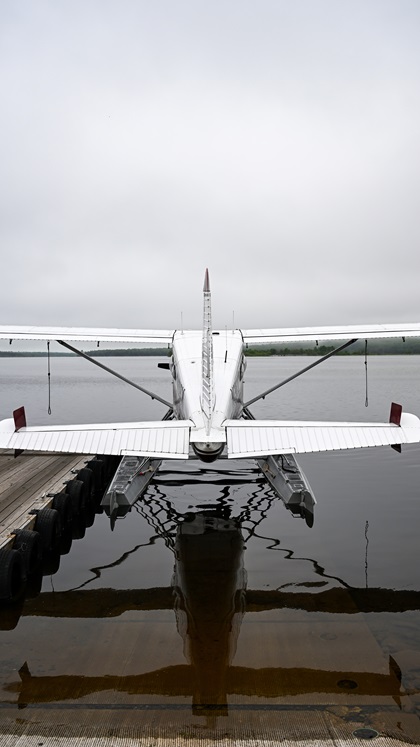
The Beavers are on straight floats and the Cessna’s amphibian properties are only helpful for when it is stationed in Florida for the summers. After a couple of previous nearby bases in the last decade, the aircraft are now based out of Torch Lake, in Michigan’s Upper Peninsula.
“We chose this location because it gives us plenty of room for operations,” Rector said. “It’s a pretty large lake, and there’s very little boat traffic here, so it’s a great operating location for us.”
Located south of Thunder Bay, Canada, and north of Michigan, Isle Royale is accessible in only two ways: by boat or by air.
Seaplanes connect passengers to Rock Harbor on the east end of Isle Royale and Windigo on the southwest end—the only developed outposts in a park where nearly everything else is wilderness.
“It’s an isolated wilderness area in the Lower 48, which you don’t come across very often,” Rector said. “One of the unique things about the island is how hard it is to get there.”
Boats make routine trips to the island from both Michigan and Minnesota, but relative to the seaplane, it’s a long and often wavy ride across the open waters of Lake Superior, with people frequently headed to the back of the boat to lose their lunch. Depending on your departure and destination, boat journeys range from four to more than six hours. The shortest ferry from the mainland takes about three and a half hours from Copper Harbor. A seaplane gets you to Isle Royale from Torch Lake, northeast of Houghton, Michigan, in around 40 to 45 minutes.
Rector, a former law enforcement, charter, and airline pilot, and his wife, who still works for a major airline, took over the business in 2014, when the company only operated the 206.
“We decided that two airline pilots and the schedule and having a kid is not really a good idea, so we took that opportunity to buy the floatplane business,” he said.
Since then, the fleet has grown, and Isle Royale Seaplanes now operates with six pilots and around 14 total staff to support the expanding business.
“In 2014, we probably carried maybe 600 people round trip,” Rector said. “This year we’ll probably do about 9,000.”
Because the park limits the number of visitors, that’s pretty much at the maximum, he said.
Gichigami
Lake Superior, known to the local Native American Ojibwe language as gichigami and Westernized by Henry Wadsworth Longfellow as “Gitche Gumee,” is infamous for “never giving up her dead” because the lake’s frigid waters cause bodies not to bloat and float.
The lake is respected by sailors and pilots alike for its perilous conditions and rapidly changing weather, a constant factor for seaplane operations to Isle Royale.
“The weather here is absolutely the biggest challenge that we face, primarily because of Lake Superior,” said Stawinski. “It’s just cold—always cold—so lots of fog, lots of wind, lots of rain.”
It’s a lesson written in blood in the many shipwrecks—famously the freighter SS Edmund Fitzgerald—and even lost seaplanes. On the walls of the office of Isle Royale Seaplanes sit many reminders of the storied history of operating seaplanes to Isle Royale, dating back to the early twentieth century. One of those photos shows a Republic RC–3 Seabee that operated to Isle Royale, which vanished over Lake Superior, and was never found.
“Flying in Michigan has a lot of similarities to Alaska,” Rector said. “We get a lot of fog, a lot of wind, a lot of rain, a lot of thunderstorms over a long, cold stretch of water, which poses its challenges almost daily.”
Ask Rector for tomorrow’s forecast, and he’ll look at you and chuckle, like someone who has heard that question maybe a million times too many. Sure, forecasts of sorts exist, but he’s been running the operation long enough to know better than to promise anything. Lake Superior keeps its own counsel, cold enough to breed fog out of nothing, big enough to build its own weather systems independent of whatever’s happening on the Michigan mainland.
“It changes rapidly; we’re in the middle of Lake Superior, and the lake kind of produces its own weather,” Rector said. “It can change in 30 minutes. We could be ready to fly in 30 minutes, or we could not fly at all today. So, we just never know.”
Today, thanks to modern technology and advanced aviation technology—the entire fleet is equipped with glass avionics—the crossing by seaplane is safer than ever.


Hidden spirit of the wilderness
For the record, those two days of fog weren’t anecdotal; they happened to AOPA reporting this story, grounded alongside the crew and watching the same webcams, waiting it out. The mainland had seen just about every kind of weather: fog, winds, blue skies, storms, and more. The island sat unchanged, with fog sitting unwaveringly at our destination of Rock Harbor. On the third day, when the morning sun beat hard enough to burn off the fog, we scrambled into the 206. The once-sleepy base ignited to life, with passengers and operations in full gear—even the dogs jumped to life.
The flight itself is rather simple.
“We’re over the [Keweenaw] peninsula for about six or seven minutes before we get out over the open water, and then that flight is over open water the entire way out there until we get to the harbor,” said Stawinski.
The benefit of the fact that most of the flight is over water is a smooth ride to passengers. That makes it not only a significantly more pleasant journey than the boat, but also a great introduction for many who find themselves on the first single-engine propeller aircraft of their lives.
“Just yesterday I had one [passenger] who was absolutely terrified getting into the airplane,” said Stawinski. “She wanted nothing to do with it. And I said, ‘I promise you,... you’re going to absolutely love it.’ She got out and said, ‘That was awesome, let’s do it again.’”
It helps that the views inbound to the island are stunning. You’re likely to fly over ore freighters on the same route the Fitzgerald once took, headed to or from Superior, Wisconsin, or even the Isle Royale Queen IV or Ranger III boats that operate to the island out of Michigan. Approaching the island, its scale is shocking; at around 50 miles long, maps don’t do it justice quite like seeing it from a few thousand feet. As the seaplane approaches landing in Rock Harbor, passengers realize the island is in an archipelago, with more than 400 smaller surrounding islands and rocky islets.
“It’s one of the least visited national parks in the country because it’s really hard to get there,” Rector said. Isle Royale is, in fact, the least visited national park in the Lower 48 contiguous United States. That makes for one of its greatest advantages. Stawinski says the moment of seeing the island appear is nothing short of magic.
“What I really love about this job is you’re taking a lot of people on their once-in-a-lifetime trip,” he said. “You get a lot of people who have worked hard to come out here, saved up a lot, and then you land, shut down, complete silence, and their reaction is what makes it worth it every time.”
Truly, when the engines shut off and the seaplane door pops open to dock, two things are immediately obvious: the quiet serenity and the rush of clean, cool air at least several degrees Fahrenheit cooler than the mainland.
Visitors arrive for different reasons, be it day trips, lodge stays, or extended wilderness treks.
“About a third of them are actually hiking the entire island,” Rector said. “We’ll drop them at one end, they’ll hike 45 miles, and we’ll pick them up a week later.”
Rock Harbor is the only part of the island that resembles civilization. You check in with the National Park Service, and next door there’s a general store—crucial if you’re camping—a couple of restaurants, and even a beautiful lodge for those not looking to camp. But already a quarter mile down to the campsite, it’s all pure wilderness.
Wi-Fi, of recent, is only available on one point on the entire island, and a bar of cell service is nearly impossible to find. That makes wrangling passengers difficult for Isle Royale Seaplanes. A digital display informs passengers of flight updates. Otherwise, a staff member lives full-time on the island to help the airplanes in as they dock, but also wrangling passengers as required.
Spending a night on the island, it’s hard not to appreciate the beauty of both the operation and the aircraft that make it possible in under an hour. Be it the nine-cylinder roar of the Beaver or the horsepower from the 206, the brief interruption in the island’s peace only adds to its uncommon serenity. Above all, it’s great to see meticulously kept Beavers keeping on their mission of connecting people to the remote bush for their enjoyment.
Ian Wilder is a former editor for AOPA.
isleroyaleseaplanes.com
$420 round trip per person, $289 one way, reservations underway for 2027
906-483-4991

Related Articles


