Pilots to the rescue
Volunteers use a Kodiak 100 to fly rescued critters to new homes
The sun split the sky open with an orange band shading from ombre to deep pink. We were racing that sunset to make it into position for a very important pickup the next morning: A cargo full of cats. Yes, 55 adults and kittens, some two to a crate if they were litter mates. Oh, and a dog named Sandy.
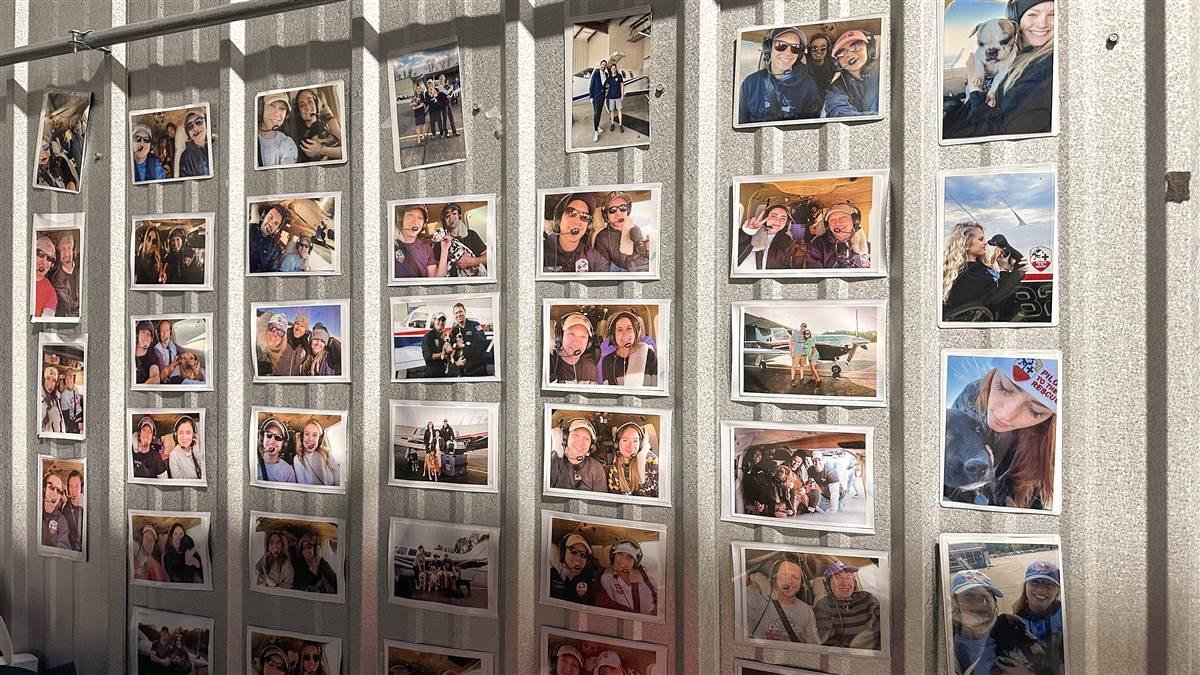


The mission? To bring these rescued, vaccinated, and neutered/spayed felines from living on the edge in Florida to forever homes in Massachusetts and New Jersey.
To fit all 750-plus pounds of critter and make an efficient trip, Pilots to the Rescue (PTTR) had just the right platform. Although they got their start using a series of Piper PA–32 models, the Daher Kodiak 100 now tackles this and other big-lift missions for PTTR.
And it succeeded in great amounts in 2025, surpassing its goal to move more than 1,200 animals from dire straits to living large. In December alone, PTTR carried more than 200 total creatures to safety (including a 250-pound pig named Stanley). Our 55 kitties were less than one quarter of their load for the month.


On a rescue mission
Michael Schneider, the founder of Pilots to the Rescue, made his debut in aviation by jumping out of an airplane, as opposed to flying one. “I received a skydive for my birthday about 20 years ago,” he says. “I remember how loud it was, how raw it was, and you could feel the vibrations. I was just enamored by being so close to the flight deck and seeing the single pilot—that really sparked my interest. So, after about three jumps, I was down in Miami, and I started asking questions of the pilot. And he said something that really stuck with me to this day: ‘Listen, skydiving is a lot of fun, but it’s a lonely sport. You can do it in whatever city you go to, but you might want to think about getting a pilot’s license because you can take your friends to, you know, a cool restaurant.’”
Schneider pursued his training at Blue Ash Aviation, north of Cincinnati, Ohio, where he was living at the time (circa 2009), and finished up his private certificate at Sporty’s Academy at nearby Clermont County Airport (I69). Then the end of the project he was working on allowed him to return to his home state of New York. He launched Pilots to the Rescue in 2015 to combine his love of animals with aviation. “The animal rescue part came from being around rescue animals as a small child,” he says. “My family, we always went to the local SPCA and we adopted cats and dogs. That’s all I knew growing up. And to my parents’ dismay, I was the kid in the neighborhood that took in the injured bird or the squirrel.”
Schneider had heard about people using their pilot wings to give back, and it spoke to him. “At that time in my life, I was going through an exploratory phase where certain things weren’t really working out. I didn’t understand why I couldn’t find someone to get married and have kids, you know—typical predicaments that young, 30-something people go through.” He wanted to use the certificate he had worked so hard to achieve, but for whatever reason, the medical-focused charitable flights he’d made didn’t resonate.
But saving animals did. “I did one of those rescue flights, and I was hooked,” says Schneider. Being a serial entrepreneur, he was determined to create his own organization. At first, Pilots to the Rescue formed a side hustle to his day job owning a for-profit business—and he made the flights in rental aircraft mostly out of Westchester County Airport (HPN). “It wasn’t until COVID hit that I realized, well, I better figure out a way to do this for a living,” he says. “And by the way, it was the best choice I ever made. A real COVID success story.” He closed the events-oriented business he owned at the time—it had been decimated during COVID anyway—and transitioned to Pilots to the Rescue full time by 2021.

The right lift for paws
Schneider had obtained his instrument rating and commercial certificate and logged about 1,500 hours over 16 years of flying. He was ready for something more capable. For Pilots to the Rescue, the Daher Kodiak 100 made sense.
“We closed on it in July [2024], but then brought it to Brodies in Fort Worth, Texas, to get some upgrades done,” says Schneider. “We just completed our one-year recurrent training.” PTTR has been operating the Kodiak 100 since October 2024. “These pilots love it. They get to build time in a turboprop, which never hurts if you’re going into charter world to fly a Pilatus or the like.” PTTR flies the Kodiak with two-pilot crews, to spread the workload associated with transporting animals, and as an extra measure of safety.
To supplement the aircraft, and to offer an alternative in weather too low to fly, Pilots to the Rescue has a fleet of four vans based at Caldwell that they can deploy on a mission. “We’re a hybrid model, because we use ground transport also,” he says. That’s how Pilots to the Rescue can move the volume of animals that they do each year.
Volunteer pilots can also use their own aircraft to fly missions, and those can be found on the organization’s transportation board on pilotstotherescue.org. Pilots end up arranging missions among themselves similar to how organizations such as Pilots N Paws do.
Our mission commander on this flight, MacKenzie Brendlen, learned to fly at Essex County Airport/Caldwell (CDW), and got her start in the Kodiak right after Schneider brought it on board last fall. She enjoys the challenge she found stepping up to the Kodiak, and on our trip she logged her 100th hour in the airplane in just under a year. Her co-pilot was Paul Mamauag, a first officer for a regional airline. “As far as finding pilots to fly the Kodiak, there are insurance-driven minimum requirements to train, which starts with a commercial certificate, instrument-rated and 750 hours total time,” says Schneider. Mentor time is also required if the pilot has little or no turboprop time behind the Pratt & Whitney PT6 series—the Kodiak 100 flies behind a PT6A-34 model.

Flying south, then north
We are flying along on a mission south to rendezvous with a team of cat rescuers based in Florida. These volunteers load their charges into vans in central Florida to meet up with the PTTR aircraft for their trip to the Northeast.
Brendlen changed our routing and pickup point a couple of times prior to departure because winter weather and persistent low coastal clouds and visibility covered the Southeast. We’d originally planned a flight from Caldwell to Brunswick Golden Isles Airport (BQK) in Georgia, with a fuel stop at Wilmington, North Carolina (ILM). That flexed to a destination of Birmingham, Alabama (BHM) because of the forecast low ceilings through the next day. But after talking with the Florida cat crew, Brendlen positioned us a bit closer, to Troy, Alabama (TOI) to save the women a couple of hours of driving time.
After about 2 hours 45 minutes enroute, we made our fuel stop at ZEF, Elkin Municipal. Another 2-hour 25-minute planned leg down to Troy extended a bit with a dogleg keeping us southeast of the Atlanta Class B. We were above the low cloud deck at that point, and treated to one of those persistent, orange-sherbet sunsets that winter in the northern latitudes is famous for.
The RNAV Runway 25 approach into Troy appeared straightforward, with reported conditions (900 feet and 10 miles visibility) above LPV minimums, at 300 and seven-eighths mile. With full nighttime on, though, and a ragged underlayer, it looked more like 500 to 600 and 3 or 4 miles at best in the darkness. It was a good reminder that the METARs at nontowered fields should be taken with a pessimistic view—and a missed approach spring-loaded in case the ceiling isn’t as smooth as advertised.
The next morning, we woke to 300- to 400-foot ceilings and a mile or two of visibility. Conditions improved by departure time, and we were in cloud at about 700 feet agl—and on top at 3,100 feet msl.
Clear skies beckoned at our fuel stop, Lynchburg Regional Airport (LYH), and we needed to stay relatively low (below 8,000 feet) because the feline (and one canine) occupants are more susceptible to hypoxia. Except for one vocal protestor named Margarita (according to the masking tape label on her carrier), there was nary a meow from the stacks bungeed well into the extra-sized cargo bay made even larger by the removal of the rear three rows of seats. Sandy, the terrier mix, must have curled up and slept the entire way, as she didn’t emit a sound.
For the last leg, from Lynchburg, Virginia, to Norwood, we knew ATC would probably take us into the layer of stratus cloud that made a bank from central Pennsylvania well into Massachusetts. Sure enough, over Altoona, Approach descended the Kodiak to 5,000 feet to stay below the corridor of jets headed into Newark, putting us right into the icy band. Since the 100 comes equipped with TKS for flight into known ice, we could proceed on, but with a wary eye to the rate of accumulation and a finger on the push-to-talk ready to advocate with Approach. About 15 minutes later, we were cleared to climb back to 7,000 and out of the junk, and with daylight still to go.
Slowing down for that segment had put us right at the deadline for meeting the rescue teams at Norwood Memorial (OWD), but that 20-minute delay was apparently taken in stride. As we taxied up to the ramp, the line of cars and vans waiting for our precious cargo shined headlights into the cold dusk. We shut down and began to unload, with volunteers calling the names of cats in each carrier as we handed them over. With about half of the cats unloaded, we fueled up and made the 1 hour 15-minute hop back to Caldwell, the Christmas lights twinkling below us as we crossed the Hudson Valley. We could just barely make out the red and green spotlights coloring the Empire State Building and other skyscrapers in the New York skyline to the south.
In the light of the open door sheltering the PTTR home base hangar, we handed over the rest of our charges to another tireless pair of volunteers, who would see those cats (and Sandy) into good homes just in time for the holidays.
Pilots to the Rescue completed a total of 85 rescue flights in 2025, with about 125,000 nautical miles flown in total. That’s roughly 2,300 lives saved—all because a handful of dedicated pilots have turned their dual passions for aviation and animals into action.
Related Articles


