- On December 26, 1973 (during the fuel crisis), President Richard M. Nixon became the first and only sitting president ever to take a scheduled airline flight when he boarded United Airlines Flight 55 (a Douglas DC–10) and flew from Washington, D.C., to Los Angeles. What was the call sign for that flight?
- How many state capitals are west of Los Angeles, and can you name them?
- From reader John Schmidt: The most common method of launching a glider—not a motorglider—is to be towed aloft by an airplane (an aerotow). Name seven other methods of launching a glider.
- A pilot won a $5,000 prize from The Baltimore Sun in 1910 by undertaking a flight dispelling the popular belief that it was dangerous for a pilot to
- fly at night.
- fly in rain.
- fly inverted.
- fly over a city.
- When did the first commercial airline flight from the United States to Europe involving a landplane take place? What airline operated that flight, and what type of airplane was used?
- True or false? The side windows of the Spirit of St. Louis were made of plastic and provided to protect Charles A. Lindbergh from the elements during his flight across the North Atlantic Ocean.
- From reader George Hulett: True or false? There has yet to be a production, jet-powered seaplane.
- Who was the first pilot to fly an airplane over both the North and the South Poles?
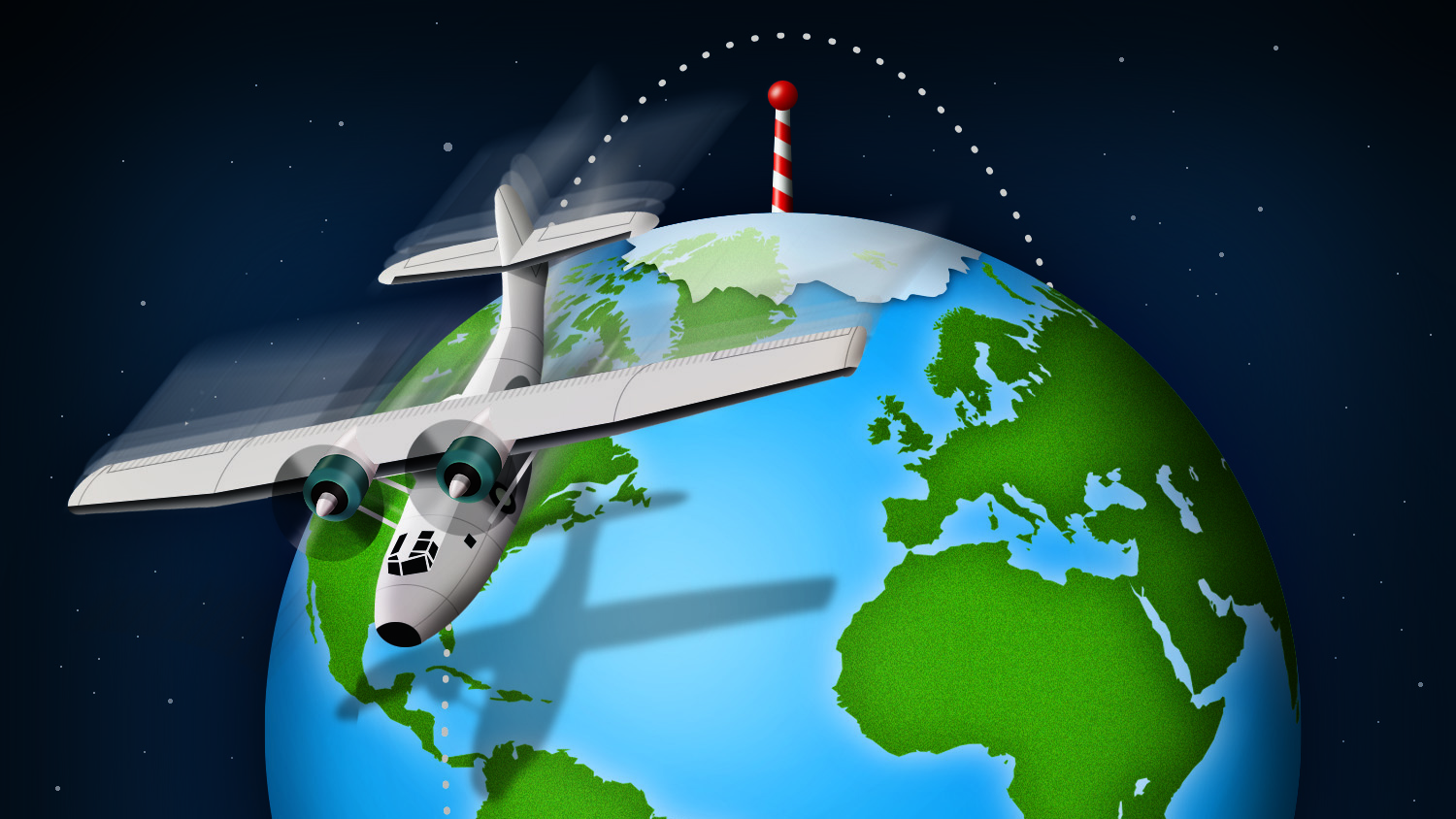
Illustration by John Ueland
- It was not “Air Force One” because the airplane was not a U.S. Air Force airplane. The call sign of a civilian airplane carrying the president of the United States is “Executive One.”
- There are six: Carson City, Nevada; Honolulu, Hawaii; Juneau, Alaska; Olympia, Washington; Sacramento, California; and Salem, Oregon.
- Gliders can be pushed off a cliff, towed by a car or truck (an auto tow), launched by a winch-operated cable, towed by a helicopter, and launched by a team of horses. In December 2025, nine Red Bull bicyclists towed a glider into the air using only pedal power. A bungee (or rubber rope) can launch very light gliders.
- The correct answer is D. On November 7, 1910, a Frenchman, Robert Latham, flew over Baltimore, Maryland, for almost an hour and dispelled the notion that heated air currents from the streets would cause disaster.
- A subsidiary of American Airlines, American Export Airlines, departed LaGuardia Airport using a Douglas DC–4 named Flagship London on October 23, 1945. It landed near London after stops in Boston, Massachusetts; Gander, Newfoundland; and Shannon, Ireland.
- True. Although these removable windows were in the airplane, Lindbergh did not use them because he believed they would “interfere with cockpit air circulation.”
- False. The first production, jet-powered seaplane was the twin-engine Beriev Be–10, a Soviet flying boat used as an open-sea patrol bomber that first flew on June 20, 1956.
- Polar pioneer Bernt Balchen. Although Admiral Richard Byrd was first to fly over both poles, he was not the pilot. Floyd Bennett and Bernt Balchen flew him over the North and South Pole, respectively. In 1949, Balchen flew from Alaska to Norway via the North Pole to become the first pilot to fly over both Poles.

Barry Schiff
Barry Schiff has been an aviation media consultant and technical advisor for motion pictures for more than 40 years. He is chairman of the AOPA Foundation Legacy Society.


