Expect the unexpected
And adapt when the unexpected happens
By Ken Petschauer
Expecting the unexpected is an important defense pilots use to protect against undesirable outcomes. A recent experience has taught me that it’s not enough to expect the unexpected—you also have to stay disciplined and adaptable once the unexpected occurs.
I was flying from Daytona Beach International (DAB) to Hickory Regional Airport in North Carolina (HKY)—a route I have flown many times. I filed IFR even though the weather was VFR along the route and at the destination. The filed route had us flying up the east coast of Florida to Savannah, Georgia, where we proceeded direct to Hickory, passing over Columbia, South Carolina.
As we approached the Columbia area, a cloud deck began to form well below our cruise altitude of 7,000 feet. Checking the weather via ADS-B, it was clear that the forecasts were in error, and a cloud layer was forming along the route. Hickory, however, was still reporting a few clouds at 1,500 feet. I was glad I had decided to file IFR and began to prepare for the possibility of having to shoot an approach into Hickory Regional. The cloud deck below us developed into a broken layer, but Hickory continued to report VFR conditions.
Flying IFR in the area approaching the Hickory airport, you are controlled by Charlotte Approach until very close to the airport before you are handed off to Atlanta Approach for sequencing. On this day, it was very busy, and the handoff occurred only about 7 miles south of the Hickory airport.
Upon initial contact with the approach controller, I was told the field was IFR with broken clouds at 1,500 feet and asked which approach I was requesting. I requested the RNAV 24.
A few minutes later, I was given a heading of 070, told to descend to 6,000 feet, and to expect the RNAV 24. I turned to 070 and descended to 6,000 feet. Shortly after that, I received the clearance “Proceed direct to INKEH, cross INKEH at or above 3,600 feet, cleared for the RNAV approach Two-Four to Hotel-Kilo-Yankee.”
This was a normal clearance, but in the several times I have flown this procedure, I had always been given direct OWALT (with no procedure turn) or been vectored to the final fix. As a result, I did not have the INKEH transition loaded into the GPS.
I promptly acknowledged the clearance and began the process of reprograming the GPS for the proper transition with course reversal. Something, however, was just not right. As I was replying to the controller, the radio sounded strange, and sure enough, after a few moments, the controller repeated his instructions. I acknowledged the clearance, but once again, something sounded wrong.
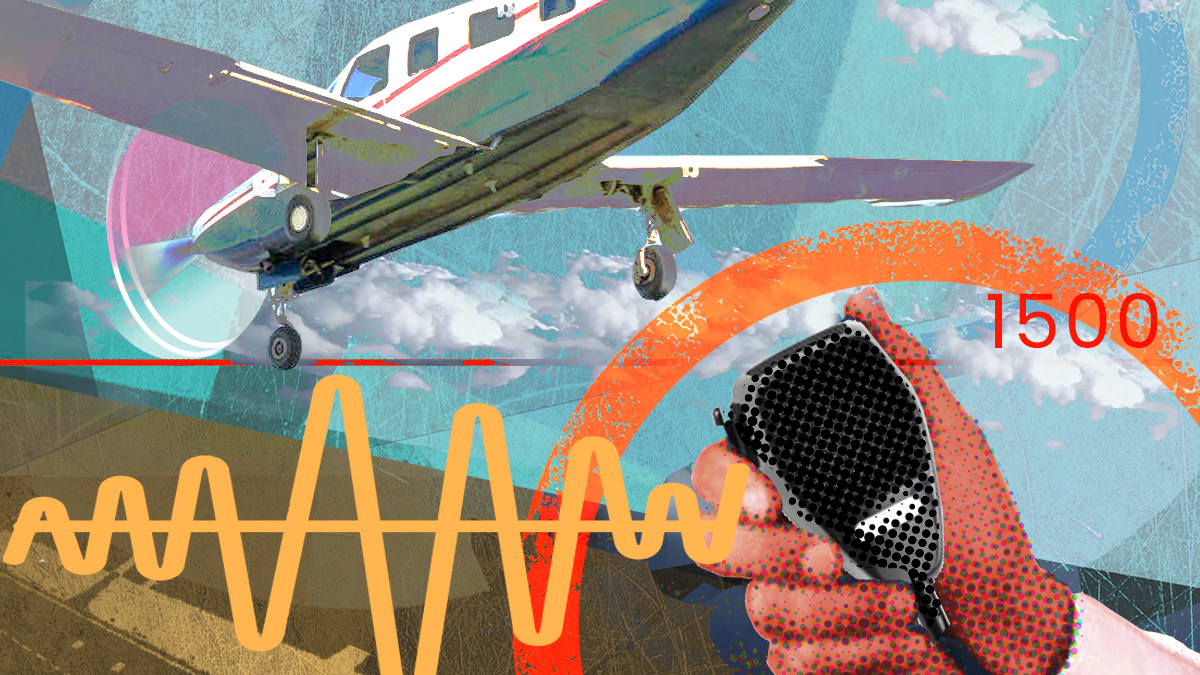
I then realized I had not heard any “side tone” in my headset when replying to ATC. The controller was quite busy, so I did not get an additional call back, but I realized the lack of “side tone” in my headset probably meant I was not transmitting. Switching radios was no help either; I could not transmit on either radio. Thankfully, at this point, the “Aviate, Navigate, Communicate” training took over. After ensuring a safe flight path, I continued to troubleshoot the issue, which I determined to be a push-to-talk (PTT) switch failure.
Considering my options, I thought of plugging my headset into the co-pilot’s side and using the PTT on that yoke. Great idea, until I realized my headset requires a panel-powered connection, which is not available on the co-pilot side.
The other option was to use the hand mic, which is normally mounted on the back of the throttle quadrant. It was a convenient option in theory, but since it gets kicked all the time when getting in and out of the airplane, I had decided to keep it unplugged and stored in the seatback pocket. Unfortunately, it was in the seatback I happened to be occupying, placing it at a very awkward reach, especially when trying to avoid accidentally disconnecting the autopilot or making undesirable control inputs.
After some painful arm bending and twisting, I was able to get the hand mic out of the seatback and plug it in. Thankfully, it worked, and I resumed communication with ATC. The controller had figured there was a mic issue, as he did hear some intermittent transmissions as I tried to reply. We broke out at 1,500 feet and landed uneventfully.
There was a lot to learn from this experience. Most important, of course, is remembering to fly the airplane. Another important, and somewhat surprising, lesson from this experience was just how strong the urge was to “fix” the problem. It could have been very easy to become so fixated on the relatively minor radio issue and forget to fly the airplane. Several accidents have been attributed to this type of distraction, and it is experiences like this that make you realize how it can happen to you. 
Ken Petschauer is a career airline pilot. As an active GA pilot and AOPA member for 38 years, he enjoys flying his Piper Saratoga and uses it to volunteer for Angel Flight and Pilots N Paws.
Related Articles


