Picking up an IFR clearance
From filing to readback correct
Not a question you want to be asking halfway down the runway. Picking up an instrument clearance is an important step to make sure that a clear expectation is set between ATC and you for your initial departure and route of flight.
With the exception of pop-up IFR clearances, you’ll need to file an IFR flight plan in order to pick up a clearance. In the pre-electronic flight bag days, this was typically done by phone or computer, and it still can be by calling 800-WX-BRIEF (800-992-7433) or going to 1800WXBrief.com. EFB apps like ForeFlight or Garmin Pilot will prepopulate all the fields with your planning details.
Although the process is speedy in the digital age, it can be helpful to leave time between filing and starting up the engine to make sure ATC has your flight plan. ForeFlight, for example, lets you file up to 28 days in advance.
For picking a route, you can always file direct; that doesn’t mean ATC will assign you a direct routing. ForeFlight and Garmin Pilot have features that let you see commonly cleared routes and might help you avoid a lengthy readback. Even then, you have to be ready for ATC to give you something completely different. Think of your filed route as your “preferred” routing.
What’s our clearance, Clarence?
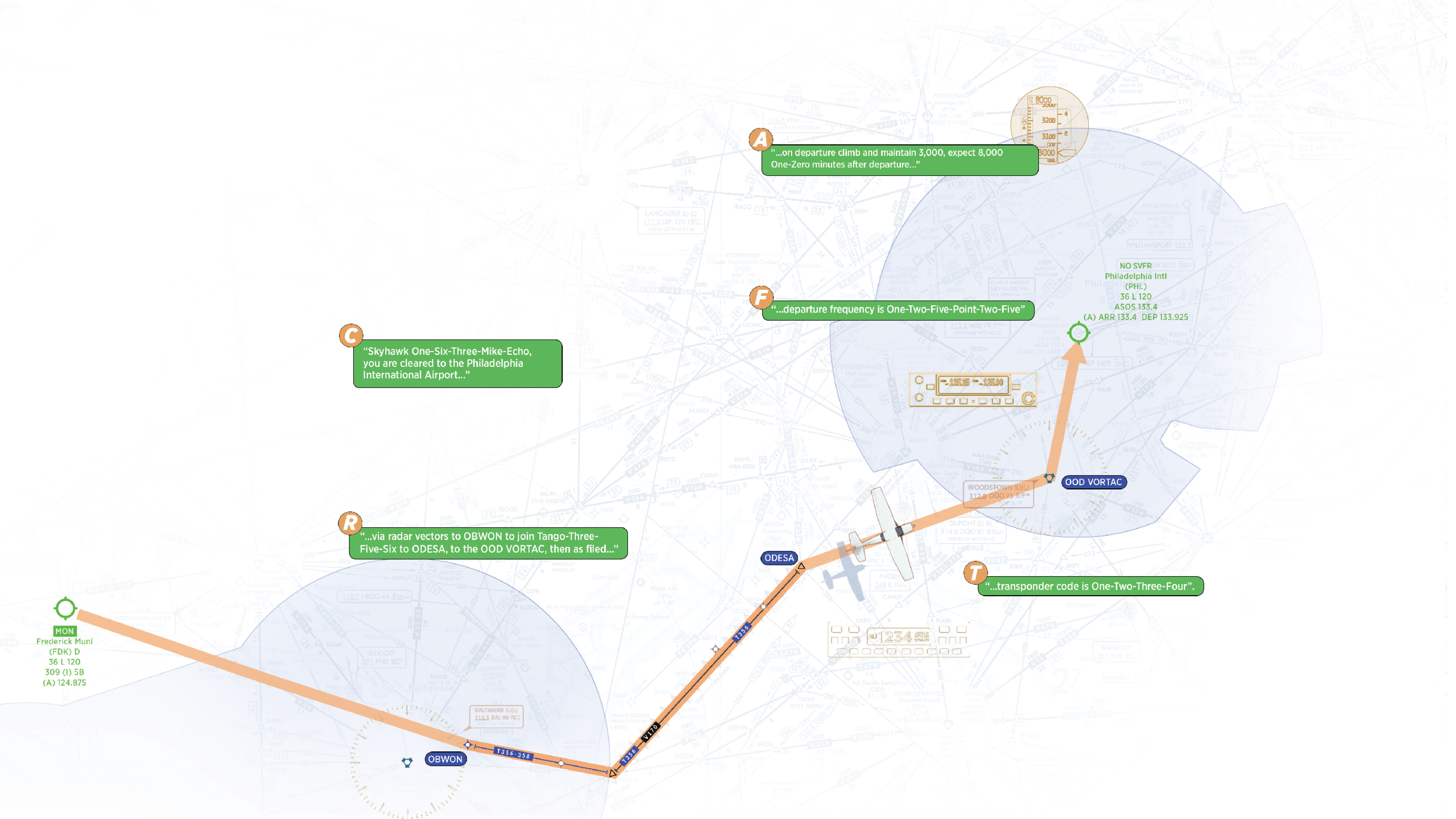
Your clearance will always be delivered in a standardized format, starting from your clearance limit, then route, altitude(s), frequencies, and transponder code. You should write the letters C, R, A, F, and T on your kneeboard before calling so you’re ready to copy. Take this sample CRAFT clearance from Frederick, Maryland, (FDK) to Philadelphia (PHL). We’d call: “Frederick Ground, Skyhawk One-Six-Three-Mike-Echo is ready to pick up our IFR clearance to Philadelphia International, Papa, Hotel, Lima.”
C:
“Skyhawk One-Six-Three-Mike-Echo, you are cleared to the Philadelphia International Airport...”
...stands for clearance limit and is most often your airport or waypoint of choosing. You might be cleared to an en route intersection, which means you’re cleared only to that intersection until noted otherwise by ATC (which might necessitate a hold). In this instance, we’re cleared all the way to the Philadelphia airport.
R:
“...via radar vectors to OBWON to join Tango-Three-Five-Six to ODESA, to the OOD VORTAC, then as filed...”
...is route; it can be tempting to try to understand what we’re being told, but our focus during the clearance process is simply on transcribing the clearance correctly. We can work on entering the clearance into our navigation after, and if it’s unclear at that point, we can always call up and ask for clarification. Here, we’d be vectored to OBWON before joining a Tango airway, proceeding to a VORTAC after exiting the airway, before receiving arrival instructions from Philadelphia controllers.
A:
“...on departure climb and maintain 3,000, expect 8,000 One-Zero minutes after departure...”
...stands for altitude and typically consists of your initial altitude on departure and when you can expect a higher altitude.
F:
“...departure frequency is One-Two-Five-Point-Two-Five”
...is frequency and is usually included to make the switch from tower to departure easy during the task-saturating takeoff process.
T:
“...transponder code is One-Two-Three-Four”
...will be your discrete transponder squawk code. After reading it all back correctly, you’ll receive follow-up instructions, like contacting ground when you’re ready to taxi.
Once you’ve received your clearance, have read it back correctly, and have programmed the cleared route into the GPS and understood the instructions, you’re ready to depart and head out into the soup.
If you’re obtaining clearance at a nontowered airport, you’ll also be issued a clearance void time. ATC will clear traffic around your void time, and if you’re not underway by your void time, you need to contact ATC again (as soon as possible, within 30 minutes to avoid search and rescue initiation) to receive a new clearance.

Related Articles


