GPS jamming active when King Air struck mountain
NTSB reports on New Mexico air ambulance crash that killed four, sparked wildfire
A Beechcraft King Air collided with a New Mexico mountain ridge while attempting an instrument approach shortly after midnight on a moonless May 14, killing four people and igniting a wildfire that took nearly a month to extinguish. GPS interference—an increasingly common event in recent years—figures prominently in the preliminary report released by the NTSB.


Investigators plotted GPS data of the fatal air ambulance flight from two sources: recorded ADS-B data, and a Spidertracks device onboard the aircraft. Two flight nurses and two pilots planned a short flight from their home base in Roswell Air Center Airport to Sierra Blanca Regional Airport in Ruidoso. Visibility was 10 miles with clear skies when the flight departed Roswell to pick up a patient for transport to Albuquerque.
Investigators compared the GPS data recorded by ADS-B and Spidertracks and found discrepancies in recorded altitudes that coincided with the military GPS jamming that was underway at the time.
"The data from both sources were consistent with each other, except the recorded Spidertracks GPS altitude was generally about 600 [feet] higher than the recorded ADS-B altitudes and there were large gaps in the recorded ADS-B data," the preliminary report states. Just after midnight, an air traffic controller advised the King Air crew they were at 13,000 feet, 1,000 feet above their assigned altitude, and the pilots responded they were descending to their assigned altitude and had "lost GPS capability." The pilot requested a heading, and ATC vectored the aircraft to 275 degrees toward Ruidoso. The pilot requested the GPS approach to Runway 24.
At 12:01 a.m., the approach controller contacted their operations supervisor to relay a request that the military stop jamming GPS, a call the operations supervisor placed at 12:05 a.m., according to the report. Two minutes later, the ADS-B data, which had been recorded at one-minute intervals during the jamming, resumed recording as normal, with positions updated every 2 to 3 seconds.
The controller had meanwhile advised the King Air to fly 350 degrees to the REYOK waypoint, the initial approach fix for both the GPS and instrument landing system approaches to the runway, which guide aircraft just south of the Capitan Mountains, and a 10,201-foot peak located about 14 miles northeast of the airport.
The King Air crew read back their clearance for the GPS approach, turned north as directed, and, during the turn, requested the ILS approach "due to the loss of GPS navigation capability." The airplane continued north for about 20 nautical miles, at a GPS altitude of 12,600 feet. "During this segment of the flight, the [approach] controller provided services to other traffic, including three additional aircraft that reported a loss of GPS. One of those aircraft expressed difficulty identifying a directed to ground based navigation aid and required additional assistance" from ATC, the report states. At 12:04 a.m., the approach controller advised the King Air to expect radar vectors utilizing right turns to align the airplane for a straight-in approach over the REYOK intersection 'in a couple of minutes.'"
The aircraft never made a right turn. Instead, it turned left toward the airport—and the high terrain—about 12 nm from REYOK.
At 12:08 a.m., the King Air, now about 31 nm northeast of the destination airport, reported "a visual on Ruidoso," and, 30 seconds later (after being stepped on by other radio traffic), repeated that they could "go visual" to their destination. The flight was cleared for the visual approach and advised they could cancel IFR in the air above 9,000 feet msl, or after landing. The crew advised they would cancel IFR "in just a couple of minutes." It was their final transmission.
The King Air, miles north of a safe southwest route to Ruidoso, impacted terrain at 12:15 a.m. Mountain Daylight Time. More than 1,000 firefighters spent nearly a month working to douse the ensuing blaze, which burned 31,860 acres.
'Stop buzzer'
GPS interference created by military jamming operations has been a concern for years, particularly as the dissemination of related notams has been inconsistent. In 2019 (and since), AOPA pressed the FAA to improve awareness of and mitigate the impacts of GPS interference caused by military jamming, advising pilots, as a stopgap measure, to request that ATC "stop buzzer" when navigation systems are affected.
The NTSB report notes that ATC made exactly that request on May 14, but then followed up at 12:10 a.m. to advise the military that the King Air was on a visual approach, and jamming could resume.
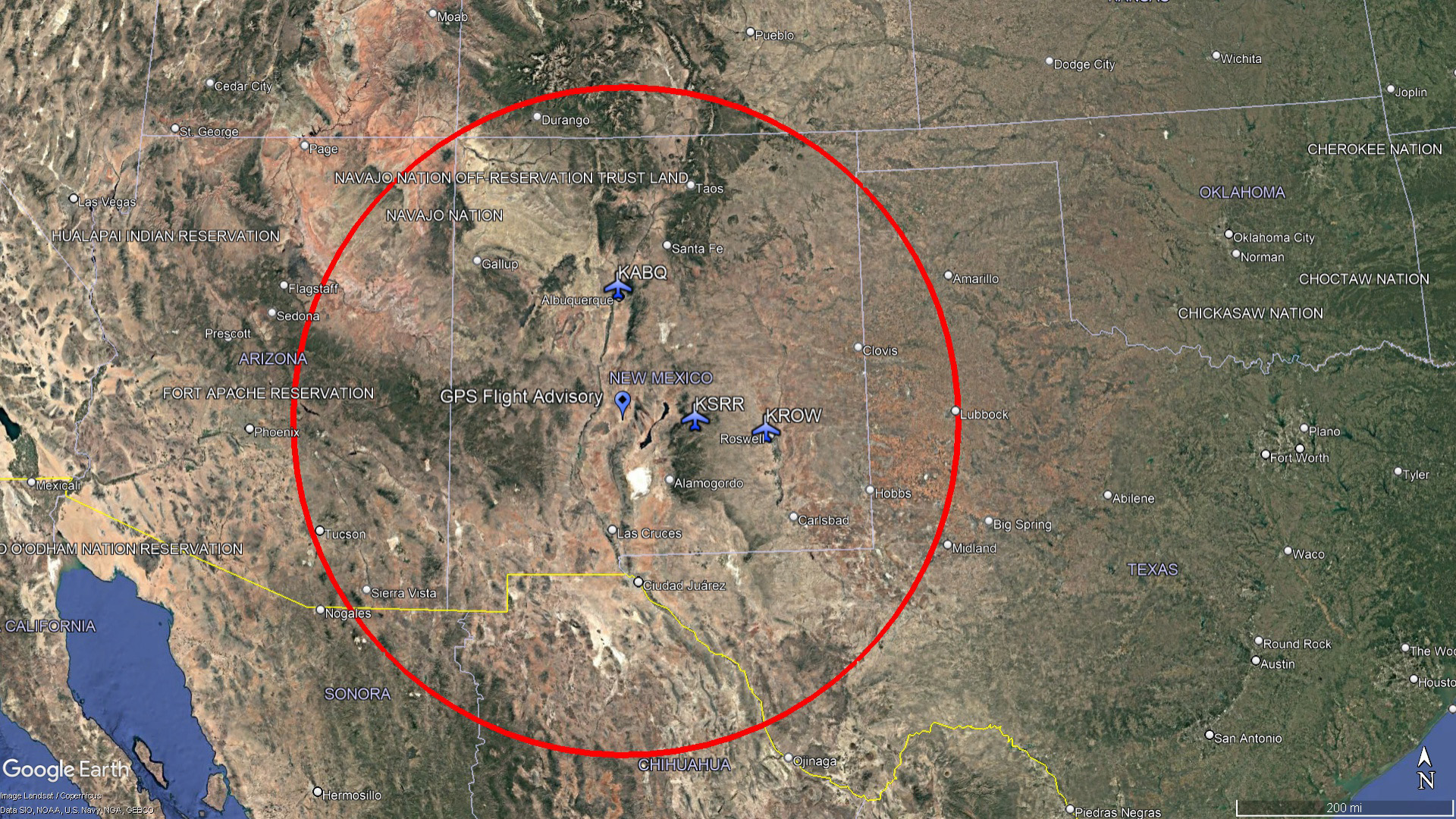
A public notice posted outside of the notam system by the FAA Safety Team detailed the GPS interference expected to originate from the White Sands Missile Range on the date of the flight, though it did not include a graphic depiction of the 240-nm radius around the listed latitude and longitude. The notice indicated GPS testing "may result in unreliable or unavailable GPS signal" within 240 miles from 4,000 feet to 10,000 feet agl. Higher altitudes could be affected up to 366 nautical miles from the center. The accident flight's destination airport is less than 70 nm from the center of the advisory area.
"At 0010:27 ADS-B again began collecting data at about one-minute intervals. About the same time, the airplane began descending toward SRR followed by a slight right turn at 0013:26 and 9,820 ft Spidertrack GPS altitude," the report states. The aircraft struck terrain at 9,950 feet, 730 feet east and 230 feet below the Capitan Mountains Summit Radio Facility at 10,180 feet elevation.
Investigators reviewed the ForeFlight briefing and notam information provided to the crew, and found it contained a notam indicating the automated weather broadcast transmitter was out of service, which would have disallowed the use of either the GPS or ILS approach to Ruidoso. An enroute navigation notam advised of GPS interference within an area defined by a coded latitude and longitude, with a center point within the White Sands Missile Test Range and a 240 nm radius, within which interference could be expected between 4,000 feet and 10,000 feet agl.
AOPA has continued to press the FAA to make these advisories more visible to pilots. In some cases, notams or public notices are issued that link to maps depicting the affected area, though not always. Public notices of GPS interference activities (and other safety-related information) posted by the FAA Safety Team on a webpage more consistently include graphic depictions of affected GPS interference areas that are otherwise time-consuming to decode. The accident flight crew was dispatched just after 11 p.m., allowing the pilots less than an hour to complete all preflight planning and inspection tasks before launching.
The ForeFlight briefing did make it clear that there were no weather reports or forecasts available from Sierra Blanca Regional Airport. Not only did that render both approaches to the destination runway unauthorized, it may have complicated efforts to correctly set the altimeter, which could have led to erroneous readings from that instrument while GPS interference was causing errors on the crew's other source of altitude information. The report does not state or speculate whether the crew intended to actually fly an approach not authorized in the absence of local weather information, or if they planned from the beginning of the flight to divert if they were unable to make a visual approach.
While this appears to be the first fatal accident in which GPS interference was a factor, flight crew reports of GPS interference, including jamming, have increased sharply in recent years. A recent search of published reports in the Aviation Safety Reporting System database found five such reports from 2019, and four in 2020. The reports, many if not most of which occurred outside of the United States, increased from about half a dozen per year through 2023, up to 50 in 2024, and 40 in 2025. Many of these crews reported operational impacts including GPS navigation malfunction.
The AOPA Air Safety Institute is funded by charitable donations to the AOPA Foundation, a 501(c)(3) organization. To be a part of the solution, visit www.aopafoundation.org/donate.