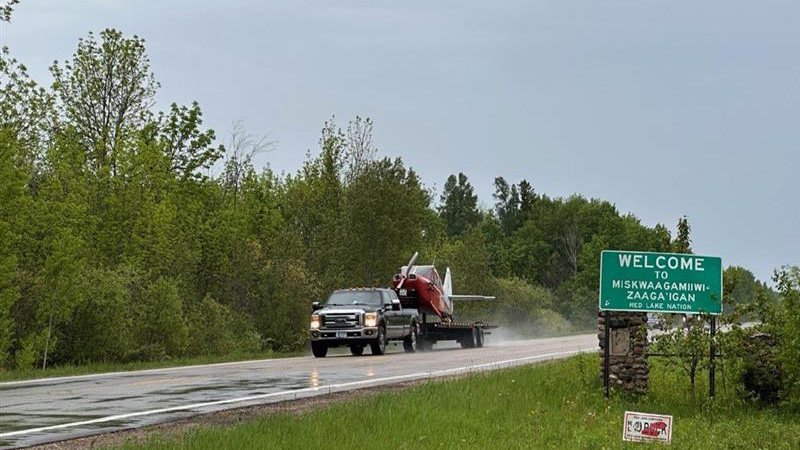
Minnesota tribe returns airplane seven months after seizure
AOPA supported pilot with legal, advocacy efforts
A Minnesota pilot, whose Stinson 108 was seized by the Red Lake Nation following an emergency landing on a state highway, got his airplane back on June 3 after months of effort by AOPA and others.

On October 15, Darrin Smedsmo was flying from his home airport in Roseau, Minnesota, to Bemidji, Minnesota, for his first instrument flight lesson when he says his engine seized over Red Lake.
Smedsmo says he called AOPA “within minutes,” and connected with Deputy General Counsel Jared Allen, who started working immediately to help Smedsmo navigate the situation.
“I first spoke with Darrin shortly after the emergency landing—he was still sitting in the airplane, and tribal police had just recently shown up,” said Allen. “I started to walk him through information the FAA might demand and other considerations following an emergency landing, and then everything changed. The tribal police let him know that they were impounding the airplane, which was a surprise. That changed the conversation with Darrin entirely. I made sure he had everything he needed out of the airplane, including certain aircraft documents, because we didn’t know what would come next.”
Since then, Allen—along with AOPA’s legal and government affairs teams—has worked tirelessly to help Smedsmo recover his airplane and ensure this does not happen to other pilots.
“No amount I ever give to AOPA in dues will ever cover what I have received,” said Smedsmo.
Allen met with Smedsmo and his attorneys at least once a week for months, and shared updates with the FAA. Meanwhile, in December, AOPA sent a letter to Interior Secretary Doug Burgum and Transportation Secretary Sean Duffy urging them to intervene.
In it, AOPA stated that Smedsmo’s emergency landing was “consistent with established aviation safety procedures and federal regulations” that “was undertaken solely to preserve life and property and was necessitated by mechanical failure,” and that the case “sets a troubling precedent that could discourage pilots from making necessary emergency landings, thereby jeopardizing public safety.”
At a recent presentation, Smedsmo asked the audience, “Do you understand what a big deal this is?” and then he answered saying, “I don't think I even realize what a big deal this is.”
Three months after seizing the Stinson, the tribe offered him the airplane back for $7,750—covering the $2,750 towing bill and also including a $5,000 donation to the Red Lake Nation Boys & Girls Club. Smedsmo told Lakeland PBS that “wasn’t acceptable.”
After declining the January offer, Smedsmo said additional counsel he retained to represent him before the tribe was optimistic that the Stinson would be returned.
“I talked to my A&P and said, ‘Are you ready to roll?’ quite a few times,” said Smedsmo.
AOPA sent another letter to Secretaries Burgum and Duffy in March and reiterated that the federal government has ”exclusive sovereignty” over the nation’s airspace and that federal regulations require “the pilot in command to take whatever action is necessary to protect life and property.”
“The current situation involving Red Lake Nation raises significant concern within the general aviation community. If an emergency landing made in the interest of safety can be treated as trespassing and result in confiscation of an aircraft and substantial penalties, it creates uncertainty for pilots who may be forced by circumstances beyond their control to land wherever safety requires,” wrote AOPA Senior Vice President of Government Affairs and Advocacy Jim Coon.
Smedsmo learned on May 30 that the tribe agreed to release his airplane.
In a June 1 letter to Smedsmo’s attorney, Red Lake Nation Chief Prosecutor Ogema Neadeau wrote, “the Red Lake Prosecution team has decided not to bring trespass or other related charges against Mr. Smedsmo with respect to his conduct on the Red Lake Nation lands on October 15, 2025; and the Prosecution has decided that it would be fair and equitable to return Mr. Smedsmo’s airplane to him at this time.”
On June 3, Smedsmo—along with his A&P mechanic and a few others—loaded the airplane on a trailer and transported it to a shed Smedsmo owns, where he and his mechanic plan to take the engine off in the coming weeks to find the cause of the engine failure.
“I believe my fight with the tribe is over,” said Smedsmo, and while he’d like to continue pursuing a legal case to clarify federal supremacy over airspace, those efforts have not panned out thus far.
Neadeau, in his June 1 letter, said the tribe reviewed and updated “the Nation’s policies pertaining to the regulation of aircraft over Red Lake Nation airspace,” and said it will allow three air ambulance operators to serve Red Lake Nation, and others can contact the tribe for permission to operate there.
In addition, the letter stated that the Red Lake Tribal Council “issued specific protocols to the Bureau of Indian Affairs, the U.S. Forest Service, and the Minnesota Department of Natural Resources” for firefighting operations—and that “each agency appreciated receiving the Red Lake Nation’s prescribed protocols.”
At the same time, the tribe said the FAA “has been very helpful in explaining the process for the Red Lake Nation’s airspace concerns to be accommodated, despite the fact that the federal government has preempted virtually all airspace matters throughout the United States.”
On June 8, the Red Lake Nation issued a press release explaining the purpose of the 1978 resolution and reacting to AOPA’s involvement in assisting Smedsmo.
“The resolution was necessary because at the time the U.S. Military had literally been dropping bombs on a regular basis over Red Lake Nation lands and waters, supposedly for testing purposes,” wrote the tribe. “As a result, the Tribal Council stepped up and enacted the resolution at issue to prohibit the further bombing and airspace breaches by those flying in Red Lake Nation airspace.”
It continued to say that Smedsmo “landed the airplane on Red Lake lands,” which it says constituted “trespassing.”
The tribe stated, “airplane owner associations and other groups secured the cooperation of local and national politicians with the goal of harassing and threatening Red Lake Nation leadership, while this matter was in the investigative stage, with no regard for Red Lake’s responsibility to complete an investigation into this matter.”
“AOPA only had two goals in this case,” said Allen. “First, we wanted to ensure Darrin recovered his airplane as he was flying in federally protected airspace and executed an emergency landing in accordance with federal law. Second, we engaged with federal officials because our nation’s airspace is federally protected. It is not governed by tribes, states, or any local government. Given what we know about the case today, we believe this seizure should have never happened.”

The tribe said it recently told the FAA that “this was not a case where the Red Lake Nation was seeking to enforce its 48-year old tribal law pertaining to the protection of Red Lake’s airspace.” However, that is what the tribe claimed when it first seized the Stinson, as noted on the citation he received at the scene—Resolution 59-78 is the tribal airspace resolution. Instead, Red Lake Nation claims that it told the FAA that it seized the airplane because Smedsmo trespassed on Red Lake Nation land, and that it only returned the airplane after its investigation was complete.
“I didn't choose this fight, but I was willing to fight it for everybody,” said Smedsmo.
“Darrin did what he needed to do—he had an emergency and used his best judgment as PIC to get the aircraft safely on the ground, without any injuries or damage,” said Allen. “And while this particular case is resolved, Red Lake Nation has done nothing publicly to assure pilots and aircraft owners that they wouldn’t seize another airplane in the same manner in the future.”
“If I had another emergency landing, I would probably be treated the same way,” said Smedsmo.
“We are certainly exploring options to ensure that the situation Mr. Smedsmo endured doesn’t happen again to other pilots,” said Coon.
“Last year alone, AOPA attorneys helped our members with more than 5,100 legal matters through Pilot Protection Services—covering a wide range of issues,” said Allen. “Some pilots need help reviewing a contract for a new airplane while others call us from the ramp after hearing the dreaded, ‘I’ve got a number for you to call,’ from air traffic control. In any case, PPS is something any pilot should have. We are here to help.”
With the Stinson’s seizure behind him, Smedsmo has finally started his instrument training—he delayed it while fighting to get the airplane back—and flew his other airplane, a Piper Cherokee Six, to Bemidji for his first three lessons on June 7, 8, and 9.