Oh! rings
Taking control of your elastomeric seals
The pilot switched tanks and tried to restart. Nothing. He turned back toward an airport they’d passed, but the airplane was already descending too fast. It struck trees and came to rest in a dry riverbed. The fuselage caught fire. The four passengers pulled each other from the wreckage, badly injured. The pilot died two weeks later.
Post-accident teardown found no mechanical failure in the engine itself. What investigators found instead was a leaking nose seal on the engine-driven fuel pump, damaged by corrosion and oxidation. That single seal—a small ring of rubber on the pump’s drive shaft—had been bleeding fuel overboard at three to four gallons per hour throughout the flight. The pilot had been flying on math that no longer applied to the airplane.
On October 17, 2022, a Mooney M20J departed Luskintyre, Australia, on what should have been an uneventful flight. It didn’t get far. Shortly after takeoff, a fire broke out in the engine compartment. The pilot attempted to return, but the airplane struck terrain and was destroyed in a post-impact fire.
The Australian Transport Safety Bureau traced the origin of the fire to something almost insultingly small: an O-ring seal on the outlet fitting of the engine-driven fuel pump. The seal had deteriorated with age, allowing fuel to leak, vaporize, and ignite in the engine compartment. The O-ring had likely been in service for decades—possibly nearly three—without ever being disturbed.
Two elastomeric seals. Two accidents. Both preventable.
A brief history
The O-ring is a simple mechanical components—a torus of elastomeric material that seals a joint by being compressed between two surfaces. It should be reliable. The wrong material, age, or poor installation technique turns an O-ring into a liability.
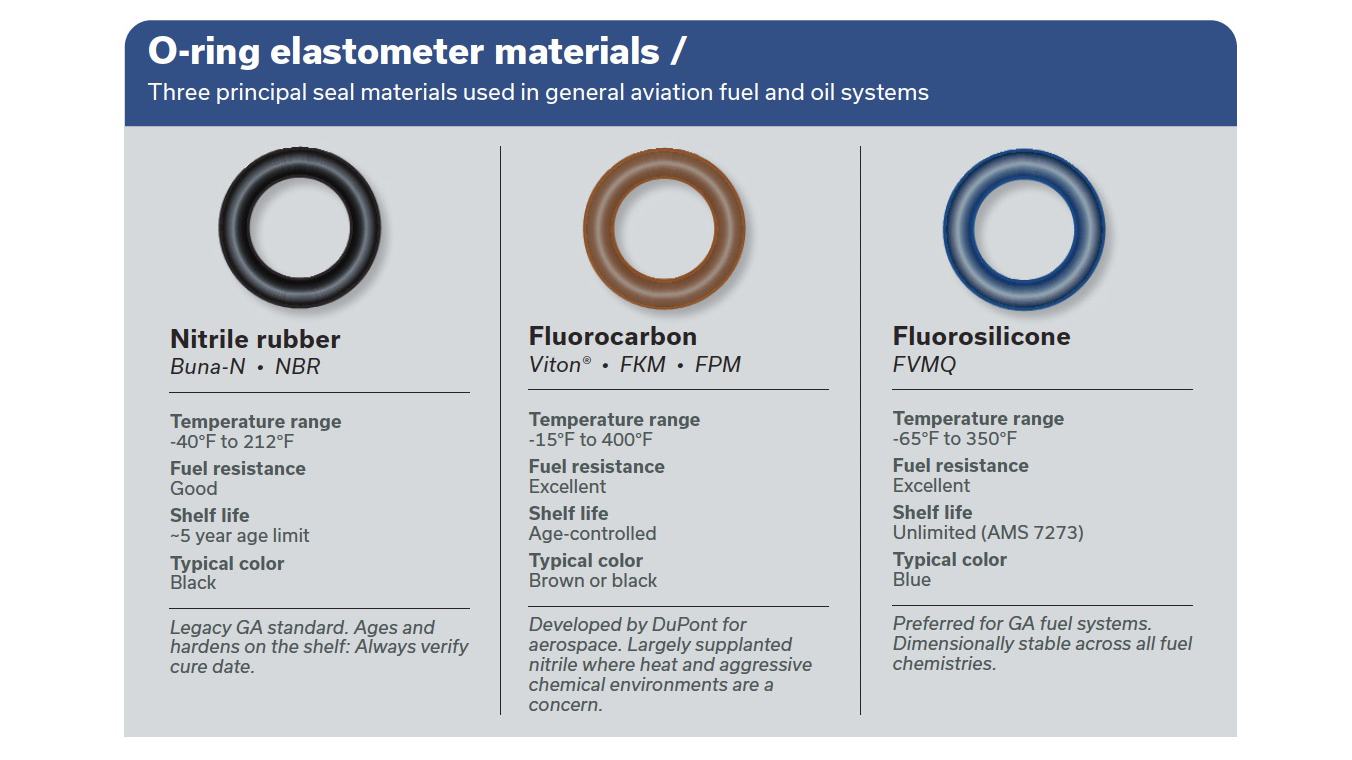
For most of GA’s history, the workhorse seal material was nitrile rubber, commonly known by trade names like Buna-N or NBR (acrylonitrile-butadiene rubber). Nitrile is inexpensive, widely available, and reasonably compatible with petroleum-based aviation fuels. It was the natural choice for carburetors, fuel strainers, selector valves, gascolators, and fuel pump housings on generations of piston aircraft.
But nitrile has limitations. Its maximum continuous service temperature sits around 212 degrees Fahrenheit—acceptable for most GA applications but marginal in turbocharged engine compartments where temperatures regularly exceed that threshold. More important, nitrile ages. It oxidizes, hardens, and loses elasticity over time, even when sitting on a shelf. For that reason, military specifications historically required “age control”—meaning nitrile O-rings had to be used within a specified number of years from their cure date and discarded when they aged out, regardless of appearance. A nitrile O-ring that looks fine on the bench may already be too far gone to seal reliably under thermal cycling and vibration.
In the 1950s, DuPont introduced Viton, a fluorocarbon elastomer that the engineering world now classifies generically as FKM or FPM. Viton was developed specifically for aerospace applications and represented a significant leap forward: temperature capability up to roughly 400 degrees F, far superior chemical resistance, and better resistance to compression set—the tendency of a seal to take a permanent “squish” and lose its ability to recover and reseal. Newer-generation FKM seals are now standard in many aircraft engine and fuel system applications, largely supplanting nitrile wherever heat and aggressive chemical environments are a concern.
The newest kid on the block—and the material that deserves more attention in piston GA—is fluorosilicone, known chemically as FVMQ. Fluorosilicone combines the fuel and chemical resistance of a fluorocarbon with the wide temperature range of silicone rubber. It retains flexibility at temperatures down to minus-65 degrees F, where both nitrile and FKM can become brittle. Fluorosilicone carries no shelf-life limitation—you can store a bag of aviation-grade fluorosilicone O-rings for 15 years and install them with full confidence.
Identifying O-ring material in service is tricky, since seals seldom carry markings. As a rule of thumb, older black O-rings are often Buna-N/nitrile, brown ones are commonly Viton/FKM, and blue or green seals in fuel system applications are frequently fluorosilicone/FVMQ. These color conventions are not standardized, however, and none should be relied upon for positive identification. The age of a seal may be a more reliable indicator than its color.
Why seals fail
Elastomers live a tough life. Exposed to heat, oxygen, fuel, oil, and constant compression, the polymer chains that give the material its elasticity gradually break down or cross-link, making the material stiffer and less resilient. A common failure mode is compression set: The O-ring takes on a permanent flattened shape and no longer pushes firmly against the sealing surfaces. It may still appear intact, but it’s no longer doing its job. A seal may weep slightly for a long time before it leaks enough to be noticed—and in a fuel system, vapor accumulation in unseen places is a hazard in its own right. The ATSB made a point in its Mooney report worth emphasizing: The absence of a visible leak during inspection doesn’t mean a seal will perform under all operating conditions.
Replace everything?
It’s tempting to think the solution is to replace every old O-ring with a new one made from better material. But the decision isn’t cost-free. Every time you open a fuel or oil system, you create an opportunity for a maintenance-induced failure. Fittings get loosened and retightened. Seals can be nicked, twisted, or improperly lubricated. Torque values can be wrong. A connection that was working fine can suddenly develop a leak after reassembly, and the damage may not be visible on inspection. The decision to replace a seal that isn’t causing problems shouldn't be taken casually. Leave an aging seal in place, and it may eventually fail on its own terms; disturb a stable system, and you may create the very problem you were trying to prevent.
The most defensible strategy is opportunistic replacement. Whenever a component must be removed for another reason—when the system is already open—that’s the time to replace its seals with modern materials. No additional maintenance-induced failure risk is incurred, and the benefit of installing current-generation fluorosilicone or FKM is realized. Beyond that, judgment is required. A seal that has been undisturbed for years, shows no sign of leaking, and sits in a relatively benign location may be best left alone. But not all seals live in benign locations. Firewall-forward, a seal failure can cause an in-flight fire. In high-consequence locations, if there is evidence—or even reasonable suspicion—that seals are decades old and have never been replaced, prophylactic action is warranted even if nothing appears to be leaking.
Dynamic seals deserve separate consideration. The shaft seal of a rotary fuel pump or fuel selector valve is subject to constant wear regardless of material and should be replaced on a schedule, not just when something starts leaking. When seals are replaced, technique matters as much as the decision to replace them. Proper lubrication, careful handling, correct sizing, and meticulous assembly are essential. An improperly installed new seal can be worse than an aging one that was working.
The two accidents weren’t the result of complex failure sequences. They were caused by small elastomeric seals that had been in service too long. Old seals retire themselves—on their own schedule, at altitude, at a time of their choosing. 
O-rings and unleaded avgas /


Related Articles


