Data from fatal approach suggests spiral dive
NTSB posts preliminary report on New Orleans IFR accident
Preliminary findings reported by the NTSB, along with ADS-B data from the accident flight, show a flight instructor and a private pilot lost control of their Cessna 172N while attempting a night instrument approach to Lakefront Airport in New Orleans on November 24, impacting Lake Pontchartrain at high speed.


The NTSB reported that the flight was operating under instrument flight rules and had been cleared for the instrument landing system approach to Runway 18R at 6:17 p.m. Central time, and the aircraft's final recorded position was 3.7 miles from the runway.
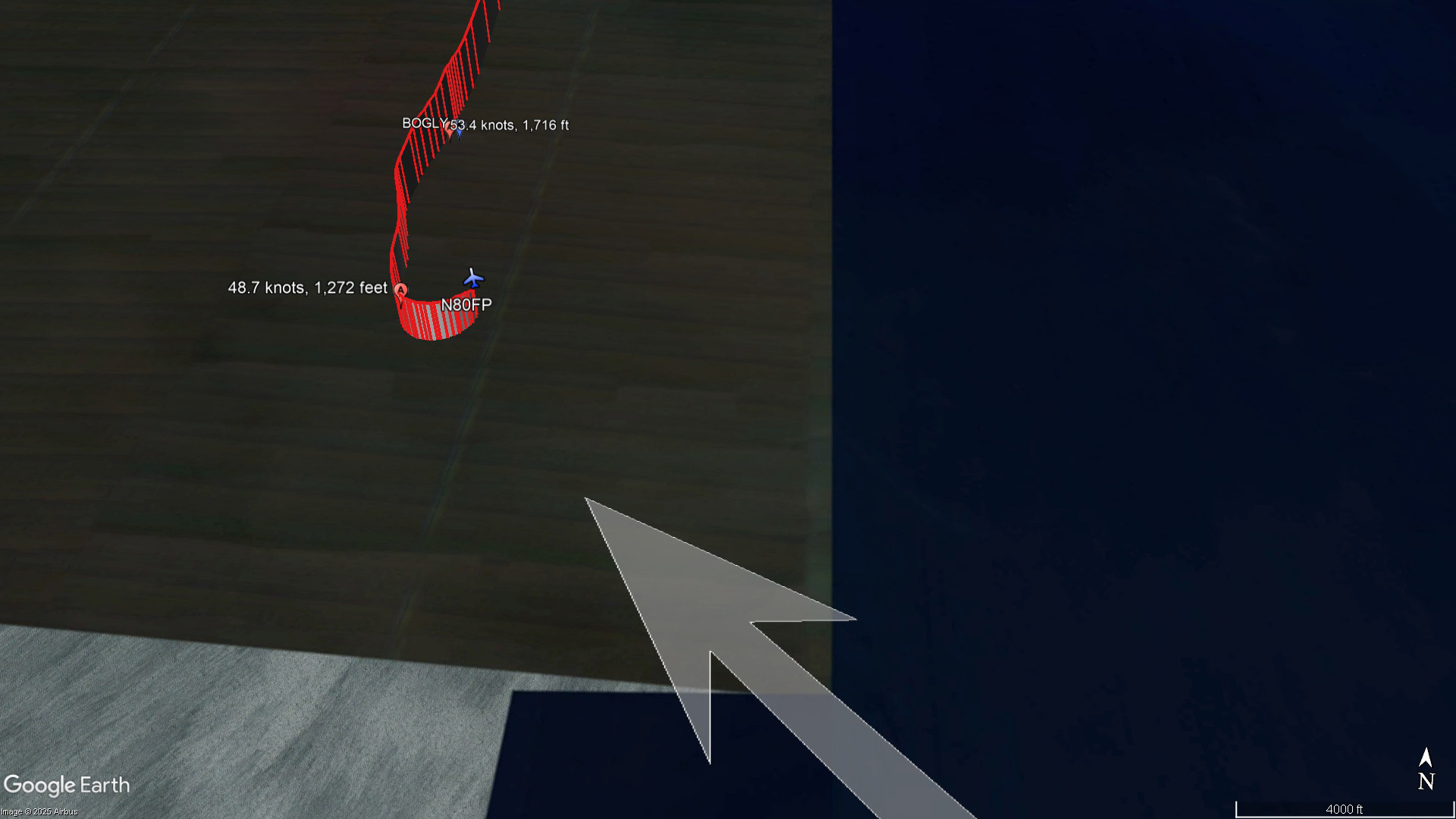
The ADS-B track of N80FP shows variations in the heading leading up to and beyond the final approach fix, BOGLY, which is 5.1 nautical miles from the runway. The aircraft crossed BOGLY at 1,765 feet, descending to 1,716 feet just after the fix while slowing to a groundspeed a little below 53 knots, according to the data; based on the published weather at the time, with surface wind at 11 knots from 130 degrees. The inbound aircraft's flight path continued to deviate left and right of course as it continued the approach and slowed to a groundspeed of 48 knots at 1,272 feet 3.6 nm from the runway, then "began a tight descending left turn that lasted about 27 seconds," according to the NTSB report.
The independently recorded ADS-B data show the aircraft's groundspeed and descent rate increased significantly in many of the final 27 seconds, increasing to 111 knots at the final data point, the aircraft by then past 180 degrees from the final approach course and about 880 feet above the water.
Factoring a likely headwind (the NTSB report does not note winds aloft), the aircraft's airspeed likely remained a few knots above the published clean stall speed of 47 knots, leading up to the spiraling left turn. It is unclear from the NTSB’s preliminary report whether the flaps were retracted or extended. In the case of the latter, the stall speed with full flaps would have been reduced to 41 knots. While a stall-spin scenario appears unlikely, the combination of increasing airspeed and the descending turn is consistent with a spiral dive, as described in Chapter 5 of the Pilot's Handbook of Aeronautical Knowledge.
It begins with a sideslip, the FAA explains, which can be caused by a gust of wind, or control inputs. The aircraft's strong tendency to align with the relative wind may overcome the weaker tendency of the wings to resist, and the aircraft begins to turn, accelerating the outside wing in the process and decelerating the inside wing. The outside wing gains lift while the inside wing loses lift.
"This produces an overbanking tendency which, if not corrected by the pilot, results in the bank angle becoming steeper and steeper," the FAA wrote, noting the nose is also being forced downward as the spiral dive develops. "A slow downward spiral begins which, if not counteracted by the pilot, gradually increases into a steep spiral dive. Usually the rate of divergence in the spiral motion is so gradual the pilot can control the tendency without any difficulty."
The FAA further notes that failure to arrest spiral dives is a common cause of catastrophe: "Improper recovery from spiral instability leading to inflight structural failures has probably contributed to more fatalities in general aviation aircraft than any other factor. Since the airspeed in the spiral condition builds up rapidly, the application of back elevator force to reduce this speed and to pull the nose up only 'tightens the turn,' increasing the load factor. The results of the prolonged uncontrolled spiral are inflight structural failure, crashing into the ground, or both. Common recorded causes for pilots who get into this situation are loss of horizon reference, inability to control the aircraft by reference to instruments, or a combination of both."
Loss of the horizon in the case of N80FP appears possible, even likely, with broken clouds reported at 800 feet at the time of the accident, according to the NTSB report—about 80 feet below the altitude of the final ADS-B transmission recorded. While visibility was reported to be 10 miles, the narrow gap between temperature (22 degrees Celsius) and dewpoint (21 degrees C) could have led to condensation that limited the approaching pilots' view. The NTSB noted the accident happened more than an hour after sunset, on a night when 17 percent of the moon's visual disc was illuminated.
A dark lake surface in the foreground, with or without bright airport lights in the distance, could also have made for a classic “black hole approach,” adding to the challenge faced by an instrument student pilot by creating the illusion that the aircraft was higher than it actually was. Approaching from above the bases of broken clouds at 800 feet, possibly within clouds, could also have contributed to spatial disorientation.
Most of the wreckage—including the fuselage, wings, tail surfaces, engine, and propeller—was located and transported from the lake a week after the accident. No preimpact mechanical issues were found on the recovered airframe.
According to local news reports, U.S. Coast Guard crews searched for the pilots by air and water for almost two full days before suspending their search. Strong winds and waves hindered the recovery effort.
AOPA's Air Safety Institute is funded by charitable donations to the AOPA Foundation, a 501(c)(3) organization. To be a part of the solution, visit www.aopafoundation.org/donate.

Related Articles


