Promises made
Are these advanced air mobility aircraft ever going to fly?

Uber Elevate, the ride-sharing company’s summit for all things UAM, was held in Washington, D.C., with easy access to supportive regulators and legislators in this emerging market. And, as often happens in Washington, there were many proclamations about the future. As also happens in Washington, none of them turned out to be true.
At that event, Uber executives predicted that in 2023 the company would be conducting commercial passenger flights in Dallas, Los Angeles, and Melbourne. By 2026, the service would expand to more cities. And by 2028, those flights would be conducted autonomously. Well, we’re pretty much there, and none of that has happened—at least in the United States.
Numerous companies were working to develop aircraft meeting the criteria laid out by Uber, including Boeing, Airbus, Embraer, Bell, Karem Aircraft, Pipistrel Vertical Solutions, and Jaunt Air Mobility. Of those, only Boeing via its acquired Wisk Aero and Embraer, with its Eve Air Mobility aircraft, are still significant players in what is today known as the advanced air mobility (AAM) industry. Some of the others have become investors in other AAM companies or they continue to develop related products for military or cargo markets.
While there have been plenty of stumbles and missed deadlines, there has also been a lot of progress in an effort to develop electrically propelled vertical takeoff and landing (eVTOL) aircraft to move people and cargo in urban and regional areas. Over the years, the definition has expanded to include some electric and hybrid-powered aircraft, including fixed-wing, meant for longer regional trips.
Today, the list of leaders rushing toward certification includes companies only marginally known in 2019—Joby Aviation, Archer Aviation, Beta Technologies, EHang, Electra Aero, Wisk, and Volocopter. Only China-based EHang is conducting limited commercial flights—in an autonomous aircraft. The others and numerous additional companies are in various stages of development and certification.
Joby acquired Uber Elevate in December 2020. Archer more recently acquired the patent assets of one-time player Lilium, after the German company went bankrupt. Volocopter too went bankrupt but emerged under new ownership by the Chinese company that also owns Diamond Aircraft. Wisk, a startup under Kitty Hawk, was acquired by Boeing. EHang, Joby, Archer, Beta, and the Embraer company Eve Air Mobility are now all publicly traded companies.
If you feel like you need a scorecard to keep track of who’s who, you’re not alone. SMG Consulting created a helpful AAM Reality Index that tracks investments in and status of the various projects.
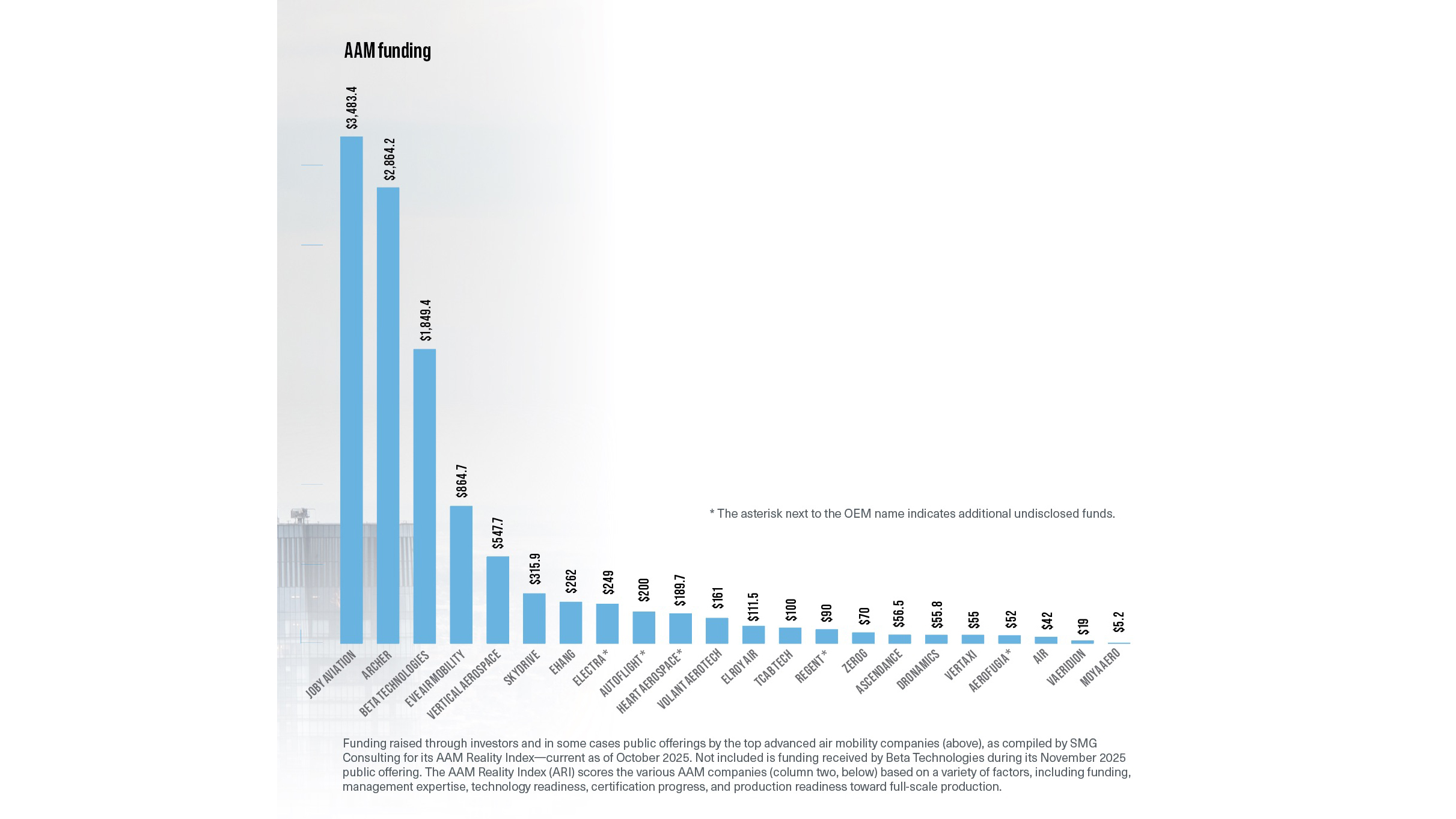
There you can discern the status of the top 25 companies. As of October 2025, the publicly traded entities have raised some $9.3 billion via investments and stock sales, according to the index. However, The Motley Fool reports that EHang, Joby, and Archer, which have been public the longest, have a combined market capitalization of $21.3 billion as of September 2025. The Motley Fool is projecting a compound annual growth rate of 55 percent for the AAM industry, achieving a potential valuation of $28.6 billion by 2030.


The more established companies have used the funds not only to develop their various aircraft, but also to build factories, acquire related companies and technologies, test military and cargo variants of their designs, and, in the case of Archer, to lease an airport in Los Angeles to establish a base of operations in the metro area. It announced the 30-year lease of historic Jack Northrop Field (HHR) from the city of Hawthorne in November for $126 million. In addition to ultimately providing AAM service to the nearby venues, Archer is the official air taxi partner for the 2026 World Cup in LA and is planning to provide extensive transportation for the Los Angeles Olympics in 2028.
Even GA stalwart Robinson Helicopter is a player with plans for an electric version of its helicopters and later a hydrogen-powered version for longer missions, as reported at the 2025 UP.Summit in October.
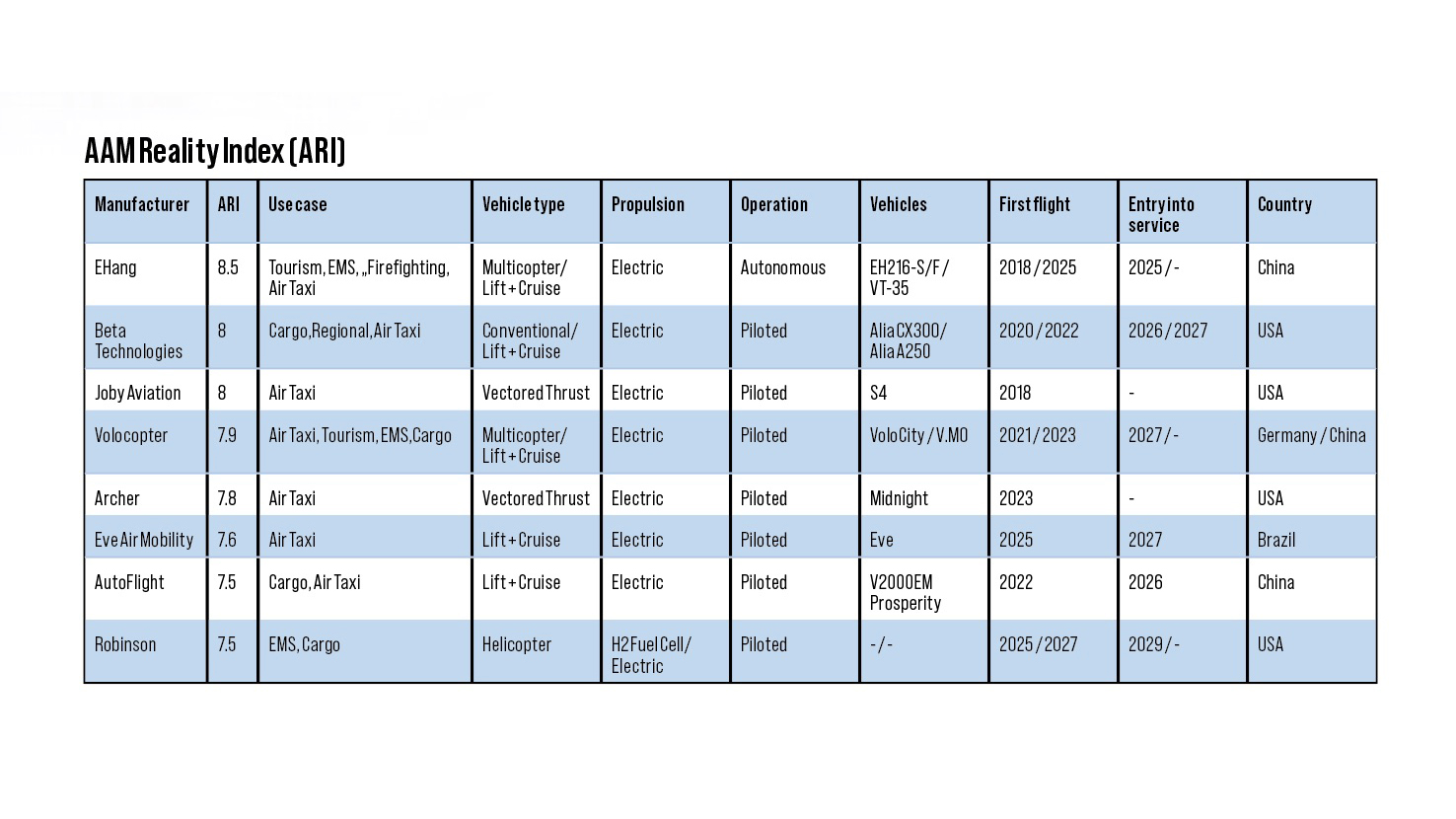
Sergio Cecutta, managing partner of SMG Consulting, said the company started the AAM Reality Index to track progress and financial status of the various companies for its own internal needs. However, it soon became evident that others were interested in the data, so they now publish it on their website, updating it quarterly. The site publishes data for 25 AAM companies and assigns an “ARI” score to each. The AAM Reality Index score uses publicly available information and SMG’s “expert knowledge” to help assess the companies’ progress toward delivery of a certified product at mass scale production. The score is based on five elements, according to Cecutta: funding; the company’s leadership team; the technology readiness of their vehicles; the certification process of their vehicles; and the production readiness toward full-scale manufacturing. A score of zero is for a mostly unknown entrant. A score of 10 is meant for a company with a certified product in mass production; no company has reached that level yet.
As of the October 2025 update, for example, EHang had an ARI score of 8.5—the highest of any company, mostly because it has already begun limited operations. Beta Technologies and Joby were next in line with scores of 8.0; Volocopter and Archer were just behind with scores of 7.9 and 7.8, respectively. Those scores were developed before Beta went public in November and before Archer leased the airport; both of those moves will likely improve their scores.
According to the index, Beta, Joby, Volocopter, Archer, and Eve all plan entries into service in either 2026 or 2027. Given recent progress, those plans may be close to target, although Eve as of late 2025 had yet to fly an aircraft.
The other companies on that list have been flying for years. Beta, Joby, and Archer in particular have been busy building massive manufacturing facilities and developing their markets.

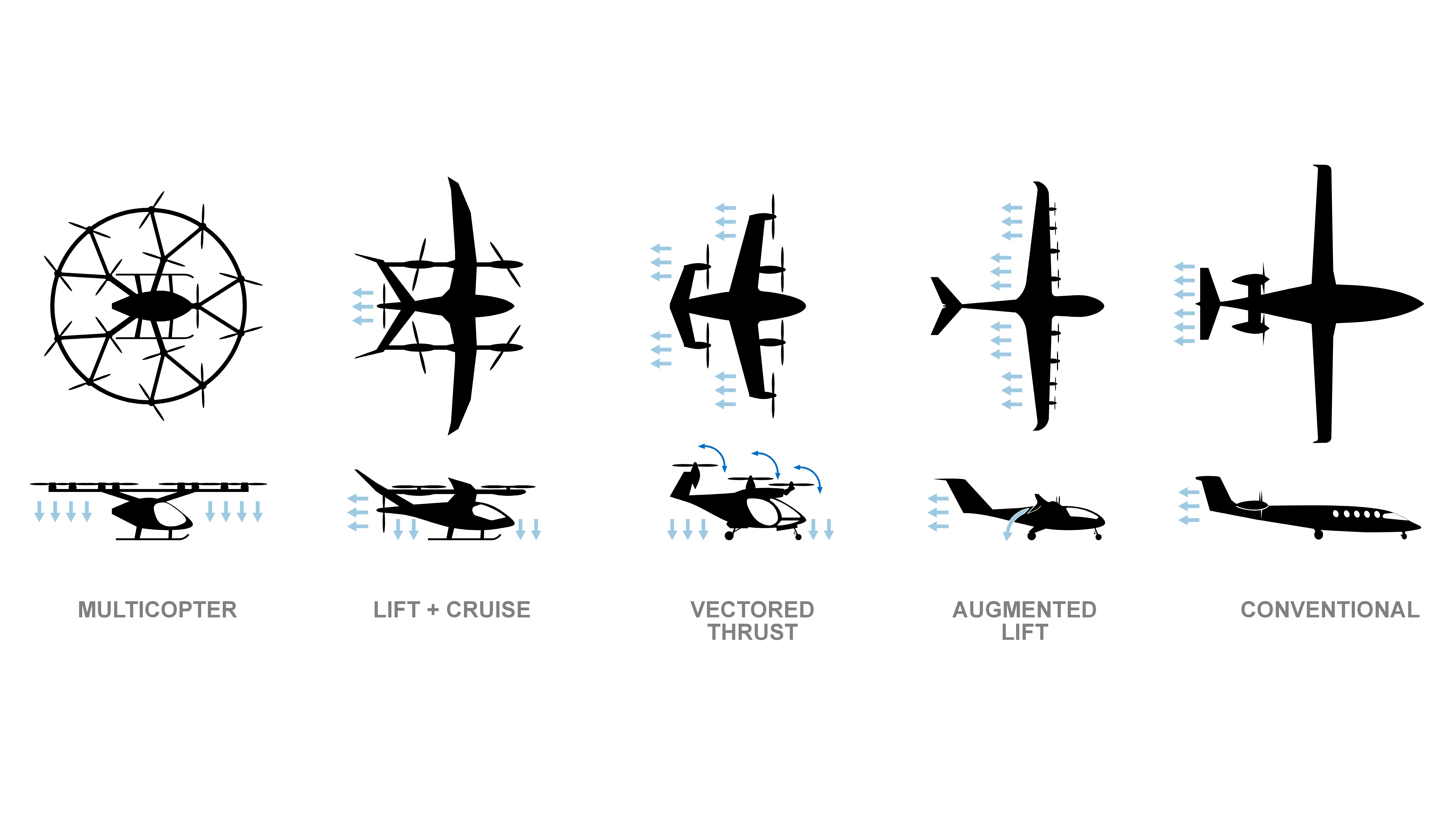
During a recent visit by AOPA to the Beta Technologies factory at Vermont’s Burlington International Airport (BTV), staff showcased the company’s electric motor manufacturing operation and sophisticated battery pack assembly system. Beta is marketing its motors to other companies inside and outside of the AAM industry. Eve is testing a Beta motor on its aircraft, which was expected to fly in December 2025. The 188,500 square foot Beta factory is designed to manufacture both its Alia VTOL aircraft and its Alia CTOL (conventional takeoff and landing) aircraft. The VTOL model has four lifting motors and one pusher motor while the CTOL model uses one pusher motor.
Beta has installed a series of charging stations along the East Coast, allowing it to quickly begin service once certification is achieved.
As with the other leaders in the space, Joby has been busy demonstrating its aircraft to the media, military, the airlines, and others around the globe. AOPA Pilot had the chance to fly the Joby simulator at the UP.Summit in Bentonville, Arkansas, in October 2025. The demonstration showed how easily the eVTOL could fit into the urban landscape and airspace of New York City, landing at the Downtown Manhattan/Wall Street helipad (JRB) and whisking off to major airports in the region.
Once it receives its FAA certification, Joby hopes to launch its air taxi service in the United States, Dubai, Japan, and the United Kingdom. It has partnered with Uber to be included in the ride-sharing company’s app, making for what it says will be seamless transitions from ground-based to eVTOL transportation.

Joby also recently began testing a hybrid turbine-electric autonomous version of its aircraft—the turbine engine allowing for longer range missions.
Meanwhile, Archer, in addition to U.S. operations, plans to launch its air taxi service in the UAE, India, and Korea. Its Midnight aircraft is powered by 12 motors with six independent battery packs.
As the companies near the certification finish line, national airspace system infrastructure becomes even more critical, reminds SMG’s Cecutta. General aviation airports will become important parts of the eVTOL ground infrastructure, but more landing facilities will be needed, especially in urban areas. Cecutta says there must be more government involvement. “Without government support, it’s going to be very tough to close the business case,” he said. “I don’t know of many subway stations or train stations that are owned by private people.”
Cecutta looks at the industry through a series of hurdles: certification; entry into service; production; and number four, being self-sustaining and making money. He credits the market leaders for progress on the certification front and their efforts toward entry into service and production. “When it comes to making money, I don’t even know if the business case is fully closed for a lot of these players.”
To concerns by general aviation pilots about airspace and airport congestion from throngs of these new aircraft, Cecutta reminds that while some companies may achieve certification in the coming months to years, it will be a decade or more, he says, before scaled operations will be achieved.