Prime Time
Daher TBM 980 debuts with Garmin G3000 Prime integrated flight deck
Daher Aircraft has been on a tear for the past 12 years, continually improving its TBM family of six-seat turboprop aircraft with an emphasis on safety-enhancing automation.
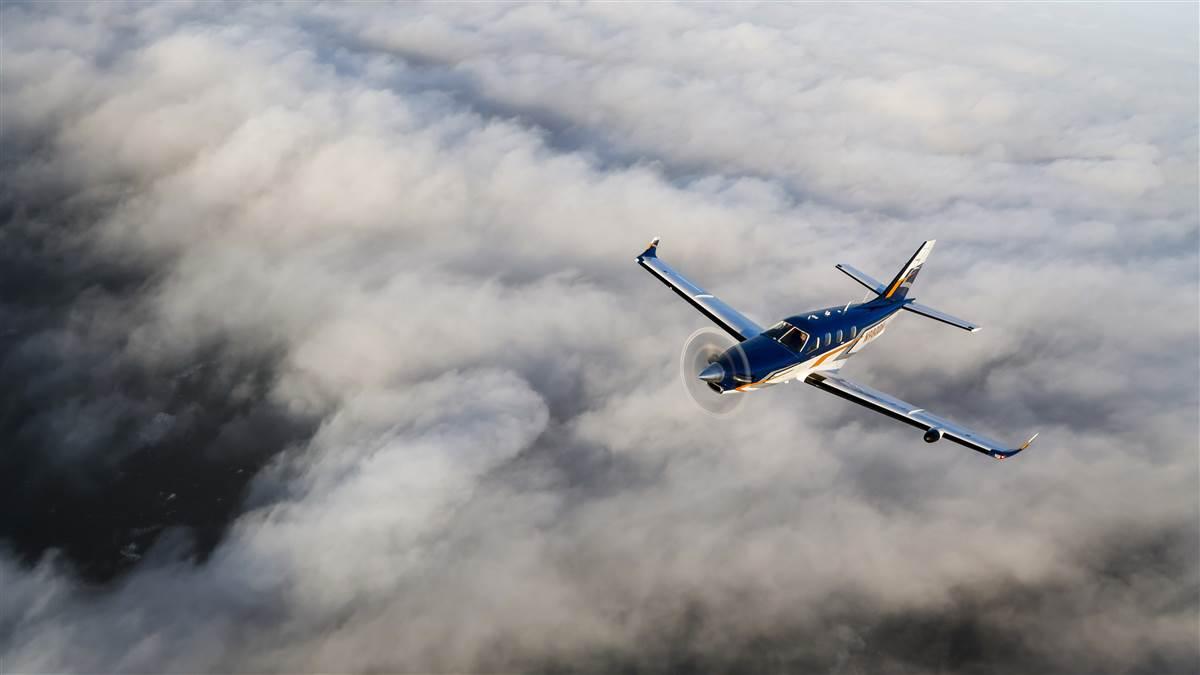
In 2014, the TBM 900 introduced significant aerodynamic and performance improvements over its predecessor, the TBM 850. Every few years thereafter, Daher introduced further advancements: The TBM 910 offered the Garmin G1000 NXi avionics suite with electronic stability and protection; the 930 introduced the Garmin G3000 avionics suite with emergency descent mode; the 940 came with autothrottle, automatic deicing, and HomeSafe emergency autoland; and the 960 added dual-channel full authority digital engine control (FADEC) with a single-lever power control, and Garmin’s GWX 8000 digital weather radar.
Daher coined the phrase “e-copilot” to describe its suite of automated and protective systems introduced over the past decade. These technologies are intended to serve the pilot by reducing workload and maintaining high levels of situational awareness—particularly during single-pilot IFR operations.
Daher’s latest evolution of the TBM is the 980, and this new model continues Daher’s pursuit of increased efficiency and reduced pilot workload.
AOPA visited Daher U.S. headquarters at Pompano Beach Airpark (PMP) in Florida to fly the TBM 980, which had just been ferried from Daher’s production facility in Tarbes, France, by company demo pilot Wayman Luy (pronounced lew-ee). But we had a weather challenge. Storms building to the west were certain to foil our plans for an evening aerial photo flight with AOPA’s Beechcraft Bonanza A36. So Luy hatched a backup plan: We would file an IFR flight plan to St. Simons Island Airport (SSI) in southern Georgia—north of the storms—and we would conduct the formation photo flight there. Along the way I’d experience the new features of the 980 in IMC while leveraging the TBM’s impressive cruise speed on this cross-country flight.
Approaching the TBM 980 on Daher’s ramp full of TBMs, you’d be hard pressed to know this is a new model other than by the striking new paint scheme, called Tehuano. The 980 has the same airframe, engine, and propeller as the 960—which will remain in Daher’s lineup. However, once you open the pilot door and hoist yourself into the flight deck, you’ll immediately spot the biggest difference between the 980 and the 960: its Garmin G3000 Prime integrated flight deck.
Click on image for slideshow and captions.


Spec Sheet
Daher TBM 980Price / $5.82 million
Specifications
Powerplant / PT6E-66XT, 850 shp
Propeller / Hartzell 5-blade composite
Length / 35 ft 3 inHeight / 14 ft 3 in
Wingspan / 42 ft 1 in
Seats / 6
Cabin width / 4 ft
Useful load / 2,890 lb
Payload w/ full fuel / 919 lb
Fuel capacity / 292 gal
Takeoff distance over 50-ft obstacle / 2,535 ft
Best rate of climb at sea level / 4,000 fpm
Max cruise / 330 KTASMax range / 1,730 nm
Max operating altitude / 31,000 ft
Landing distance over 50-ft obstacle / 2,430 ft
All specifications are based on manufacturer’s calculations. All performance figures are based on standard day, standard atmosphere, sea level, gross weight conditions unless otherwise noted. tbm.aero
The G3000 Prime avionics suite has three large 14-inch touchscreen displays and a smaller touchscreen secondary display unit (SDU) centrally located on the subpanel. The displays are vibrant in color; high in resolution; and easy to touch, pinch, swipe, zoom, and otherwise manipulate maps, engine instruments, and other information that appears on the highly customizable screens. My first impression was one of decluttered elegance and increased functionality.
Luy, an ATP and flight instructor, guided me through the “before engine start” checklist using the 980’s new checklist interface—a four-position joystick on the control wheel that replaces the traditional checklist button. The joystick simplifies scrolling and confirming checklist items and reflects Daher’s desire to make pilot interactions with the TBM’s technology more intuitive.
As we continued with checklists and entered our flight plan, I appreciated the flexibility of the app-based G3000 Prime architecture. The checklist, communications, flight plan management, and other apps can all be accessed on any display—including the SDU—using the app menu. Regardless of which screen you’re currently interacting with, the app you want is there. I found opening apps a more intuitive process than searching through menus to find what I was looking for—much like using an Apple or Android mobile device.
The G3000 Prime employs a logical sequence for setting up your flight, starting with your flight plan and moving to weight and balance and other tasks. Any information that is marked with a white triangle surrounding an asterisk is required. It’s kind of foolproof. The system will also import flight plans and current fuel state to make data entry quicker and more accurate.
After calling Pompano Beach ground for taxi instructions, Garmin’s 3D SafeTaxi popped up on the primary flight display to provide a three-dimensional view of my path from the Daher ramp to the active runway. At Pompano Beach, where there are three intersecting runways and many opportunities to make a wrong turn, this was a comforting tool to have.
I took off and entered the clouds at 1,500 feet. (This article focuses on upgrades unique to the TBM 980. See “TBM 960 Takes Off,” June 2022 AOPA Pilot, for the startup, takeoff, and landing experience, which—other than the avionics—is identical between the TBM 960 and 980.) We popped out between layers and were soon staring at some monster cumulus buildups, which were depicted in sharp detail via SiriusXM Aviation on the center multifunction display.
As we worked with departure to divert around the storms, we encountered increasing turbulence. I personally prefer pinching and zooming and pressing the buttons on touchscreens. But if you prefer a more tactile feel—or when the turbulence approaches moderate levels—the TBM 980 includes a Garmin GCU 315 cursor controller with physical controls. This enables you to zoom in and out, toggle to different frequencies, and push to select everything that you need on any of the touchscreens. That was really handy as we changed frequencies, altitudes, headings, and flight plans on our way to Flight Level 290.
“You know, the last 22 years since the [Garmin G1000] came out…night and day in our flying,” said Luy. “A benefit of the automation, I think, is the situational awareness that this brings to us.” Once we leveled off, I asked Luy what power setting I should set for cruise. Luy laughed and said, “We don’t go slow in a TBM.” We maintained full power and rocketed toward SSI at 323 knots true airspeed.
I only scratched the surface of learning the capabilities of the G3000 Prime implementation in the 980, but what I experienced was impressive, and its integration into the TBM 980 felt intuitive and well thought out.Next, we logged on to my favorite workload-reducing, safety-enhancing feature: controller pilot data link communications (CPDLC). The ability for ATC to send pilots text messages regarding frequencies, altitudes, and flight plan revisions is a game changer. And the CPDLC integration in the TBM 980 is slick. The 980’s SDU acts as the CPDLC interface. When ATC hands you off to a new controller and frequency, you simply send an “accept” message to tell ATC that you’re going to change to the assigned frequency. Press the “set frequency” button on the SDU and it will load it into the com radio of your choice. If you’re assigned a new altitude, you can accept it and the new altitude will go right into the flight management system. Even better, if you get an amended flight plan, you can accept the plan and it will automatically update your current flight plan. No manual entry required.
“It’s been a couple of years with CPDLC,” said Luy. “Most centers are just using it to change frequencies. But every so often you get a controller who says, ‘Cleared direct Orlando.’ And if they say to go around the weather they could designate a lat-long, and it comes into the flight plan, and you don’t have to type it in or enter any waypoints or say, ‘Spell that again.’”
Meanwhile, in the back of the cabin, our passengers were kept updated on our progress toward SSI through an upgraded passenger display console that provides real-time en route flight information and manages the TBM 980’s environmental control system, electronically-dimmable windows, and LED ceiling lighting. Other 980 cabin upgrades include four 100-watt USB-C charging ports—powerful enough to charge laptop computers—and a factory-installed Starlink Mini terminal for satellite-based internet access.
Surface winds at SSI were 17 gusting 30, but at least they were directly down the runway. Ten minutes out, Luy suggested we turn off all the automation and that I hand-fly the visual approach to get a feel for how the airplane handles in preparation for the evening’s photo flight. Even without the autopilot, yaw dampers, autothrottle, and other automation, the airplane was stable and handled the gusts with ease.
This was only the second time I had interacted with the Garmin G3000 Prime avionics suite—the first was a demo at Garmin’s booth at NBAA-BACE. My flights in the TBM 980 demonstrated how the flexibility and customization of the G3000 Prime avionics suite change how a pilot interacts with the aircraft. I only scratched the surface of learning the capabilities of the G3000 Prime implementation in the 980, but what I experienced was impressive, and its integration into the TBM 980 felt intuitive and well thought out.
“This [flexibility] significantly improves efficiency and reduces pilot workload, a key consideration for single-pilot operations,” said Pierre Six Daher lead flight test engineer. “The airplane adapts to the pilot, not the other way around.”  [email protected]

Related Articles


