A wild ride
Mike Melvill lived a high-flying life
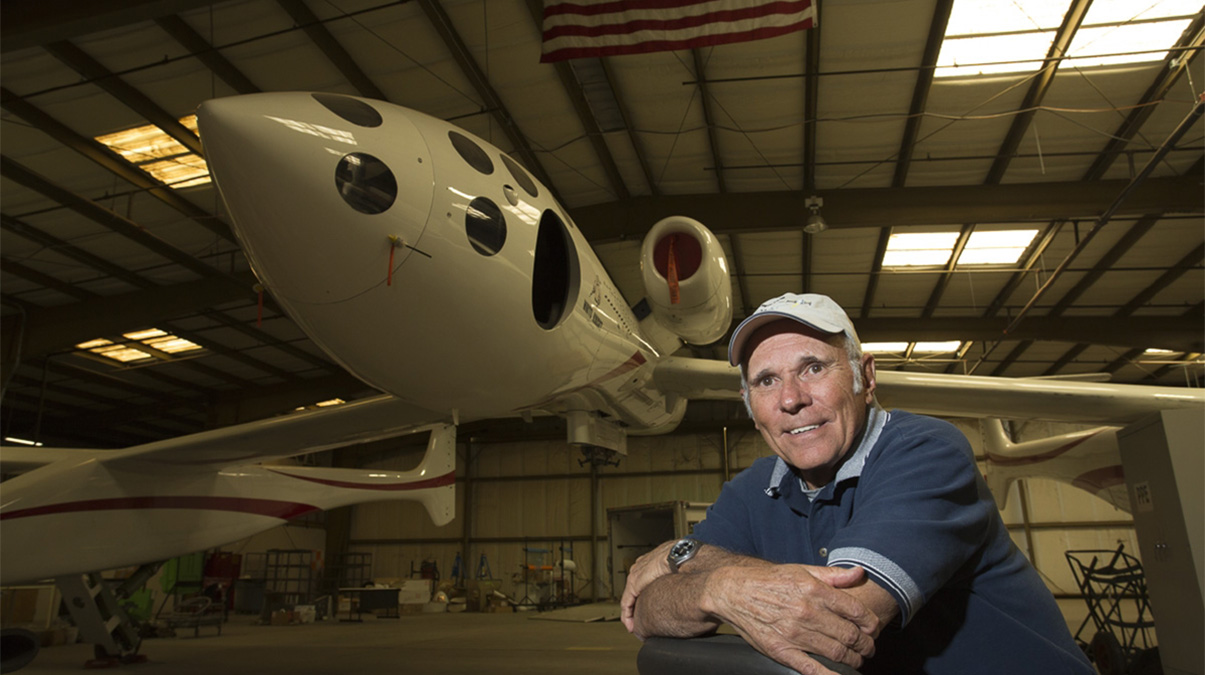
Mike Melvill, 85, the world’s first commercial astronaut and winner of the Ansari X Prize for pioneering flights in SpaceShipOne, died March 19 in California after a long illness.

Melvill’s unique and unlikely path to space began in 1940 in South Africa where he was an indifferent student but excelled at motorcycle racing and working with machinery.
The couple emigrated to the United States in 1967 and settled in Muncie, Indiana, where Melvill repaired industrial box-cutting machines. He learned to fly as a means of getting to job sites quicker and progressed rapidly through commercial, instrument, and multiengine ratings.
In 1974, he bought a set of plans from designer Burt Rutan for the VariViggen, a two-seat, Volkswagen-engine-powered canard aircraft. He completed the experimental-category airplane a year later—the first customer to do so—and flew it to California with Sally on a work trip. They stopped to see Rutan at his desert home in then-desolate Mojave, and Rutan was so impressed with the quality of Melvill’s work that he offered him a job on the spot.
The Melvills moved to California, and both joined the Rutan Aircraft Factory and later Scaled Composites, Rutan’s aerospace firm. Both eventually became vice presidents there. Mike was general manager and test pilot, and Sally led the human resources team.
Melvill and Rutan worked extremely closely on a long series of aircraft and Melvill performed the maiden flights on dozens of them including the Ares attack jet, Grizzly airplane, VisionAire Vantage, Williams V-Jet, White Knight, Proteus, and Boomerang piston twin.
The two would meet informally most mornings to discuss ideas. Rutan was the visionary, and Melvill the hands-on pragmatist.
“I’ll never forget the day [Rutan] said he thought we had the technical expertise to fly an aircraft into space,” Melville said in a 2013 interview with AOPA Pilot. “It was something I’d never considered. We were doing a credible job with airplanes that flew about 200 miles an hour, but to get to space we’d have to fly at Mach 3. It seemed too ambitious to seriously contemplate, and I was intimidated.”
Rutan’s revolutionary design was ingeniously simple. Flight controls used conventional mechanical linkages; the cockpit was a sealed pod; the rocket motor consumed rubber and liquid nitrous oxide; and twin tail booms folded into a “shuttlecock” position as the aircraft descended almost vertically during re-entry.
Melvill flew SpaceShipOne by hand from the time it was released from the White Knight carrier ship, pointed the nose straight up as it accelerated rapidly, folded the tail booms for re-entry, and then unfolded them and glided to a runway landing.
It was a wild ride.
On his second space flight, high-altitude turbulence at 160,000 feet caused SpaceShipOne to yaw 15 degrees and pitch up an additional 8 degrees, and that started a series of 29 vertical snap rolls that Melvill couldn’t stop.
“There’s just not enough air up there to fix that particular problem,” he said.
Melvill carried Sally’s wedding ring with him into space, one of the few times she ever removed it during their more than 60 years of marriage.
SpaceShipOne is enshrined at the Smithsonian National Air and Space Museum in Washington, D.C., and Melvill donated his Long-EZ to the EAA Museum in Oshkosh, Wisconsin.
Melvill is survived by Sally and their son, Keith Melvill, of San Bernardino, California.
Related Articles


