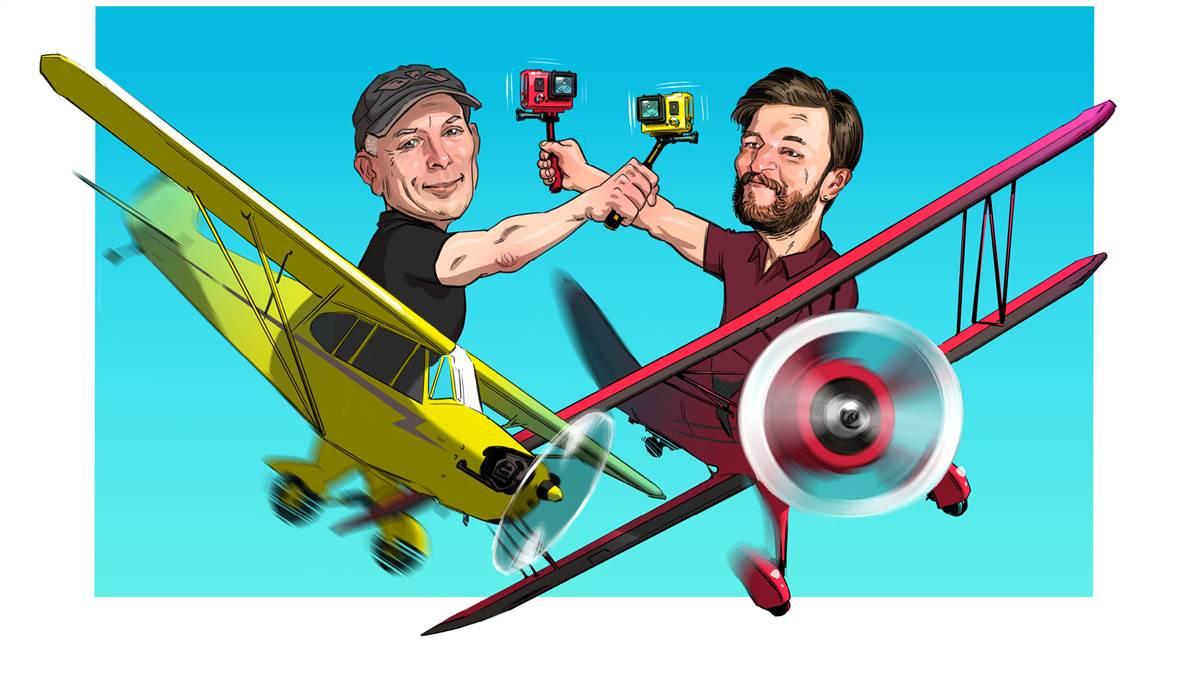
Kodak courage
Action cameras appeal to our worst instincts
By Dave Hirschman
There’s nothing inherently evil about action cameras—yet they bring out the worst pilots.
Go online and you’ll find a seemingly endless rogues’ gallery of aerial idiocy: low flying, intentionally scaring passengers, looping and rolling nonaerobatic airplanes, and a litany of show-off antics. This phenomenon is sometimes called “Kodak courage”—a term used to describe when a person is emboldened to act recklessly when they know they are being filmed. The negative image of general aviation that these videos create is as damaging as it is needless. The unavoidable question is whether pilots would take these foolish actions if not for the presence of cameras.
Sure, pilots did plenty of dumb things before action cameras were invented. But the combination of in-airplane video and social media makes things infinitely worse. And the problem goes far beyond goofball pilots who float their dogs or kids at zero Gs. YouTube also provides perverse incentives for bad pilot behavior. Trevor Jacob’s intentional crash of a 1946 Taylorcraft, which was done at least in part for YouTube views, is the most prominent case in point.
Another modern mystery is the apparently irresistible urge some pilots have to post self-incriminating videos of their own misdeeds on their public social media accounts. What’s the point? Wouldn’t it be quicker and easier to simply drive to the nearest flight standards district office and surrender their pilot certificates voluntarily?
Even when pilots record in-flight videos for noble purposes, cameras on the flight deck are a distraction. They demand our attention, usually at the most inconvenient moments, even when they’re working properly. And heat, cold, faulty mounts, short-lived batteries, and weak Bluetooth connections mean they seldom work properly. They also tend to block at least a portion of the windshield, and that reduces outside visibility.
Action cameras are powerful tools that can play valuable roles in aviation education, inspiration, and documentation. I find them tremendously useful in recording exactly what happens on demonstration and test flights, especially when paired with audio, and I use them extensively in post-flight debriefings. Creating a visual record of some of the spectacular sunrises, sunsets, and cloud formations we’re so privileged to see from the air can be rewarding, too.
But it’s only by acknowledging that action cameras appeal to our worst instincts—vanity, impulsivity, and an irrepressible desire to impress—that we have any hope of mitigating their considerable risks.
And too many pilots have shown they’re just not up to that task. 
Can I get a replay?
Cockpit cameras capture lessons, memories
By Ian Wilder
A quick blur. That’s how every flight felt when I started flight training. Be it task saturation, early training stress, or the cramped environment of a Cessna 152, the postflight debrief only helped me to remember so much. I’d distinctly remember the slight grunt of disapproval from the right seat after losing too much altitude at the end of a steep turn. But as to what mistakes I made early in the turn? It was hard to recall.
Sure, your instructor always talks you through your mistakes, but nothing replaces playing back the tape.
Much like a football film room, a couple days after “gameday,” I’d pop the SD card into my computer and scrub through the video. I’d find the steep turns, and I remember distinctly picking out the moment I let the nose drop and start bleeding altitude, about a few seconds after applying 45 degrees of bank. On my next training flight, I was prepared for that to happen, and just like that my steep turns improved ever-so-slightly with no actual flying time.
With the cost of flying, if something lets you learn something out of the cockpit, that’s an opportunity you should take advantage of every time. Even if you’re not in flight training, you can learn something about yourself as a pilot from watching the tape.
Admittedly, a plague of cameras and aviation content has descended upon the internet. It feels like social media has made aviation the new Hollywood, with too many people trying to push the envelope to make it big. But those willing to push the legal limits for the camera would be doing it with or without the tape rolling. You don’t wake up one morning and decide to leave the FARs by the wayside. It’s a conscious decision, and if a camera is enough to influence someone to cross that line, there’s no doubt in my mind they would’ve done it anyway.
With everyone having mobile phones nowadays, I’m not sure that mounting a camera makes a difference. If you want to record yourself doing something dumb, your tool is right in your pocket (and if you choose to post it, it will end up with the authorities for their review).
When all is said and done, I find most of the content out there on the internet to be not only entertaining but informative. If I see a challenging approach I plan to execute, I’ll see if I can find a YouTube video of that very approach to be better prepared. And now, as I fly for enjoyment or proficiency, I still use my camera for the memories, and continuous improvement. I keep a lot of my flying to myself, but if you’re so inclined to post it on social media, go for it.
Regrettably, there’s some aviation misinformation out there, and some people post videos with a blatant disregard for safety and the law. But most pilots are serious about their duties as pilot in command, and a camera won’t change that. So, mount that camera, press record, and (a critical step) leave it be. Enjoy the memories and lessons that’ll follow. 

Related Articles


