Pumpkin drop from an airplane
How to hit the target
Each October, the Golden Age Air Museum in Bethel, Pennsylvania hosts a pumpkin drop competition. A pilot flies an airplane down the runway while a passenger tosses a pumpkin overboard with the goal of hitting the target—last year the sundeck of a small boat.
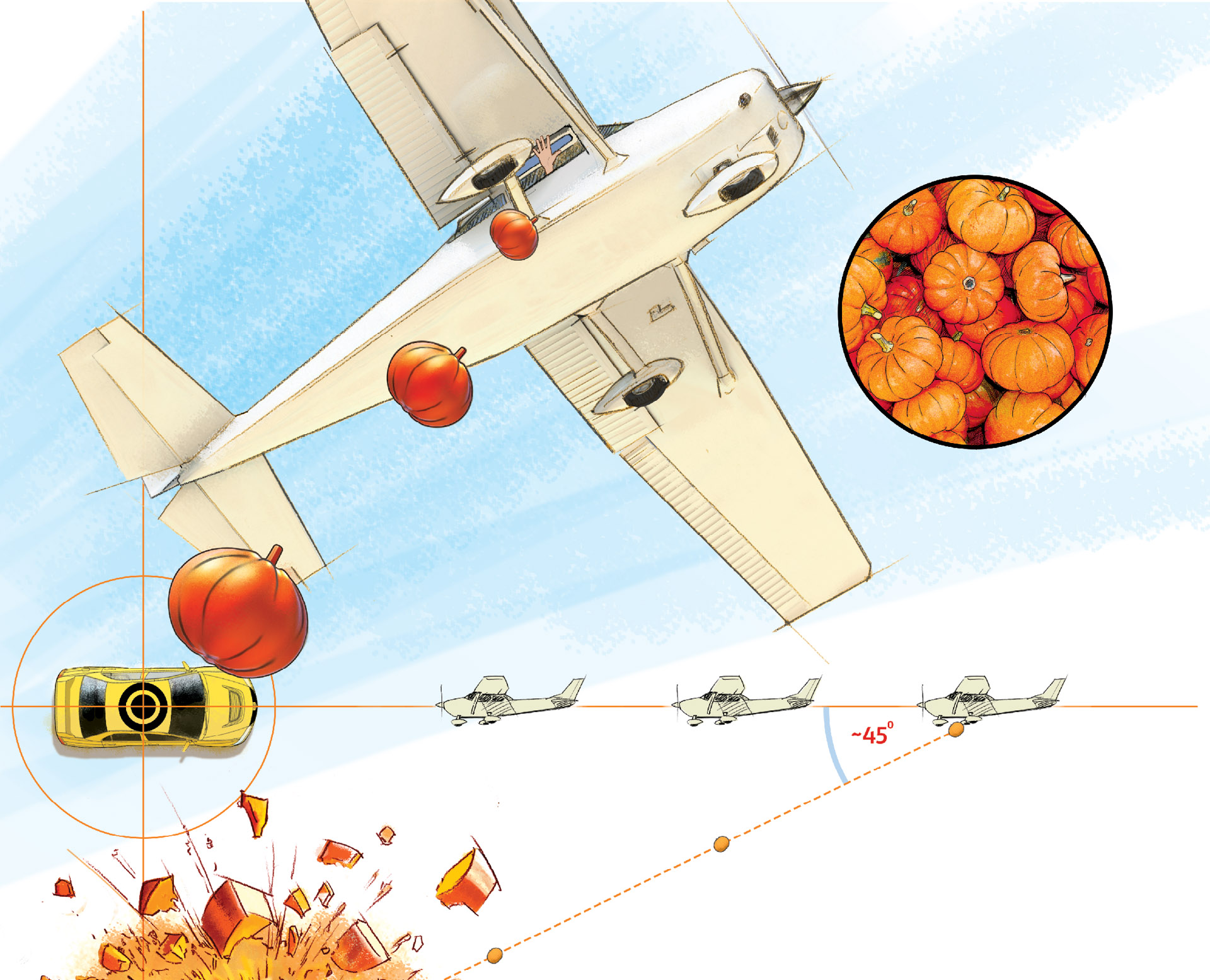
It sounds relatively easy, but on most days very few pumpkins hit their target. Some fall short and most fall long. Golden Age Air Museum Director Michael O’Neal revealed the technique his pilots use to increase the odds of a bull's-eye.
Altitude and airspeed. Fly the airplane 50 feet to 100 feet above the runway. Flying a precise airspeed is less important than altitude, and should be a safe and comfortable speed for the pilot and passenger with a door or window open.
Pumpkin away. At the Golden Age Air Museum, the pilot tells the passenger when to drop the pumpkin. This is done using a hand signal, which is more reliable than a verbal signal when an aircraft door or window is open. The pumpkin should be dropped, not thrown. This both increases accuracy and prevents the pumpkin accidentally hitting the propeller.
Bull's-eye. Did you hit the target? Often the pilot and passenger team won’t know until after they land. Ultimately, a lot of luck is needed to hit a bull's-eye—even with a target as big as a car.
The pumpkin. Take all the time you'd like picking a pumpkin, but ultimately pumpkin size is not a predictor of a successful drop. Smaller pumpkins are easier to fit in the airplane.
Drop angle. The goal is to have the pumpkin drop out of the aircraft at a 45-degree angle to the ground. Dropping from a height of 50 to 100 feet assures the pumpkin will fall at a constant angle. Dropping from a higher altitude will cause the pumpkin to follow a parabolic arc, making targeting more difficult.