'Jenny'
A historic airplane brings people and their stories together
Filmmaker and student pilot Susan Roe Musacchio's latest documentary follows a group of volunteers restoring a Curtiss Jenny JN-4, the same type of airplane her grandmother flew a century ago.

When Musacchio discovered a group of men in their 80s rebuilding a Curtiss Jenny at Poplar Grove Airport in Illinois, she knew she had found her next story. "Each one of them was a character," Musacchio said. Their work became Jenny, scheduled to premiere on November 6, at the airport where the airplane was rebuilt.
Musacchio grew up in Detroit. Her mother was an instrument-rated pilot and seaplane pilot who published a magazine about women pilots for 25 years before spending another 15 years publishing the Ninety-Nines' magazine. She was also an early board member of Women in Aviation International.
Musacchio knew her grandmother had flown airplanes, but it wasn't until her mother's death during the COVID-19 pandemic that she began piecing the details together. She inherited a photo album containing photographs of her grandmother flying around Detroit in the 1920s. Among them were photographs of her grandmother with Brooks, who was testing an experimental airplane for Ford.
Musacchio's great-grandfather owned a farm near Dearborn, Michigan, where Ford operated his automobile plant. He would plow a section of his hayfield so Brooks could land his airplane. "He made a square," Musacchio said, explaining that pilots would choose their landing direction based on the wind.

At the time, Ford was developing the Ford Flivver, a small airplane intended to make personal flying more accessible. Just as he had helped put automobiles in American garages, Ford hoped to make airplanes available to ordinary families.
In February 1928, Brooks died when the airplane crashed into the ocean off Florida. The wreckage was recovered, but his body was never found. "And then Harry dies in 1928 and the photo album stops," Musacchio said.
The following year, the Great Depression began, bringing further hardship to her family. Her great-grandfather lost his money, and her grandmother eventually married, raised two daughters, and traveled extensively. "My grandmother's life did a complete change," Musacchio said.
The discovery left Musacchio wondering what those years had meant to her grandmother and how much of that history had been lost.
As Musacchio investigated her grandmother's flying years, she became interested in the Curtiss JN–4 Jenny, a World War I-era trainer that helped introduce thousands of pilots to aviation. After the war, surplus Jennys became popular with civilian pilots, including barnstormers who traveled from town to town offering rides and performing aerial shows. Her research led her to Poplar Grove Airport, about 90 minutes northwest of Chicago by car, where a group of volunteers were rebuilding a Jenny. "I couldn't believe it," she said. "Here these guys were building a Jenny like an hour and a half from me."
The volunteers had undertaken a restoration that required learning new skills and working with materials and equipment from another era. They rebuilt the engine, worked on the airplane's structure, and reinstalled the original instruments. "They never did this before, and here's a bunch of guys that just like airplanes and rebuilt this thing and flew it," Musacchio said.
Some of the men faced significant health challenges, including Parkinson's disease and a stroke. Yet they continued to work together sharing their knowledge and learning from one another. "That's really the story of Jenny," she said. A group that "found a combined love, and decided to, you know, bring history back."
Musacchio did not begin her professional life behind a camera. She spent much of her career in marketing and finance. She also wrote four historical books and spent decades exploring Native American history, working with indigenous communities and historical organizations in the Chicago area.
Around the beginning of the COVID-19 pandemic, a cancer diagnosis and the loss of her voice for a year prompted her to reconsider her career. "I looked at my husband, and I said, I'm done. Like, I'm done. Life is too short." Her research into Billy Caldwell, a nineteenth century Native American leader associated with Chicago's history, led her to work with a tribe in Kansas on her first documentary. Without formal film school training, Musacchio taught herself through Sundance master classes, online tutorials, and Adobe Premiere Pro. When hiring editors became too expensive, she learned how to edit her own films. "I just love the detective work that's required," she said.
Her work has since expanded to include The Negotiator: Billy Caldwell and Pulitzer Trophy: The Third Age of Aviation, which explores the connection between historic air racing and today's electric aircraft. She founded Aviatrix Co., bringing together her interests in aviation, filmmaking, education, and history. In development is Derby Skies, which follows the route of the 1929 Women's Air Derby, also known as the Powder Puff Derby, which began in Santa Monica, California, and ended in Cleveland, Ohio.
The latter project has taken Musacchio to historic airports along the race route, including Douglas, Arizona. "I have to go there," she said. "I have to touch. Know where the ladies flew to, where they landed, how they did, what was said that they saw."
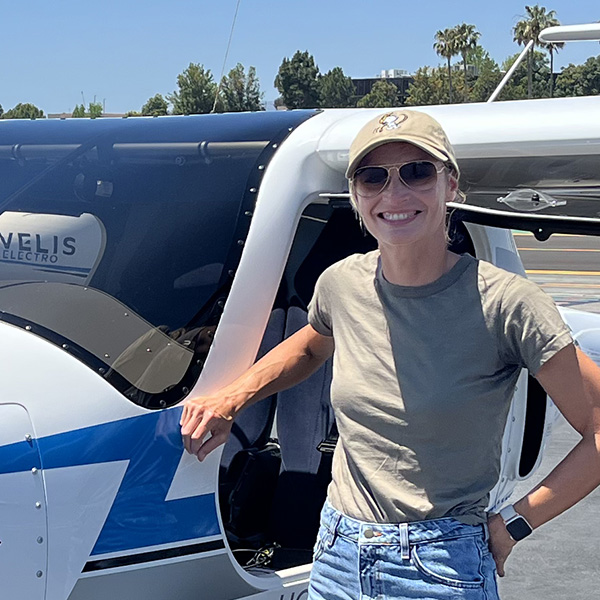
Musacchio has accumulated about 85 flight hours while pursuing her private pilot certificate. Her training was interrupted for six years because of medical certification issues. She returned to flying about a year ago, but with several films in production, "I'm just going to take the pressure off," she said.
For now, she is enjoying flight her way, making films, and spending time with people who share her interest in aviation. "I think what I found are my people," she said. She has attended EAA AirVenture Oshkosh for decades and continues a tradition of sharing accommodations that began when her mother traveled there with women who served as Women Airforce Service Pilots during World War II. "What attracts me to a lot of these historical women figures is just how tough they were," she said.
Rather than wait for a traditional film festival to accept the documentary, Musacchio decided to bring the film to the people who helped make it possible. "Pilots care about what I'm doing," she said. "These guys rebuilt this airplane; they care about what I'm doing and their friends. So, we're going to have a premiere at their hangar."
One project remains especially personal. River of Flight explores her grandmother's relationship with Brooks and their years flying around Detroit. Musacchio has researched Brooks's work with Ford, worked with The Henry Ford museum, and filmed aerial footage of the Rouge River near her family's former property. She has assembled several versions of the film, but none has felt complete. "When the story's ready, it's going to come together."
Jenny premieres November 6 at Poplar Grove Airport. More information about the film is available online.
Related Articles


