Is it time to end the VMC demo?
Too many pilots have died
By Doug Rozendaal
“Over the last decade...the most common fatal Baron/Travel Air scenario was loss of control in flight (LOC-I) in an attempted VMC demonstration during the conduct of dual instruction or, in one case, with a pilot examiner during a practical test.”—Tom Turner, executive director of the ABS Air Safety Foundation
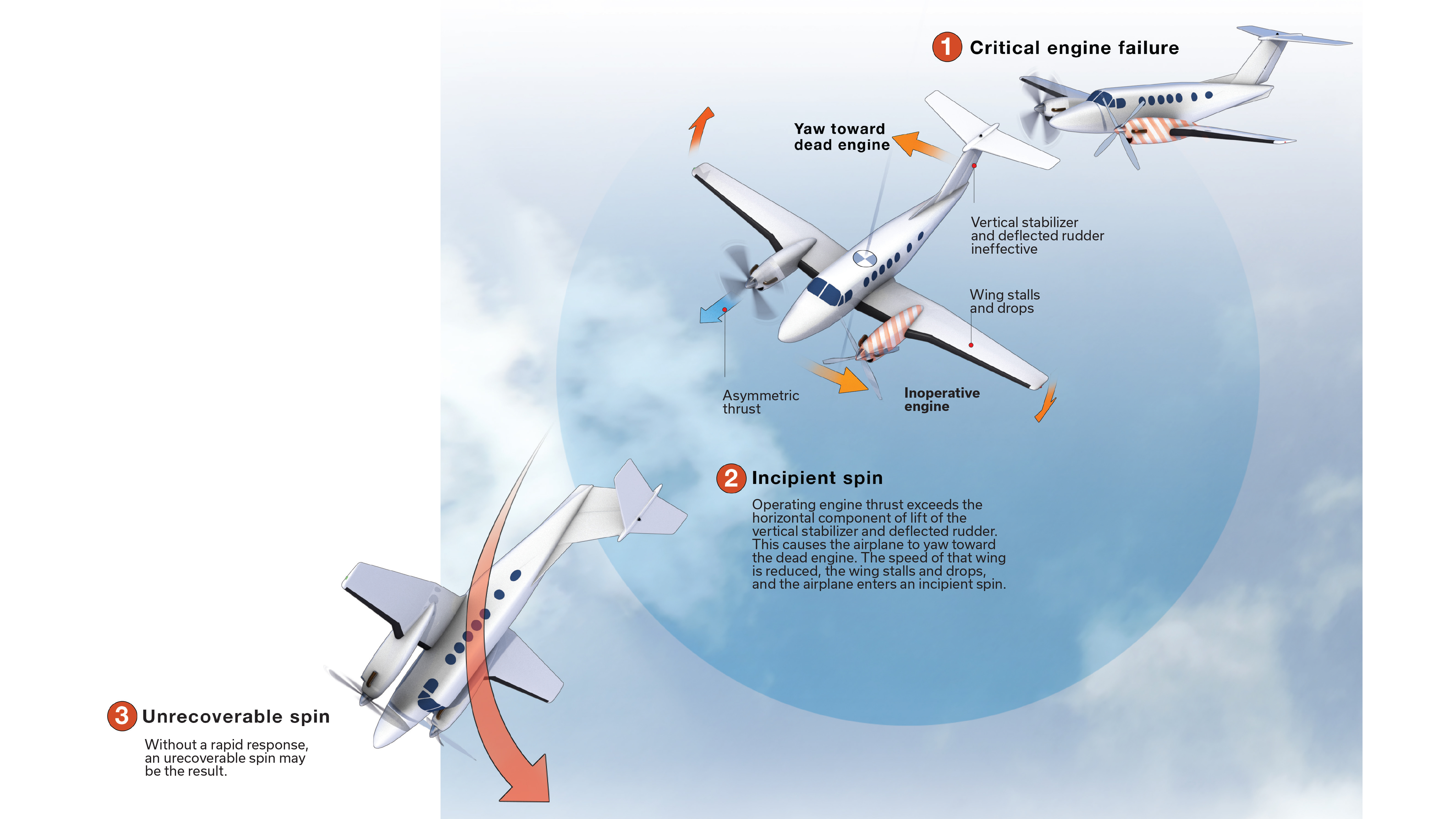
As a Baron owner, instructor, and recently retired multiengine examiner with nearly 20 years of experience, that struck me as a powerful statement. Turner’s words, recent accidents, and a full-up VMC departure I experienced during a Piper Twin Comanche checkride might suggest there is room for safety improvement in multiengine training and operation.
In 1949, the Civil Aeronautics Administration (CAA) determined that spin training was costing more lives than it was saving and deleted it from training and testing requirements for all but the initial CFI certificate. While that decision was hotly debated for many years, it seems that time has tempered the discussion. Although it is difficult to precisely quantify the impact of that policy change on accident rates, most now agree it was the correct move.
The reasoning in 1949 likely centered on the fact that students, instructors, and examiners were being killed during the training itself. A better approach involves teaching students that entering a spin close to the ground is almost certainly fatal, thereby instilling a healthy respect for, and to avoid conditions that lead to, spins.
If VMC training is the most common cause of fatal accidents and, even with the training, pilots are still having VMC accidents, something needs to change. I believe VMC training should go the way of spins, remaining in the syllabus only for multiengine instructor candidates.
The reality of VMC
The FAA defines minimum control speed with critical engine inoperative (VMC) as the calibrated airspeed at which a multiengine aircraft can be controlled and straight flight maintained following the sudden failure of the critical engine, assuming maximum takeoff power, a 5-degree bank, and an aft center of gravity.
This describes very specific criteria for VMC. Because this speed is marked as a red radial on the airspeed indicator, many students memorize it as a fixed, universal speed. In reality, a VMC event can occur at speeds much higher, or lower, than the red radial depending on variables like density altitude, weight, and configuration. A dynamic change in speed, heading, pitch, or rudder deflection can significantly impact the speed at which the airplane departs controlled flight.
Archilochus noted in the seventh century B.C. that people do not rise to the occasion, but rather fall to the level of their training. Good initial and recurrent training in multiengine airplanes is essential. I believe that teaching VMC respect and avoidance in the classroom, just as with spins, and teaching in the airplane to maintain VYSE at all costs, will reduce accidents and save lives.This concept goes far beyond the “SMACFUM” acronym that many examiners require students to recite. A thorough understanding of VMC dynamics is well beyond what is expected of a low-time multiengine student or even a multiengine instructor. Rote learning breeds a false confidence that as long as the airspeed is above the red radial, VMC is not a concern. VMC departures and asymmetric power-on stalls are closely related. If one occurs, it is almost always followed by the other, and this means that incorrect or abrupt rudder, or elevator, application can cause a departure well above the memorized speed.
Negative transfer of learning

The VMC demo prescribed in the airmen certification standards (ACS) is typically performed in a low-performance trainer with a large vertical stabilizer and naturally aspirated engines. Because full rated power is not available at a safe altitude, or the altitude prescribed in the pilot’s operating handbook, to conduct VMC demonstrations, the actual VMC speed is significantly reduced, often below stall speed. Then the “demo” often results in little more than a chirping stall horn before a simple recovery is initiated. There is no yaw, no roll, and no awareness of the impending danger of an asymmetric power-on stall.
This is textbook negative transfer of learning. The student perceives that VMC is not dangerous, “no big deal.” When that student transitions to a high-performance aircraft where VMC can be violent, a really big deal, they are unprepared. Stalls with asymmetric power are prohibited in nearly all light twins, yet the VMC demo is essentially an approach to an asymmetric power-on stall.
Flying well below the “blue line” (VYSE) creates a false sense of security. Multiengine training should be laser focused on, and strongly reinforce, that the only time it is acceptable to be below VYSE is during stall training with symmetric power or when a landing is assured and out of the clouds in visual conditions.
A simplified approach to safety
VMC accidents do not just happen in training. Loss of control too often occurs while flying to the airport following an actual engine failure. Both can be avoided by simply lowering the nose anytime the airspeed falls below VYSE. This should be the primary emphasis of one engine inoperative (OEI) training.
Human instinct often causes a pilot to pull back on the yoke if the airplane is not climbing, but this is the wrong response. Many light twins will not climb on one engine; the only alternative is to lower the nose and find a safe place to land. Pulling back increases the descent rate and, unchecked, leads to a VMC departure or an asymmetric stall. The result of either can be a snap roll into a spin.
Teaching VMC recoveries in a low-performance trainer does not prepare a pilot for a dynamic event in a high-performance twin or turboprop. A dynamic VMC departure recovery is a spin-prevention maneuver in the incipient phase and cannot be taught safely in a light twin. That type of training requires an aerobatic aircraft.
Archilochus noted in the seventh century B.C. that people do not rise to the occasion, but rather fall to the level of their training. Good initial and recurrent training in multiengine airplanes is essential. I believe that teaching VMC respect and avoidance in the classroom, just as with spins, and teaching in the airplane to maintain VYSE at all costs, will reduce accidents and save lives.
We often say in aviation we want to learn from our mistakes. We should also learn from our successes. Over 70 years ago, the CAA realized that spin training was killing more people than it was saving. Nearly all the reasons for deleting spin training apply directly to VMC training. Is it time to delete the VMC demo and focus on VYSE instead?
Doug Rozendaal is an experienced warbird pilot, multiengine airline transport pilot, single- and multiengine CFI, and CFII.
Related Articles


