The unpredictable way aviation can shape you
Hayley Herberg in general aviation on her own terms
Hayley Herberg didn’t start flying with a career in mind. There was no plan for regionals or majors, no predetermined timeline. She just wanted to fly—for the sake of flying.

A sunset flight from Palm Springs, California, to Santa Barbara in a Cessna 172—what she now calls her "golden flight"—introduced her to general aviation in a way she didn’t know existed. Until then, she hadn’t realized small aircraft were even an option. That introduction gave her a new sense of possibility.
Herberg was hooked, but she chose to finish college before committing fully to aviation. She earned her private pilot certificate, followed by her instrument rating and commercial and multiengine qualifications, and eventually she became a certificated flight instructor. After three years of instruction, she built skill and confidence to follow a path that was right for her. She wasn’t chasing hours just to leave aviation's entry level for the airlines. Community, to her, was just as important as curriculum. She was building time to deepen her place within it.
"I didn't actually want to even work as a pilot," she shared. "I just enjoyed flying."
It turned out she also loved teaching. Her approach to instruction reflected how she had been trained herself. Herberg learned using paper charts and traditional navigation methods before transitioning to advanced avionics. She believes there's a place for technology—but only after pilots learn the fundamentals.
Much of her flying took place in Diamond airplanes. She trained and instructed in the DA40 and DA42 and later expanded her experience into the DA20, DA50, and DA62. Flying across the Diamond spectrum gave her fluency and a deep understanding of the aircraft: how they fly, how they're built, and how their safety‑driven design translates into flying.
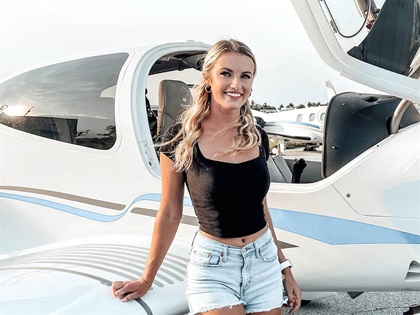
Eventually, a door opened she hadn't anticipated. A simple Instagram post—a photo of her standing in front of a DA40—caught the attention of Premier Aircraft, a Diamond distributor. One direct message turned into a role. She became the company's marketing lead and later a Diamond ambassador.
"It's funny how one DM can change everything," she said.
By the time these opportunities emerged, Herberg had already begun shifting her focus. While she continues to fly, she dedicates much of her energy to storytelling, using platforms like her Instagram, Fly With Hayley, and her YouTube with the same handle to promote GA not as a steppingstone, but as an end in itself.
Herberg's career is not organized around urgency or hierarchy, but around skill, curiosity, and independence. She didn't use aviation to narrow her options; she expanded them. And when she sets her mind to something, she follows through.
For Herberg, that meant ownership.
She knew she wanted to own an airplane, and that goal shaped how she approached both time and money. She paid for her flight training herself, studied independently, and built time efficiently—often flying with friends instead of renting.
After several years of saving, she purchased a 1966 Beechcraft Debonair 35-C33A, a high-performance, conventional-tail aircraft powered by a 285-horsepower Continental IO-520-B engine.
Ownership brought a new level of responsibility. "You learn so much from owning an airplane," she said. "You have to maintain it, care for it, know all its systems." Maintenance decisions, systems knowledge, and financial planning became part of her daily thinking. But ownership also delivered what she had been building toward from the beginning—freedom.
With her Debonair, trips that once required hours on the road became short hops. The airplane wasn't just a milestone; it marked a shift in how she experienced aviation. Still, she emphasizes that ownership—and progression into higher‑performance aircraft—requires patience and preparation.
Before buying the Debonair, she had already gained experience in faster, more complex aircraft, including multiengine airplanes. Higher-performance aircraft increase workload and demand more precise decision making.
Today, based near Lake Tahoe in Nevada, she continues to expand her flying through mountain operations and tailwheel experience, with plans to add a seaplane rating next.
She exemplifies the reality that not every pilot is building toward the same destination. "I never want flying to become something I resent," she said. She encourages pilots early in their training to see hours not just as a requirement to be met, but as a tool—one that can shape a specific outcome, whether that's the airlines or a more individualized path in aviation.
In Herberg's case, those hours led to an airplane of her own, a role within the industry, and a flying life built on her own terms.
Related Articles


