Backcountry flying experience
Floats and tailwheel in Montana
Backcountry Flying Experience in Kalispell, Montana, is one part of a trio of unique operators offering seaplane training in a place few people readily associate with float flying—the Rocky Mountain West. But this hidden gem deserves to be on the seaplane radar, because float flying in northern Montana is truly spectacular.
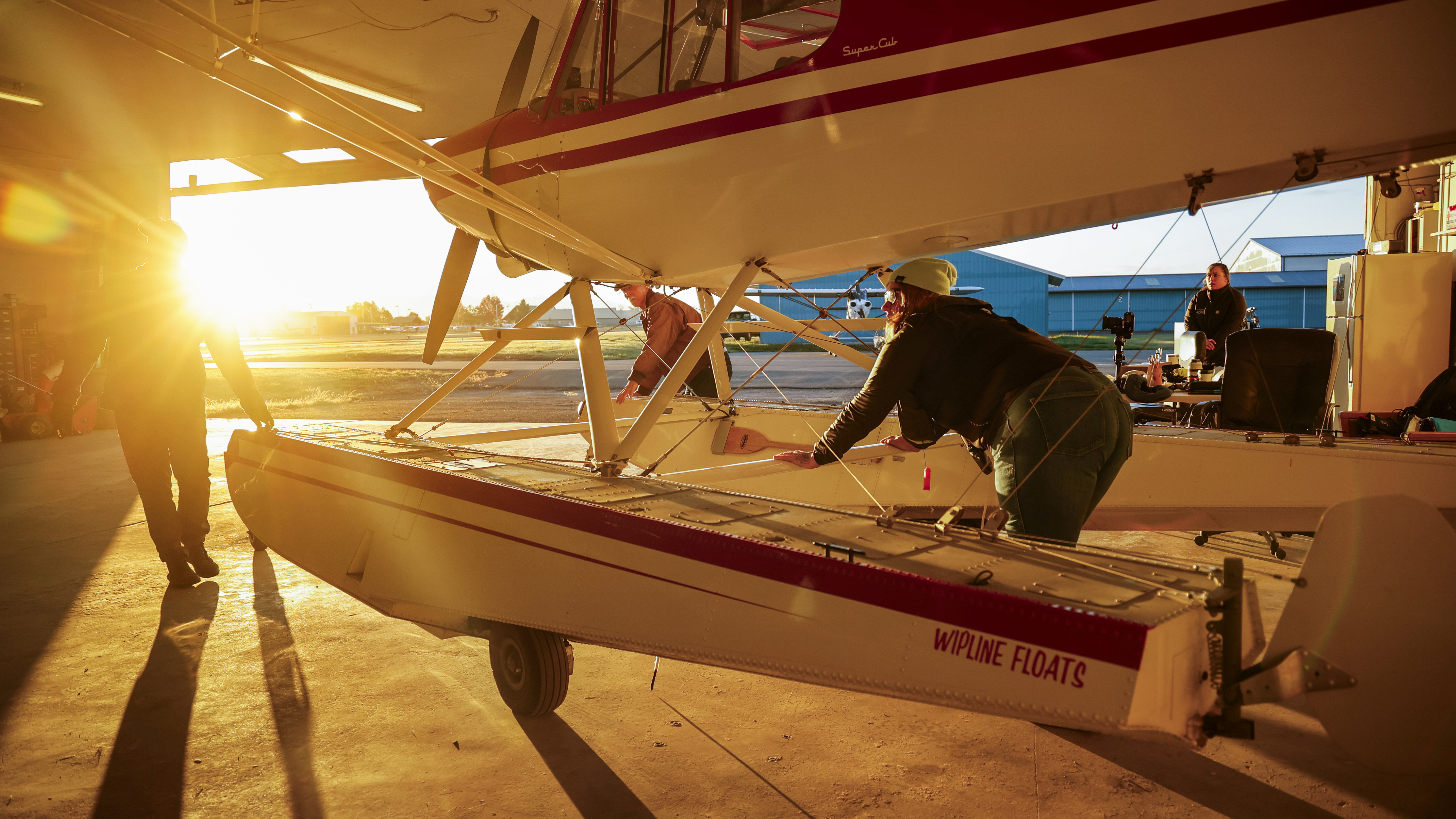
We meet at Backcountry’s hangar at the Kalispell City Airport (S27) on a crisp morning, wisps of fog ringing the hills and blanketing Flathead Lake to the south. In addition to its bread-and-butter seaplane training, Backcountry offers tailwheel and land-based backcountry flying as well as air tours. CFI Beth Steele; owner, CFI, and experienced seaplane pilot Terry Hayes; and chief pilot Jeff Scholl prepare the fleet for the day. Tom Allen, the tailwheel expert and another key part of the team, is out with a student who has flown in from Japan for his annual training visit. With Kalispell not terribly convenient to get to from anywhere, even in the continental United States, that’s quite an endorsement.
Today, Steele and I will be flying in the company’s classic white and red Piper Super Cub on amphibious floats. She came to aviation at a young age, but only recently decided to follow the path professionally as a CFI, and almost all her dual-given hours are singleengine sea.
“My first introduction to general aviation was as a 6-year-old. My grandpa took me flying, and he did that every year for my birthday,” she says. “And then I started flying when I was 29 and got my pilot’s license.”
She started out as a recreational pilot and then decided to take it up a notch, pursuing more ratings and purchasing a Taylorcraft three years ago.
“Eventually, I was like, oh, it’d be really nice to make money doing that as opposed to the engineering job I was doing. So, I changed careers and worked fairly hard to get my CFI. It took me a while to do it. I built hours in my Taylorcraft and, ultimately [earned my CFI certificate] in a 172. And then while I was doing that, I met Terry and Tom, and they got me involved with Backcountry.”
Steele grew up in Kalispell and loves sharing the Flathead Valley with her students. I earned my commercial single-engine sea certificate a few years ago, but like most of us, haven’t used the rating much since the checkride. Airplanes and folks from the sister companies will also come out to play—Parkwater’s Daher Kodiak on amphibs (“Taming the Kodiak,” February 2026 AOPA Pilot Turbine Edition) and Coeur d’Alene’s CubCrafters XCub on amphibs. My goal for today is, therefore, to knock some of the rust off and enjoy the experience of flying with someone new, in a new place, in a new-to-me configuration of the beloved Super Cub.


Blue for water
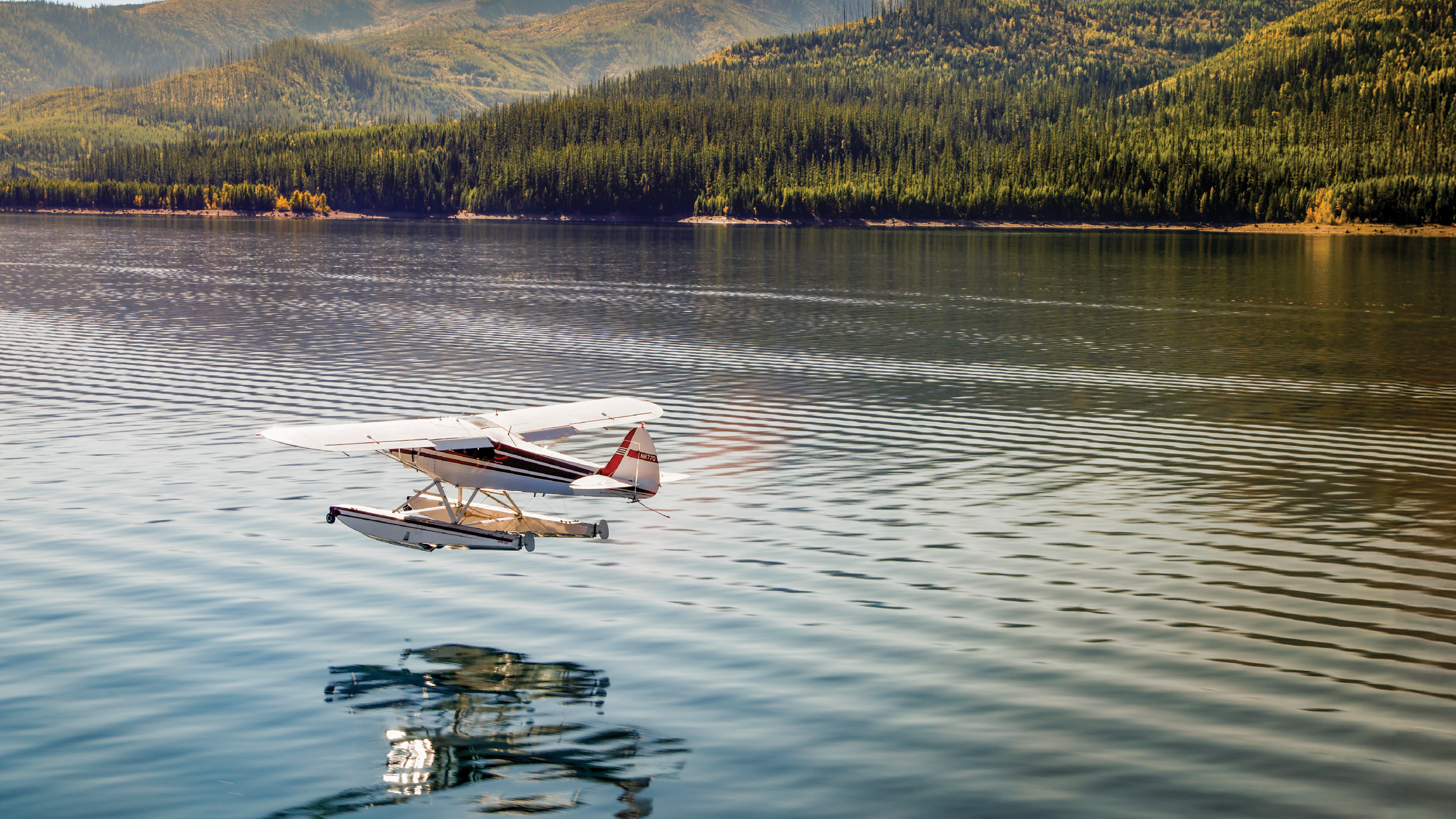
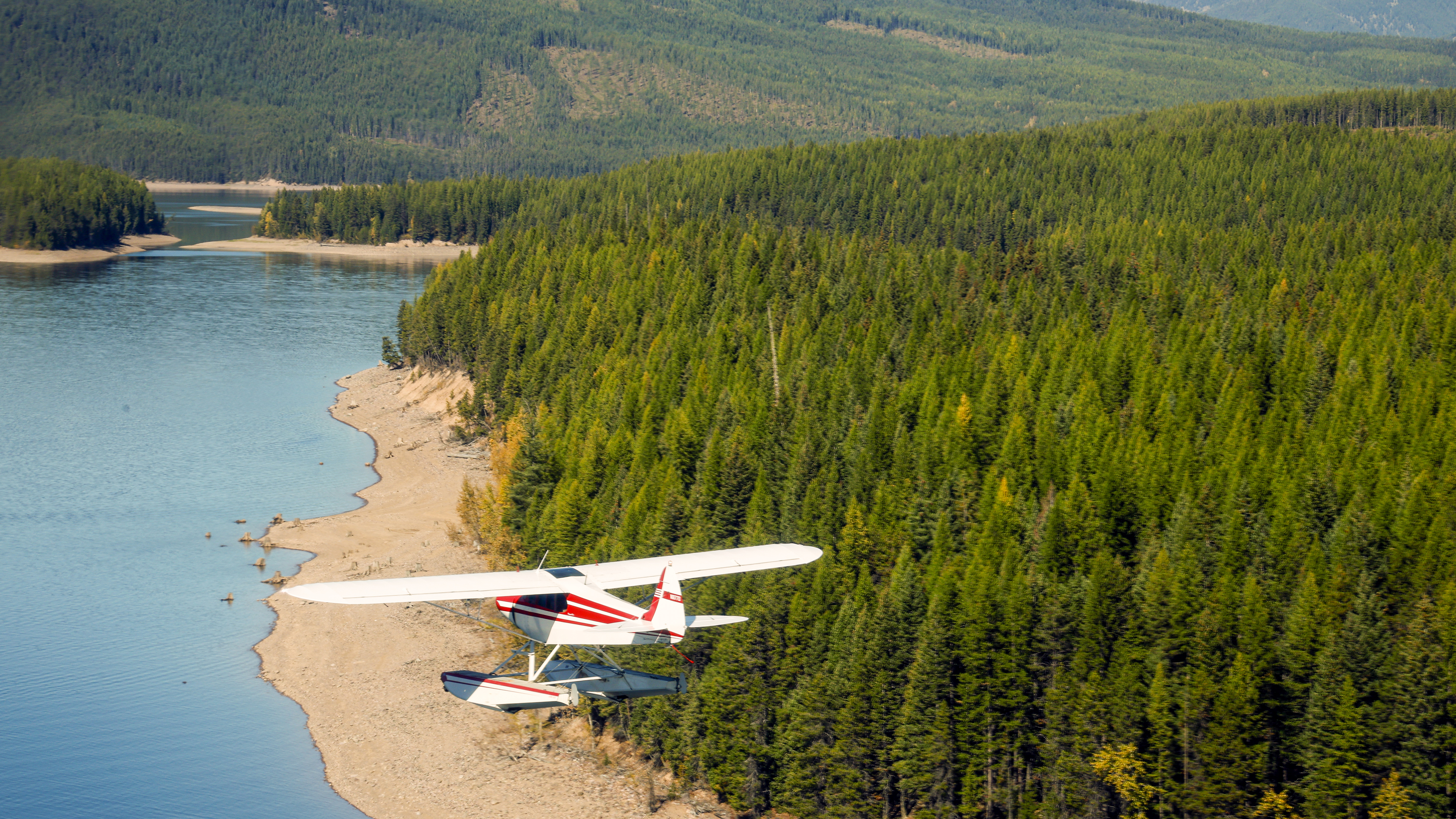
The Super Cub keeps me honest right away; the extra drag from the amphibs magnifying any uncoordinated flight. Even before we’re over the water, the view is incredible. Flathead Lake is to our right. The mist is now clear, revealing a shore lined with varying mountains and flatlands. Ahead of us is the Swan Range, which climbs up to more than 7,500 feet, evergreen peaks against a crystal-clear deep lapis blue, living up to Montana’s nickname, Big Sky Country. Canada is less than a cross-country away to the north. You only get your seaplane rating once, and it boggles the mind that anyone would choose not to earn theirs in a place of diverse beauty like this.
We hop over the Swan Range and start a descent for the water. Hungry Horse Reservoir is just about the perfect seaplane playground, with water that’s variably wide open and confined, glassy and textured, deep and shallow, and just a few short minutes from Kalispell City. Steele calls parts of it “stump city,” because of the still visible stumps of the trees that were cut down before the damming of the valley.
All seaplane flying on water is technically off airport, but being surrounded by mountains solidifies that feeling. But in land-based backcountry flying, the runway is typically set. In seaplane flying, everything’s up to you—where to land, at what angle, in what water, facing what direction. Seaplane flying introduces so much choice that it can be overwhelming to students who are used to being told where to go and when; the lack of constraints giving too many choices, too many ways to make a mistake, sometimes leaving newcomers paralyzed by indecision.
Since you can choose your own runway direction, especially on open bodies of water like this reservoir, you always want to land as much into the wind as possible, just like on land. There are no windsocks out here, no ATIS, but the environment tells you what you need to know if you know how to read it. Look at the texture, look at the trees. Find signs to see which way the wind is flowing and know the typical local patterns. Smoke, flags, anchored boats all help, but here at the reservoir, there’s none of that, just the signs on the surface. Being able to better read the weather is a skill that benefits pilots no matter what type of operating environment they’re in.
Conveniently, the wind seems to favor an approach parallel to the shore, which helps give us a frame of reference for landing. I set us up and slow down a little, forgetting just how draggy those floats make an already slow airplane once you take the power back. Steele helps me correct, and we touch down fairly smoothly. If there’s one thing I’d forgotten, it was just how quickly you slow down in a floatplane once you land on the water. We settle and float on, then follow the shape of the reservoir north and practice some more.
The cold air and intense sun of higher elevations morphs into a summer day by the early afternoon, and we’re all shedding layers before we hop over to Whitefish Lake for lunch. We skirt the edge of Glacier Park International Airport’s (GPI) airspace, remaining outside and away from the need for towered ops, a reminder of how close we are to civilization even though Hungry Horse felt very far away.
On our way to Whitefish, the distinct bare peaks of Glacier National Park rise in the distance, the edge of what the Blackfeet call the Backbone of the World. The ice-gouged valleys are so cleanly formed and deliberate in some areas that they look as if they could have been chiseled by hand.
I’m glad we dusted off the float skills first at Hungry Horse because our lunch spot at Whitefish is just that bit different to present a reasonable challenge. Despite a forecast that called for wind, we’re greeted with nearly glassy water and a semi-confined approach over the trees, a fun combo of the landing type that needs the most space in conditions where you have the least. We touch down a moment before I anticipated, which is startling, but Steele reminds me to just ride it out and keep the stick all the way back as we get rid of the slight power we carried to cope with the glass. As long as you keep the front of the floats from digging in, most landings are good landings.
The rest of the crew beat us to the dock (Super Cubs!), and Terry catches our wing before we climb out onto one of Backcountry’s favorite stops, the Lodge at Whitefish Lake. Crystal clear and idyllic, the only changes are the ribbons of refracted light in any boat’s wake. My only regret of the day is not bringing a swimsuit or change of clothes in the backseat of the seaplane for a dip in Whitefish Lake, which I suspect is a seaplane pilot rookie mistake.
Green for grass
The Backcountry experience wouldn’t be complete without some wheel flying. The next morning, we all hop over to an introductory grass strip at the Ferndale Airfield (53U). This well-manicured, wide field is where Backcountry’s students can get a benign intro to off-pavement ops. I’ll be flying with tailwheel guru Tom Allen this time, whose main focus for the day is that we have fun.
On our way to Ferndale, we fly over Backcountry’s original location on the Flathead River, where the company used to operate with straight floats before losing their lease a couple years ago and moving to Kalispell City. Allen misses it and wistfully notes that it feels strange to overfly their old home.
I find it somewhat agonizing to get tailwheel current with cameras rolling. Allen’s approach is gentle, focusing on using just enough control to get the airplane to do what you want and no more. He notes that he gets a lot of students who have watched a little too much YouTube, and that dramatic, showy overcontrolling is something he regularly has to teach out of folks. His straightforward, stripped-down approach to teaching tailwheel makes it seem even more accessible than normal, and we hop around the pattern enough to get current and feel good about it.
“Is the fun meter in the green?” he asks. Tom, it has been in the green nonstop for the past two days. And by the time we’re done, I can say confidently that two days is not enough. A minimum of one week is what I would recommend. Or a lifetime. We all take a break around the airplanes and chat.


By this point we all know that any workplace that says they’re “like a family” is a red flag, but in the most green flag way, Backcountry really does feel like one. One of the coolest things about Backcountry is that everyone seems truly happy to be there. Terry, Jeff, and Tim could have easily insisted on being the only person we fly with, but they want to highlight their youngest CFI instead, Steele. No one’s counting every click of the Hobbs, eager to get an app in and peace out. They take the craft of flight instruction seriously, and they’re happy to guide and mold the students they get, aware of the effect their teaching will have on a pilot’s life beyond the training they do here. All that to say, the time you get with them is quality time. Steele, who one might assume by her young age would be rushing to the magic number, is in no hurry to leave her hometown and the sweet gig she’s got at Backcountry, working with people who want to see her succeed and give her the tools and trust to do so.
“There’s a weightlessness that happens when you fly,” she says. “You can’t necessarily let the other things in from the world. And so there’s like a really deep focus that happens. And then also there’s just like a freedom that happens, especially in Montana.”
“There have been so many sunset flights that I’ve had where there’s no one on the radio, it’s just me and my little lawnmower of an engine just ripping around and that freedom. And the focus is such a wonderful combination. It’s my favorite part of flying.”
Related Articles


