Tube-type tires
A simple inflation solution
At some point in your flight training—if for no other reason than for your checkride—you might have learned that your aircrafts tires are “tubed.”
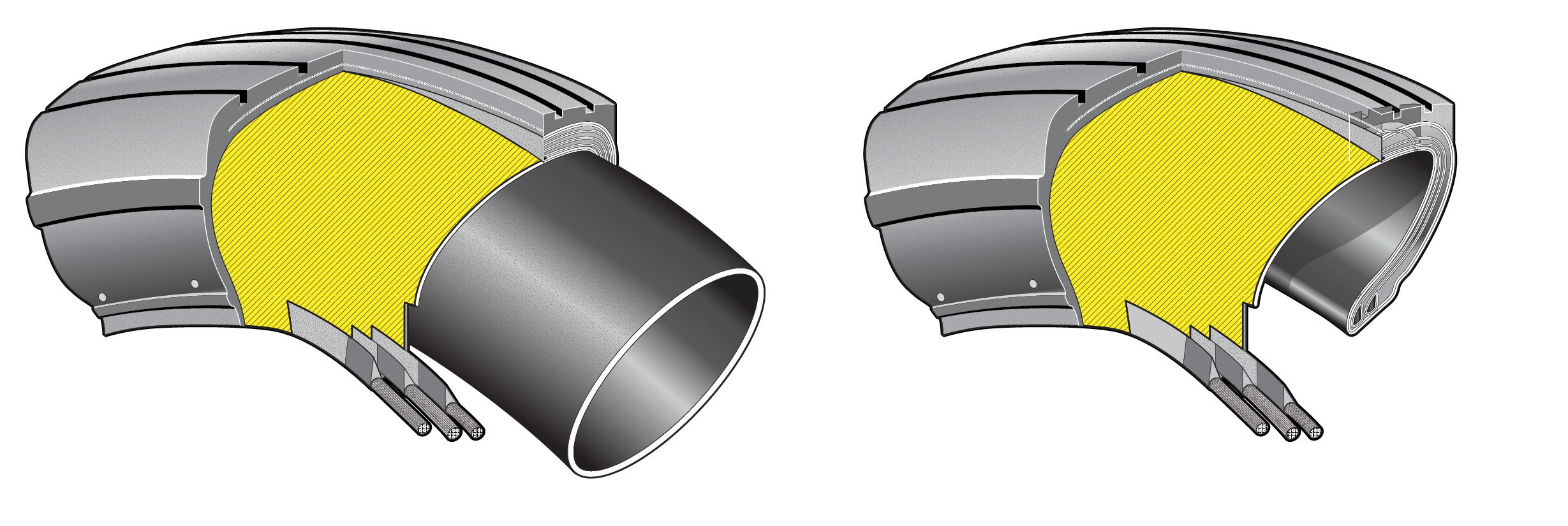
Tube-type tire (left)
The inner tube of a tube-type tire adds some weight, but the ability to replace just the tube is attractive to some owners.
Tubeless tire (right)
Many manuals also allow the option of tubeless tires, and the cross-section shows a whole lot less material involved. The weight savings can be attractive in situations where every pound counts.
Illustration by Steve Karp
A large proportion of light general aviation aircraft owners opt for a tube-type tire. The easiest way to think about a tubed tire is to imagine a balloon inside the tire as the part that maintains the tire’s pressure. When you go to inflate it, you’re inflating the inner tube (balloon), and the tire provides structure and traction, as well as protecting the inside balloon. Most other tires (and conventional car tires) are tubeless, which means when you inflate them, you are inflating the tire itself; the air pressure is acting directly on the tire casing and wheel rim.
Aviation tires face unique challenges, including rapid spin-up, high loads, temperature swings, backcountry gravel, and more. With a tube, the tire air retention is independent of the tire bead seal (where the tire connects to the rim). If the tire shifts slightly off the rim during a side-loaded slam-and-go, it’s less likely that tire will lose pressure, let alone immediately. Likewise, a small puncture or damage is less likely to cause rapid deflation, and more likely to result in a slower leak.
Most aircraft tires also use split rims, which are basically two-part wheels (namely for easier changing of tires and service). Because tubeless tires are inflated directly against the rim, the bead seal must be perfect, which is harder to achieve with split rims. Tubes do not suffer from that problem because the tube’s inflation is independent of the bead seal.
From a cost perspective, tube prices have been trending up and the long-standing cost benefit offered by tubed tires is pushing many GA owners to tubeless tires.
The reason you won’t find tubed tires as commonly in jets and higher gross weight aircraft is because tubed tires are heavier (a Boeing 737NG’s main tires are already 44.5 inches in diameter, and there are four mains and two nose tires) and saving weight makes airline flights more efficient.



.jpg?mw=650&mh=366&as=1&hash=73D217D9DBE526082C1DAAD9CF28B5C7)