King of the hill
Montana's Sky Ranch community
It reads like an old western: Several men meet in a bar and hatch an idea, and soon “checks are flying across the table.” That’s Bill Paulin’s recollection of how the Sky Ranch community started outside of Flathead Lake in northwest Montana.
Sky Ranch Airport (MT95)
Private airport community 12 miles southeast of Glacier Park International Airport (GPI). Flathead Lake is just a short hop at the end of the north/south runway, and Glacier National Park (West Glacier entrance) is 42 miles to the northwest.
Runway 16/34: 5,000-feet long grass runway north to south, 120 feet wide
Elevation: 2,905 feet
CTAF: 122.9 MHz
Established: 1991
Price range: $375,000 to $1.2 million
HOA: $550/year per lot
• All plans for any structure or fence must be approved by the HOA committee before construction starts
• No lot is less than five acres
• 66 established lots
• Two horses or two llamas per five acres
• Eight chickens, no roosters
Flathead Lake Sky Ranch
395 Manning Road
Kalispell, Montana 59901
 flatheadlakeskyranch.com
Paulin, a pilot since he was a teen but a banker by trade, had always wanted to live in a fly-in community and found a large piece of acreage near his home in Kalispell. “As is typical in Montana, we went to a bar and I told these guys they needed to give me some money,” he says. “So, I had the money, and I got a call from a friend who owned a piece of property. He says, ‘Bill, I hear you’re looking for land in the Lower Valley,’ which was different from the property I’d told the other guys about. I wrote him a check from my personal account, and I did a switch on those guys, but not a word was said. It was just go with it. Most built a home here, although I was the first.”
The property appealed to Paulin because there was a mile-long grass runway that, to the south, took off over Flathead Lake, the largest natural lake in northwest Montana at more than 197 square miles. Kalispell is rimmed with the mountains Montana is famous for, but this section, at 320 acres, is completely flat. The Flathead area is named for the Native Salish people. While some tribes practiced infant head shaping, a tradition with deep cultural significance and often misunderstood by early European settlers, the region more likely derives its name from a misinterpretation of early Native American sign language.
Ironically—or strategically—Paulin, as the first homebuilder, excavated his lot to create a hillside that his home is built into. His hangar—designed initially to house his Beech 18—is on the bottom of the hillside, its T-shape designed to accommodate the wings of the brawny Beech. A friend from high school designed the hangar, with input from his daughter who proposed the dormers on either side mimic the wings of the aircraft. “If you look at it right, the garage could be the tail. You’ve got to think a little bit about it,” Paulin says.
He has time to think these days. Retired and no longer flying, he is nonetheless the patriarch of this community. The upper portion of his home is dominated by massive windows that overlook the runway. “I’m king of the hill,” he says.
A rocking chair for his wife and his armchair give new meaning to the joy of front porch sitting. Through his window on the world, he watches the aviation lifestyle his growing number of neighbors enjoy. “This window just takes in the whole view. We have an excellent view of the mountains to the east,” he says. “I’m very thankful for the neighbors. It was slow going at first, but it’s become popular. We went from average quality houses to multimillion dollar houses, which I’m very pleased about. They’re drawing the value of my property up because I have the oldest house here.”
The massive windows overlook the runway. "This window just takes in the whole view. We have an excellent view of the mountains to the east. I'm king of the hill," Bill Paulin says.


Flying out
Within minutes of rotation off Sky Ranch’s Runway 16, we are 100 feet over the northern end of Flathead Lake, headed south in HOA board member Eric Komberec’s Cessna 206. He banks to the right so that we are over the coast where Route 93 traces the lake’s west edges, around charming towns and up mountainsides, and along islands such as Wild Horse Island, a tall-sided bump in the water that must keep the remaining horses in good shape (only five horses left there today, Komberec tells us). It’s the largest of the dozen islands that dot the lake. Komberec points out the Mission Mountains, for which his company Mission Mountain Flying Service is named. He also shows us Melita Island, which is the site of a Scout camp and a bald eagle reserve.
It’s a big blue sky Montana day and—cliché alert—we can see for miles. Komberec continues as our unofficial tour guide, and it is clear this Montana local loves his home. He shows us the area of Bigfork, where the river enters the lake, and where he and his family lived before moving to Sky Ranch 10 years ago. He tells us of the great fishing on the river, of bull and cutthroat trout and whitefish, and the spectacular sunsets on the river his family enjoyed.


“I always had a dream since I was a kid to live on this airstrip,” he says. “I started up instructing when I was 18. Eventually as our hard work paid off, I was able to buy a house here and settle here with my family and raise my kids. When we moved here, we had a 50-by-50 hangar with a bathroom and living quarters above it. We’ve now got pretty much, for the pilot, what I think is the perfect setup. I am able to walk out of my kitchen, across my front yard, and into my office in my hangar and go play with my airplanes.”
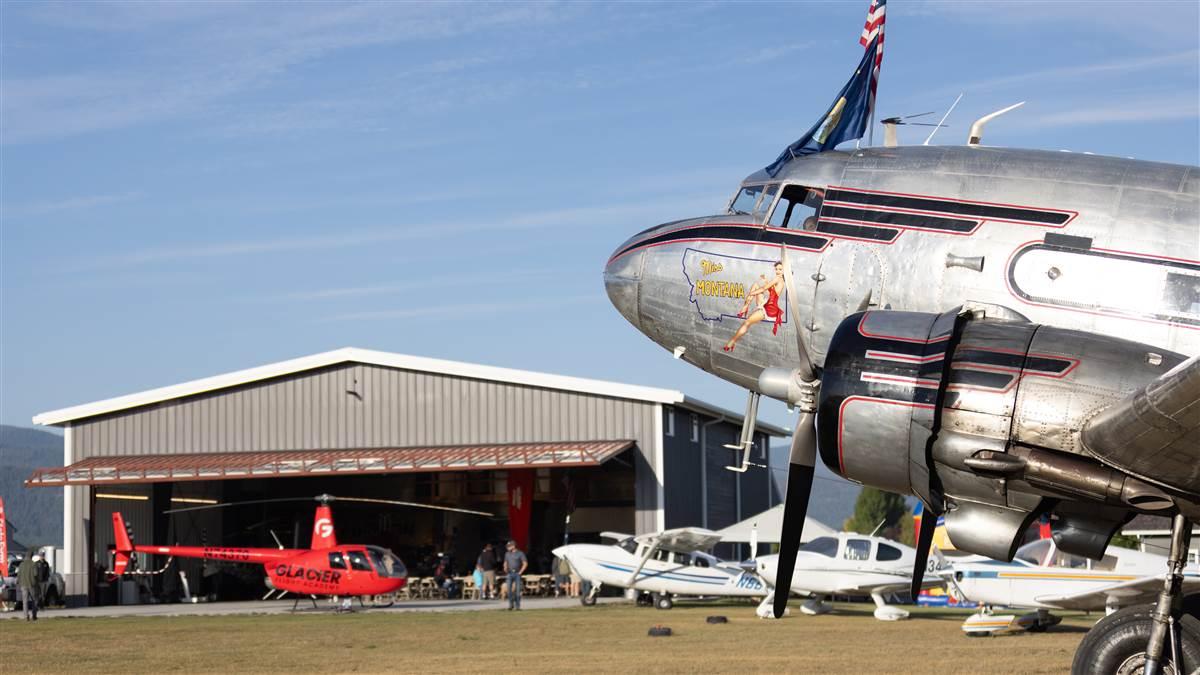
And what aircraft he has. In addition to the original hangar, he now has a 70-by-70 hangar with office apartments upstairs and a bathroom and a shower. Housed here and in hangars in nearby Missoula (nearby is a relative term when you’re in Montana; it’s a 45-minute flight in the 206 but a three-hour drive; aircraft serve as cars in this area of the country) are three 206s, two 172s, a Piper Lance and Piper Cherokee; three helicopters—an R44, Bell 47, and Jet Ranger; and his antiques—a Stinson, Piper J–3 Cub, Taylorcraft, Fairchild F–24, and a Travel Air. He also owns a turbine Commander. Most all are working airplanes; his company offers scenic tours, charter services, and contract and survey services for U.S. Fish and Wildlife and the U.S. Forest Service. He stepped in for his father, who started the Museum of Flying in Missoula, and with pilot Bryan Douglass and other volunteers restored a 1944 Douglas DC–3, Miss Montana.


Fly-in
We leave the 206 in Missoula and fly back to Sky Ranch in Miss Montana, Douglass and Komberec in the cockpit and AOPA photographer Rebecca Boone and I sliding around in the back (see “Flying in Miss Montana,” below). The longest part of the flight is the warmup, getting that old gal’s oil heated up, but it is the setting sun and the crowd when we land at Sky Ranch that lingers. We do a pass over the airstrip where friends and family have been preparing the field for the next day’s annual fly-in, and the assembled cheerleaders hold the lights from their phones up like we’re at a Springsteen concert. And everyone hollers and claps when we disembark.
Komberec’s hangar will serve as the meeting place and breakfast spot for the fly-in. The community has been hosting fly-ins for nearly the full 30 years Sky Ranch has been developed. Many will fly in from across the state, but the residents also pull their aircraft out of their hangars to show off on the flight line. Miss Montana is an attention-getter, but it’s the camaraderie that is at the heart of this community and this day.
Residents and friends started the morning early, brewing the coffee, mixing the pancakes, scrambling the eggs, and sizzling the sausages. All volunteers wear a brown, logoed T-shirt, and all seem to be smiling. It’s clear everyone enjoys one another.


“We did this event to showcase aviation in our community and also help get a museum built at Glacier International Airport [GPI],” says Brandy Grigg, the HOA vice president. “I feel like it was a success because we had a lot of airplanes, a lot of drive-in people, and there was a lot of new faces too. We just like sharing the love of flying and sharing our community. And our hope is that we can attract people who love aviation, pilots, and future neighbors into this community.”
Grigg and her family moved here five years ago, purchasing an existing house and hangar where they keep the family’s helicopter and Cirrus SR22 that her husband Travis uses for his business. Brandy has been flight training in the Cirrus, and the oldest of their three children recently soloed. “What makes it the most amazing is we have neighbors who have ended up becoming our family. Living in a community where you have a flying hobby is pretty cool because then you all have something in common,” she says. “That’s a huge part of why we love where we live.” 
Flying in ‘Miss Montana’


Related Articles


