Pilots recount Chipmunk journey to AirVenture
Women flying warbirds are rare. And seeing two together is nearly unheard of. Yet in July, pilots Katie Mack and Lisa Corker ferried the Canadian Aviation Museum’s de Havilland Chipmunks from Windsor, Ontario, to Oshkosh, Wisconsin, for EAA AirVenture.

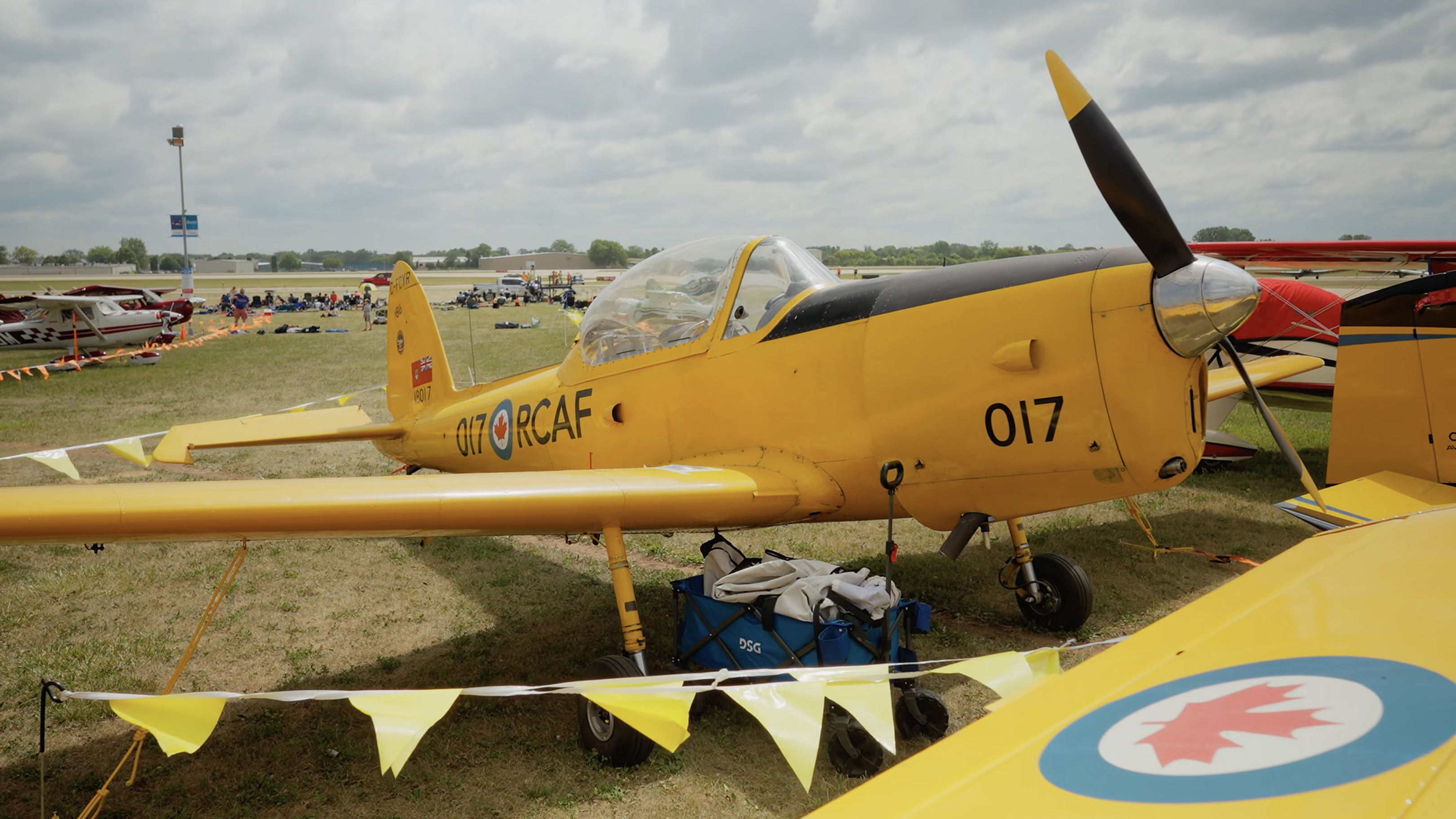
The trip was planned to join a gathering in honor of the Chipmunk's eightieth anniversary. The aircraft, a just-post-World War II trainer intended as a steppingstone to more powerful aircraft such as the North American T–6 Texan, is an eye-catching taildragger that was designed to demand a pilot’s full attention. Deliberately challenging to fly and requiring left rudder rather than right because of the inverted and offset engine turns the propeller counterclockwise (from the pilot's perspective), the two-seat, tandem low-wing is pure stick-and-rudder.
While many pilots flying into AirVenture this year dealt with weather challenges, flying in a bare-bones vintage aircraft only added to the challenge for Mack and Corker. Thorne flew his Van’s Aircraft RV–14 in support of the Chipmunks, which have neither reliable radios nor ADS-B (which meant more paperwork in addition to what is typically needed for the border crossing).
The journey to AirVenture began with a quick hop—only six minutes—from Windsor to Detroit, where the flight of three cleared customs.
“And then we got stuck there for an hour and a half because of weather,” said Mack. “And then things just kept going like that, we had to divert for fuel, we had to divert for weather, but we made it around 5.30 p.m. on Saturday, so it was a long day.”


Stronger than normal headwinds forced the fuel diversion, and deteriorating visibility caused by the Canadian wildfire smoke led to the second. Oppressive heat combined with the bubble canopies had the pilots operating in temperatures over 100 degrees Fahrenheit. The conditions were less than ideal, and at the last stop before Wittman Regional Airport, Thorne considered calling off the flight.
“I actually had a crewmember with me who's a student pilot who was helping out. He bailed on the last stop,” said Thorne. “He's like, I'm done. He was motion sick. He [had] heat stroke. It was exhausting. We were sweating because we were low level, hot, going slow. So my engine was cooking. I was cooking. It was very uncomfortable. And honestly, on the final stop when he bailed, I was talking to Katie and Lisa like, I have a three-strike rule for flying. We're getting close to the third strike here because of how many things we're up against.”
Mack and Corker convinced Thorne to give it a shot after some cooling down, and they continued without problem to the Warbird Arrival.
“I think that was one of the most fun parts because we knew we were in,” said Mack. “Because by that point, it's like, all we have to do is wait for the landing clearance and we're in. Before that, we just didn't know if we were going to make it. Because we had the diversions, we had the weather, the smoke was coming in, and we knew if we didn't get here early enough, we would get stopped by the smoke. And when we landed, it was within half an hour that the field shut down because of the smoke. Visibility got too bad. So we were very lucky to have made it.”


“That was a bit surreal, turning final,” said Corker, who previously vowed to never fly into AirVenture after watching Fisk horror stories on YouTube but couldn’t resist the once-in-a-lifetime opportunity to arrive in a Chipmunk. “Realizing as I'm seeing like all the planes just appearing and that … in the distance through the smoke, I am about to land on the yellow dot in a yellow Chipmunk at Oshkosh on the eightieth anniversary. How did I end up here? I'm so happy about it.”
“It was tough,” said Thorne. “I felt like it was a rewarding trip to do. And I really enjoyed watching Katie and Lisa crush it.”
After landing, the Chipmunks and RV–14 parked across from the International Aerobatic Club booth, where, along with a support team that drove in from the museum, the pilots chatted about the airplanes and sold merchandise all week. The Chipmunks are also capable aerobatic airplanes, and Mack, who has started her aerobatic training, hopes to eventually fly the primary sequence in a Chipmunk—though the specialized instruction required for aerobatic training in a Chipmunk is challenging to arrange.
“It's amazing,” said Mack. “You know, these planes, they're historic, you know, and they're part of Royal Canadian Air Force history. But they're also just very, very good airplanes. They're very stable. They fly great. They're a joy to fly. They're really lovely. I mean, they're bare bones, but you get that feeling where you really know what the plane is doing. You really feel everything. It's kind of like driving a manual transmission car on a windy road. Like you have to feel it, right? And you do that in the Chipmunk.”
Learn more about the Canadian Aviation Museum and book a ride in a Chipmunk online.

Related Articles


